Use case
Build Reliable No-Code AI Workflows (2026)
A vendor-neutral method for designing, testing, approving, monitoring, and scaling no-code AI workflows across business applications.
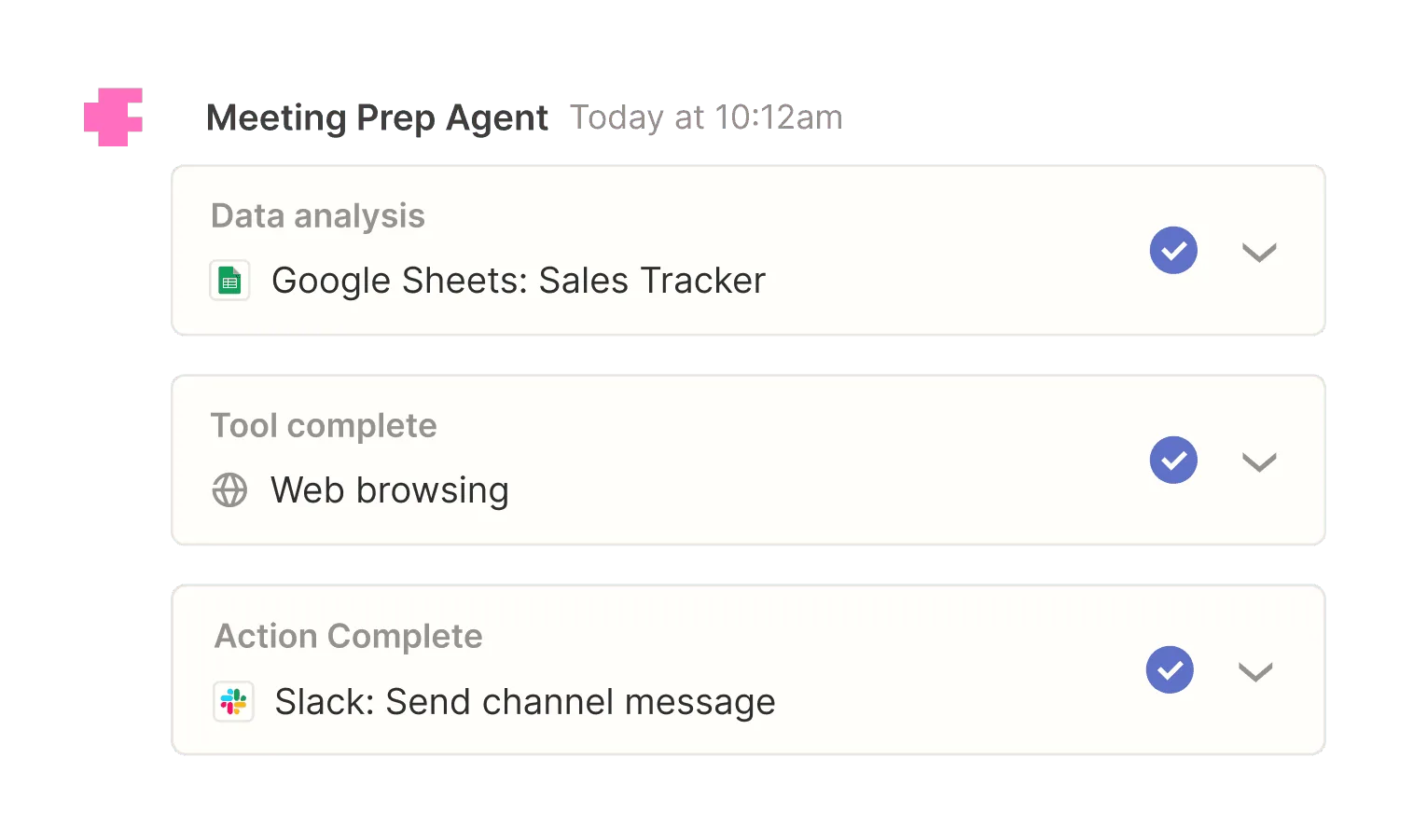
A no-code AI workflow becomes production software the moment it can email a customer, edit a CRM record, approve an invoice, or expose company data. The canvas may look friendlier than code, but the engineering questions remain: What triggers it? What schema enters and leaves each step? What happens twice? Who approves risky actions? How do you know it failed?
Build one narrow workflow around those questions before shopping for an all-purpose “AI employee.”
The 2026 AI workflow automation shortlist compares the platforms. This guide covers the design and operating controls that remain necessary whichever builder you choose.
Pick a workflow with a crisp finish line
Good first projects are frequent, reversible, and easy to check: classify an inbound request, extract invoice fields into a draft, summarize a call into a review queue, or enrich a lead before routing it. Avoid starting with a workflow that can send money, delete records, or communicate publicly without review.
Write the contract before touching a builder:
| Contract | Example |
|---|---|
| Trigger | New support email in shared inbox |
| Required input | Message ID, sender, subject, body |
| Structured output | Category, urgency, account ID, confidence |
| Side effect | Create a draft ticket; never send a reply |
| Success | Ticket exists and links to source message |
| Failure | Alert owner with run ID and safe retry link |
This makes the tool replaceable. It also prevents a prompt from quietly becoming the business process.
1. Keep deterministic steps deterministic
Use ordinary filters for exact rules: email domain, order value, country, file type, required consent, duplicate ID. Use an AI step only when the input is unstructured or the classification boundary genuinely requires judgment.
Ask the model for a fixed schema rather than prose. Include an allowed enum, a confidence field, and a short evidence span. Validate the output before any downstream action. If parsing fails or confidence falls below the threshold, route to a person instead of prompting the model repeatedly until it invents an answer.
Make suits visual, branching scenarios that need substantial data transformation. Microsoft Power Automate is the natural shortlist for Microsoft 365, SharePoint, Teams, and governed enterprise processes. Both are strongest when the path is largely deterministic and AI is one bounded step.
2. Choose an agent only when the path must vary
An agent earns its place when it must inspect context and choose among several permitted actions—for example, researching an account, deciding which internal source answers a question, then drafting a structured result. Do not use an agent to move the same five fields from one app to another.
Zapier Agents combines agent decisions with Zapier app actions and knowledge sources. Lindy is oriented around AI teammates and multi-step business processes. Relevance AI lets teams build tools and chain them into agents. Gumloop offers a visual canvas that can mix AI nodes, integrations, and browser-oriented work.
Give the agent the minimum tool set. Separate read tools from write tools, restrict selectable destinations, and put approval before every action that sends, updates, or deletes. Zapier’s current guidance supports explicit approval requests and a Human in the Loop action after an Agents step.
3. Build a fixture set before the happy-path demo
Collect 20–50 sanitized examples from the real process. Include normal items plus missing fields, long inputs, unsupported languages, conflicting instructions, duplicate events, prompt-injection text, and records that must be rejected.
For each fixture, define the accepted output or acceptable range. Run the workflow in test mode and save the result, tool calls, cost, and latency. A visual inspection of three successful runs is not a test suite.
Version prompts, schemas, connections, and workflow configuration together. Zapier Agents creates published versions; use comparable draft/publish controls in other platforms where available. Keep a changelog so an accuracy drop can be traced to a prompt or connector change.
4. Design for retries and partial failure
Webhooks retry. Users double-submit. SaaS APIs time out after accepting a request. Every side effect therefore needs an idempotency key, such as source event ID plus action type. Before creating a record, search for that key; on retry, update or return the existing result.
Split long workflows into stages with saved state. If enrichment succeeds and Slack notification fails, retry the notification—not the paid enrichment and CRM write. Set maximum attempts and send exhausted runs to a visible dead-letter queue with enough context to replay safely.
Connections fail independently. Test an expired token, a rate limit, a missing document, a changed spreadsheet column, and an unavailable model. The workflow should stop at a known boundary and tell an owner what failed.
5. Add approval where judgment changes consequences
Approval is not a generic final checkbox. Put it immediately before the risky action and show the reviewer the proposed payload, source evidence, confidence, and editable fields. Define a timeout and rejection path.
Start with approval for every run. After measuring error types, automate only the low-risk slice: perhaps known vendors under a spending threshold or support messages with a high-confidence category. Keep sampling automated runs because model and source behavior can drift.
Relevance AI reviewer Nolan Vu praised the “build tools, chain them into agents” model, while reporting limited native integrations and surprising credit burn at scale. That combination is typical: composition feels powerful; connector coverage and unit economics determine whether it survives real volume.
6. Instrument outcomes, not just completed runs
Record trigger ID, workflow version, model, structured output, tools called, approvals, retries, final side effect, latency, and estimated cost. Redact sensitive inputs from general logs and define retention separately from business records.
Track a business metric beside reliability. For ticket triage, that could be correctly routed tickets and manual minutes saved—not merely runs completed. Calculate cost per accepted outcome, including platform operations, model usage, browser actions, and human review.
The metering unit differs by platform. Zapier Agents counts triggers, knowledge lookups, actions, browsing, and searches as activities. Make uses credits. Relevance AI separates action quotas and vendor costs. Model one real production run rather than comparing headline monthly prices.
Platform fit by constraint
- Choose Zapier Agents when integration breadth and fast SaaS setup dominate.
- Choose Make when visual branching and data transformation are the core work.
- Choose Power Automate when Microsoft identity, connectors, approvals, and governance dominate.
- Choose Lindy when nontechnical teams want role-like assistants around recurring processes.
- Choose Gumloop when a visual AI canvas and web-oriented automation matter.
- Choose Relevance AI when reusable tools, multi-agent composition, and API exposure justify more setup.
Production gate
Before publishing, prove that duplicate triggers do not duplicate side effects; invalid model output cannot pass schema validation; high-impact actions pause for approval; revoked credentials create alerts; failed runs can be replayed from the failed stage; secrets are not exposed in logs; and an owner can disable the workflow quickly.
That is the difference between a neat canvas and an operational system. The best no-code tool is the one your team can understand at 2 a.m. when a connector breaks—not the one that produced the flashiest first demo.
Sources & further reading






Ordered for comparison, not as a universal ranking. Inclusion requires a direct fit with this page's stated workflow.