Best tools
Best Self-Hosted AI Automation Tools in 2026
Choose n8n, Activepieces or Dify by runtime ownership, license, paid controls, data egress and recovery. Includes Flowise's archive status and hosting costs.
Verdict
Choose n8n for technical business workflows, Activepieces when an MIT-licensed automation core matters, and Dify when the main deliverable is a knowledge-backed AI application. Each can put a runtime on your infrastructure. None makes model calls, SaaS integrations, enterprise controls or incident response free by default.
Do not start a new deployment on the assumption that Flowise has active upstream maintenance. Its official announcement sets code freeze on July 29, repository archival on August 13 and end of core-team presence on August 31, 2026. The Flowise profile covers the separate decisions to retain, fork or migrate an existing installation; old public cloud price cards are not proof of a currently purchasable, supported service.
This page answers a deployment decision: which runtime and operating model can your team own? The broader workflow shortlist also covers managed services. For the two general business-automation candidates, use n8n versus Activepieces.
Compare the self-hosted boundary first
| Candidate | Best reason to host it | Free-core boundary | Decision that can reverse the choice |
|---|---|---|---|
| n8n | Custom APIs, code and business-system orchestration | Free Community under the Sustainable Use License; queue mode included | Projects, workflow/credential sharing, SSO and Git version control are outside Community |
| Activepieces | Extensible visual flows with an MIT Community core | Commercial features have separate licensing | The current licensed Free/Plus/Team plans and the MIT Community edition are different deployment choices |
| Dify | RAG, knowledge pipelines and AI-app orchestration | Community: one workspace under a modified Apache 2.0 license | Multi-workspace service and frontend branding restrictions can require a commercial agreement |
| Flowise, existing installations | Preserve a visual agent graph while evaluating migration | Apache 2.0 outside enterprise and explicitly restricted files | Upstream repository archived; a fork needs its own maintenance and security owner |
Self-hosting means you run the application. It does not necessarily mean OSI open source, unrestricted redistribution, offline operation or all enterprise features. Check the exact edition and license before building a client-facing service around any of these products.
n8n: business orchestration with technical ownership
n8n is the first candidate when the hard part is connecting business systems, transforming records and mixing code with visual steps. Its Community edition supports queue mode but excludes multi-main scaling, shared projects, SSO, external secrets and Git-based version control. Adding workers is therefore a separate decision from buying collaboration or high-availability controls.
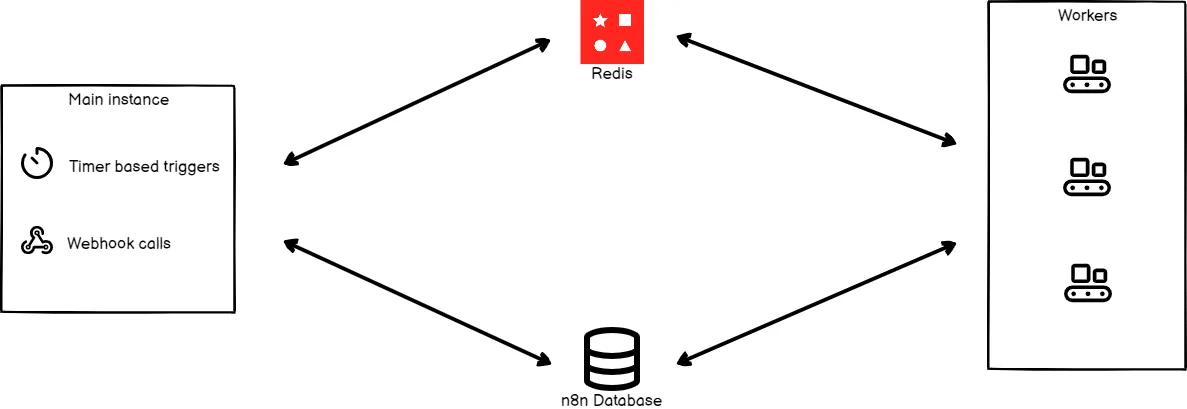
The queue documentation shows a main process, Redis, workers and a shared database. Workers need the same credential-encryption key. A distributed queue over SQLite is not supported; filesystem binary storage is also incompatible with queue mode. Validate attachment storage and its edition entitlement before moving document-heavy workflows to workers.
This is a stronger fit for a team that can own migrations, backups and failed jobs than for a business operator expecting a managed service. See the n8n profile for execution billing, tool approvals and the unresolved vendor documentation conflict over failed-run charging.
Activepieces: distinguish the MIT core from the licensed install
Activepieces is worth a pilot when a visual business-flow builder and inspectable TypeScript integrations are the priorities. Its repository separates the MIT core from commercial features. That distinction matters more than the broad “open source” label on a pricing page.
The current recommended install uses Docker Compose with PostgreSQL and Redis. The Docker guide says an install starts on the Free plan and accepts a license key for paid features. Other provider templates may install Community and lag the core team's versions. Do not assume two images labeled Activepieces have identical Agents, collaboration or governance entitlements.
The same guide makes a useful recovery point: database contents live in a Docker volume, so copying the application folder does not back up flows. Pin the release, save secrets separately and rehearse a database restore before an operator depends on the automation. Compare the current edition split in n8n versus Activepieces.
Dify: choose it for the AI application layer
Dify fits work centered on knowledge retrieval, prompts, model selection and AI-app workflows. It can sit beside a business automation platform: one service retrieves and drafts an answer, while another owns the approved CRM write or ticket transition. It is not automatically the best replacement for every SaaS connector in a general workflow tool.
The Docker deployment guide describes multiple services, including API, workers, database, Redis, vector storage, a code sandbox and an SSRF proxy. Size and back up that stack; a successful container start does not demonstrate retrieval quality, isolated tenants or recovery after a partial upgrade.
Dify's license permits commercial use but adds conditions to Apache 2.0. It defines a tenant as a workspace and requires written authorization for a multi-tenant environment. It also restricts removal or modification of frontend logo/copyright information. The pricing page describes Community as a single workspace; Enterprise adds commercial authorization, multiple workspaces and SSO. Evaluate the intended deployment against the actual terms rather than assuming internal use or an API wrapper removes every restriction. The Dify profile separates hosted quotas, self-hosting and application controls.
Price software, infrastructure and operations separately
Prices checked October 14, 2026. These are public software-plan references, not complete hosting estimates.
| Option | Published software cost | Limit or excluded cost |
|---|---|---|
| n8n Community | No subscription fee for permitted use | Infrastructure, external APIs/models and operations remain yours; paid governance absent |
| n8n Business self-hosted | €667/month equivalent, billed annually | 40,000 executions/month, six shared projects; infrastructure is separate |
| Activepieces MIT Community | Free core | Commercial features and operation of the server are separate |
| Activepieces Plus, current licensed plan | $20/month billed monthly | 10,000 credits/month, five users; overage $0.007/credit, AI work can add usage |
| Dify Community | Free under its license | Single workspace; infrastructure, model/embedding costs and operator time are separate |
| Dify Enterprise | Custom quote | Commercial authorization, enterprise deployment and governance need a scoped agreement |
Activepieces' current plan table permits cloud or on-prem hosting, while its pricing FAQ and table disagree on whether the Free allocation resets monthly or daily. Do not project a production budget from that inconsistent allowance. Confirm the licensed self-hosted plan, meter and connectivity requirements in writing. Plus's paid monthly allocation is clearer, but it is not the same thing as unlimited use of every commercial feature.
Budget for database and vector storage, backups, worker capacity, model/embedding calls, observability and the person who handles an expired credential at night. No hardware benchmark here establishes a minimum viable monthly infrastructure bill.
Keeping data local requires more than a local container
Map four boundaries before procurement: workflow payloads, credentials, model/embedding traffic and operational logs. An application running inside a private network may still send documents to a cloud model, retrieve data from SaaS, load plugins or report telemetry.
For example, n8n documents telemetry enabled by default and separate controls for diagnostics and version checks. Turning those off does not stop a workflow's deliberate model or connector requests. For every candidate, test outbound destinations, log retention, backup access and credential rotation against the actual deployment. “Self-hosted” alone is not evidence of an air gap or a compliance outcome.
Community evidence: test upgrades at the action boundary
In a July 21, 2026 n8n community report, andreiradu2102 described an approval appearing in version 2.27.5 without the expected tool execution afterward. jan later linked the fix in release 2.34.0 on August 4. This is a version-specific report and response, not a current reliability ranking.
The practical lesson is to keep a small acceptance workflow for approvals, denial, retries and recovery after restart. Run it before and after upgrades. Confirm that a repeated event cannot silently repeat a write and that a resumed run uses the approved payload. These are recommended checks; we did not execute an authenticated product benchmark.
Choose the platform only after a named owner can restore it, inspect a failed item and explain its external data paths. Continue with building a no-code AI workflow or the n8n/Activepieces comparison to turn that deployment choice into a bounded pilot.
This is source-based research, not a hands-on hosting review. Screenshots and architecture images are vendor examples. Current public pricing, official repositories and attributed community evidence were reviewed on October 14, 2026.
Sources & further reading
- n8n current pricing
- n8n Community edition boundaries
- n8n queue deployment
- n8n telemetry controls
- n8n license FAQ
- Activepieces pricing and editions
- Activepieces source and licensing
- Activepieces install choices
- Activepieces Docker deployment and backups
- Dify pricing and self-hosted editions
- Dify license
- Dify Docker deployment
- Flowise end-of-life announcement
- Flowise archived repository
- Flowise license boundaries
- n8n community approval regression and fix




Ordered for comparison, not as a universal ranking. Inclusion requires a direct fit with this page's stated workflow.