Comparison
n8n vs Activepieces (2026)
Choose n8n for deeper technical orchestration and AI controls; choose Activepieces for an MIT-licensed core and a larger entry allowance.
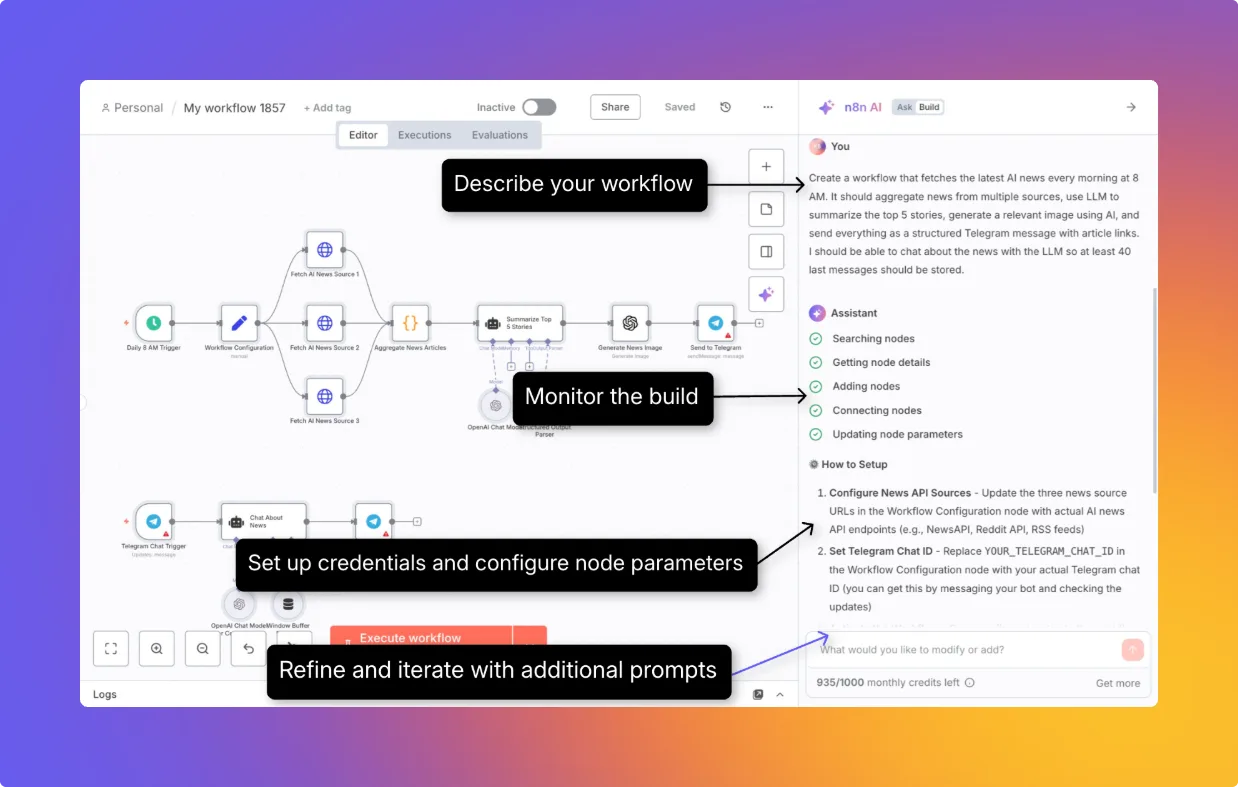
Verdict: Choose n8n when a technical team needs complex branching, code and API escape hatches, or native approval before selected AI tool calls. Choose Activepieces when an MIT-licensed automation core, self-hosting without a platform credit pool, and a larger published ordinary-run allowance on its entry paid plan matter more than n8n's technical surface.
The named choice is clear: n8n is the stronger technical orchestrator; Activepieces is the stronger open-source choice. Both can run long visual workflows without charging for every ordinary step. The real separation is licensing, governance packaging, AI charges, and how much operational depth the team needs.
We did not run a controlled reliability, migration, performance, or usability test. This comparison uses current first-party pricing and documentation checked on October 14, 2026, plus one attributed practitioner report. Prices remain in the currencies and billing periods each vendor displays; no exchange rate was invented.
n8n vs Activepieces decision matrix
| Decision | n8n | Activepieces |
|---|---|---|
| Best fit | Technical teams building complex API, data, and agent workflows | Teams prioritizing an MIT-licensed core and a larger published ordinary-run allowance on Plus |
| Cloud meter | One production workflow execution, regardless of steps | One credit per ordinary run, regardless of steps; AI costs sit on top |
| Public cloud entry used here | Starter: €20/month equivalent, billed annually, 2,500 executions | Plus: $20/month, 10,000 credits; then $0.007 per credit |
| Self-hosting | Community Edition plus paid self-hosted Business and Enterprise editions | MIT Community core; current Free, Plus, Team, and Ultimate plans list cloud or on-prem hosting, with commercial features licensed by plan |
| License | Sustainable Use License; source-available/fair-code, not OSI open source | Core under MIT; enterprise directories under a commercial license |
| AI cost | Workflow execution plus model-provider or Gateway cost; build-time Assistant credits are separate | Base run plus 2/10/20 credits for fast/smart/frontier model steps; agentic actions cost 1 credit each |
| Failure recovery | Execution log, error workflows, manual retry with original or current workflow | Step retry, continue-on-failure, checkpointed resume, retry from failed step or latest version |
| Governance | Community omits SSO, projects, external secrets, log streaming, Git version control, and multi-main | Team adds SSO and standard roles; Ultimate adds SCIM, custom RBAC, audit logs, secret managers, and Git Sync |
| Operational burden | Self-hosters own database, workers, encryption keys, scaling, upgrades, backups, and observability | Same core burden; recommended production stack uses app, worker, PostgreSQL, and Redis containers |
Pick n8n for technical workflow depth
n8n is the better default when the workflow is likely to outgrow a simple sequence of app actions. Its current plans include JavaScript and Python code steps, custom HTTP and GraphQL requests, cURL import, API control, and self-hosted custom nodes. That matters when an integration lacks one action, payloads need extensive reshaping, or the workflow becomes a small application.
Its cloud meter is also predictable for long deterministic workflows. n8n says a production workflow run is one execution even when it contains many steps or processes many items. Starter currently costs €20 per month equivalent when billed annually for 2,500 executions. Pro costs €50 per month equivalent when billed annually for 10,000 executions. Both include unlimited workflows and integrations; current headline concurrency is five on Starter and up to 50 on Pro, depending on the selected plan size.
n8n's main disadvantage is the license boundary. The Community Edition is self-hostable and its source is visible, but the Sustainable Use License is not an OSI open-source license. Internal business use is generally permitted, and the current license FAQ permits consultants and agencies to build client workflows when clients cannot configure workflows themselves. White-labeling n8n or exposing substantial editor functionality to customers can require an Embed or other commercial agreement. If permissive redistribution is a hard requirement, Activepieces has the cleaner core license.
Pick Activepieces for the MIT core and larger Plus allowance
Activepieces publishes its core under the MIT license. The repository separates enterprise code into commercially licensed directories, so “open source” accurately describes the core rather than every feature in the product. Teams can inspect, modify, redistribute, and self-host that core under the MIT terms. Paid enterprise code still requires an Activepieces license in production.
For deterministic workflows, Plus currently lists $20 per month, 10,000 credits, up to five users, and $0.007 per extra credit. Team lists $200 per month with 50,000 credits, 25 users, unlimited projects, SSO, standard roles, and global connections. Activepieces says an ordinary run costs one credit however many non-AI steps it contains.
Activepieces Plus therefore publishes four times n8n Starter's ordinary-run allowance at a superficially similar displayed numeral: $20 versus €20. The prices use different currencies and billing terms, so this is an allowance comparison, not proof that Activepieces costs less. Connector coverage, AI use, support, downtime, and operator time can outweigh the subscription. A required action rebuilt through HTTP or a custom TypeScript piece can change the result quickly.
Pricing: compare the same workload
The two “10,000” allowances are close enough to compare for ordinary runs, but not for AI-heavy work.
| Workload | n8n Cloud | Activepieces Cloud |
|---|---|---|
| 2,000 deterministic runs/month | Fits n8n Starter at €20 annual equivalent | Fits Activepieces Plus at $20/month |
| 8,000 deterministic runs/month | Needs at least the displayed n8n Pro 10K tier at €50 annual equivalent | Fits Activepieces Plus at $20/month |
| One long 40-step ordinary flow | One execution | One run credit |
| AI step inside each run | Model-provider or Gateway charges are separate from execution count | Published AI credit charge sits on top of the run credit |
| Usage beyond included pool | Plan-specific; current support says new triggers can fail at the limit | Plus and Team continue at $0.007 per extra credit |
These are platform-meter examples, not total-cost estimates. n8n's euro prices above require annual billing, while Activepieces displays US-dollar monthly prices. Taxes, infrastructure, model tokens, external APIs, storage, support, and labor are excluded.
Activepieces' Free plan has a documentation conflict worth treating as unresolved. The same live pricing page says “1,000 credits a month,” lists the Free credit reset as “Daily,” and says exhausted Free runs wait until credits refresh “the next day.” Another FAQ sentence says users wait until the next month. Do not build a production forecast around the Free reset until the vendor confirms account behavior.
AI costs separate the meters
n8n counts the workflow execution; it does not advertise an extra n8n platform charge for every AI node. The model still costs money through the connected provider or n8n Gateway. n8n's Assistant credits are a separate allowance for the build-time Assistant, not the meter for running AI nodes in production workflows.
Activepieces uses a layered model. Its pricing FAQ says the run costs one credit, then classifies AI steps at 2 credits for a fast model, 10 for a smart model, and 20 for a frontier model. Agentic actions cost one credit each. Plus and higher plans can use their own AI provider keys; Activepieces says that reduces each AI step to one platform credit while moving model cost to the provider bill.
So a 10,000-run allowance is not 10,000 AI-agent runs by default. Model one representative flow with the actual number of model steps, agent actions, loops, and retries. On self-hosted Activepieces Community, current AI Router documentation says Community has no platform credits, but provider usage and infrastructure still cost money.
Self-hosting changes the bill, not the work
Both products offer a free self-hosted core, and neither turns infrastructure into someone else's problem.
n8n Community includes most workflow features and queue mode, while its current feature page reserves projects, SSO, environments, external secrets and storage, log streaming, Git version control, and multi-main scaling for paid editions. The operator owns TLS, database durability, credential-key preservation, upgrades, worker sizing, monitoring, and incident response.
Activepieces recommends Docker Compose with separate application, worker, PostgreSQL, and Redis containers. Its documentation warns that data lives in the PostgreSQL volume rather than the checked-out application directory, and that losing the encryption key prevents stored connections from being decrypted even with a database backup. Current pricing lists Free, Plus, Team, and Ultimate as cloud or on-prem plans. The install runs the free plan by default; licensed commercial features require the enterprise edition and a license key. Self-hosting alone does not unlock SSO, audit logs, custom roles, secret managers, or Git Sync.
Activepieces wins when “open source” means a permissive core license. n8n wins when the team's priority is its workflow model and technical surface, and its fair-code restriction fits the use case. For either product, test restore procedures and an upgrade rollback before calling self-hosting cheaper.
Governance can outweigh run price
For Activepieces Cloud, the $20 Plus tier still caps the workspace at five users and does not include SSO or standard roles. Team moves to $200 per month and adds 25 users, SSO, standard roles, projects, and shared global connections. SCIM, custom RBAC, audit logs, secret managers, event streaming, private pieces, and Git Sync are Ultimate features with custom pricing.
n8n's hosted Starter and Pro plans include unlimited users but limited shared projects. Its paid self-hosted Business plan is currently €667 per month equivalent billed annually for 40,000 executions, six shared projects, SSO/LDAP, multiple environments, queue mode, and Git version control. Enterprise adds unlimited projects, external secrets, log streaming, extended retention, and dedicated support.
The cheaper plan can become the wrong plan the moment procurement requires SSO, separated projects, audit evidence, secret-manager integration, or support with an SLA. Price the governance tier first, then the execution pool.
Retries and failure recovery need acceptance tests
Activepieces documents checkpointed execution: completed step outputs are saved, and a resumed run skips completed work before continuing at the interrupted or failed step. A failed run can retry from the failed step with prior outputs, or rerun the latest published version from the beginning. Current tooling still exposes Continue on Failure and Retry on Failure. A January 17, 2024 vendor announcement described up to four attempts across roughly four minutes, but current documentation reviewed here does not restate that exact count; verify it on the deployed version.
That design reduces duplicate work before the failure point, but it does not guarantee external side effects are idempotent. A step that timed out after an API accepted a payment or sent an email may run again. Activepieces does not state on the reviewed pricing page how repeated AI attempts are charged, so budget them as potentially billable until account data proves otherwise.
n8n supports dedicated error workflows and manual retries using either the original or current workflow definition. Its current first-party pages conflict on quota accounting: execution documentation says scheduled runs count regardless of outcome and dedicated error workflows do not count, while the Cloud support FAQ says failed executions do not count and says retries and error-handler workflows are affected by the cap. “Affected” does not establish whether every attempt increments usage. Ask n8n for the plan-specific rule in writing, then observe the meter during a controlled failure test.
For both products, require idempotency keys around irreversible actions, route dead letters somewhere visible, and test expired credentials, rate limits, worker restarts, and a model timeout before production.
What one practitioner reported
In a January 2025 r/selfhosted discussion, u/bradhawkins85 reported that Activepieces completed the job but felt harder to use than n8n for one migrated workflow. They said the Activepieces build took a day, a Power Automate rebuild took several days, and the n8n rebuild took a couple of hours, while still recommending Activepieces when it fits the use case.
That is one person's migration, with no published workflow definition, versions, or controlled timing. It supports running a representative build with the people who will maintain it. It does not establish that n8n is universally faster to build in, or that Activepieces is harder for other workflows.
Practical verdict
- Pick n8n for a technical automation platform where branching, code, APIs, custom nodes, AI tool approval, and production controls matter more than a permissive license.
- Pick Activepieces when the MIT core is a purchasing requirement, ordinary cloud run volume dominates the budget, or the team wants a self-hosted visual core it can modify and redistribute under MIT terms.
- Before committing, rebuild one real workflow in both: include the least-supported connector, an AI call, a loop, a forced failure, a retry, a credential rotation, and a restore from backup.
See the broader AI workflow automation tools guide or narrow the shortlist to the best self-hosted AI automation tools. The no-code AI workflow guide covers approval, evaluation, and fallback requirements before implementation.
Read the detailed n8n profile for its execution, privacy, and license boundaries, or the Activepieces profile for its current cloud and self-hosted fit.
Sources & further reading
- n8n pricing
- n8n execution documentation
- n8n execution limit FAQ
- n8n Community Edition features
- n8n Sustainable Use License FAQ
- n8n license
- n8n execution retries
- n8n human approval for AI tools
- Activepieces pricing
- Activepieces license documentation
- Activepieces repository license
- Activepieces self-hosting
- Activepieces durable execution
- Activepieces building flows
- Activepieces AI Router
- Activepieces retry controls
- Activepieces permissions
- Activepieces versus n8n community discussion


Ordered for comparison, not as a universal ranking. Inclusion requires a direct fit with this page's stated workflow.