Use case
Route and Summarize Support Tickets with AI (2026)
Build an evidence-backed AI ticket triage workflow with structured summaries, deterministic escalation, route validation, safe write-back, and human review.
Verdict
Use AI to propose a compact summary, issue family, product facts, and evidence spans inside the existing ticket. Keep queue ownership, contractual priority, security escalation, and write permissions in deterministic policy. Choose n8n when a technical team wants API escape hatches, code steps, or self-hosting; choose Make when support operations owns a managed visual scenario with explicit branches; choose Dify only when the classifier itself needs an LLM application layer, retrieval, and native review forms. Start in shadow mode. Automate a route only after sampled evidence shows that route is safe.
This workflow enriches records in a ticket system and proposes the correct operating queue. It does not monitor a shared email inbox, generate autonomous customer replies, or resolve tickets. Intake from documents and attachments belongs in the document extraction workflow. Approval mechanics belong in the human-approved automation guide. For the broader platform architecture, start with reliable no-code AI workflows and the AI workflow automation shortlist.
Define the record the agent should receive
The ticket system remains the source of truth. Trigger on a ticket-created or ticket-updated event, then fetch the current record by ticket ID. Do not trust the webhook body as the final state: comments, assignee, organization, entitlement, and status may have changed before the workflow starts.
Pass the model the minimum data needed to classify the case. Preserve an immutable reference to the original record, but redact secrets and omit unrelated profile fields from the model input.
| Input group | Include | Keep out unless required |
|---|---|---|
| Ticket identity | Ticket ID, event ID, record revision, channel, creation time | Internal database keys with no workflow purpose |
| Request content | Subject, current description, relevant public comments, attachment text after scanning | Access tokens, passwords, payment data, unrelated attachments |
| Product context | Product, plan, deployment, version, affected component when already known | Whole account history by default |
| Service context | Current queue, owner, status, entitlement, region, approved escalation rules | Model-generated priority from an earlier run treated as fact |
| History | Prior routing decisions, human corrections, linked incident ID | Unlimited conversation history with no retrieval boundary |
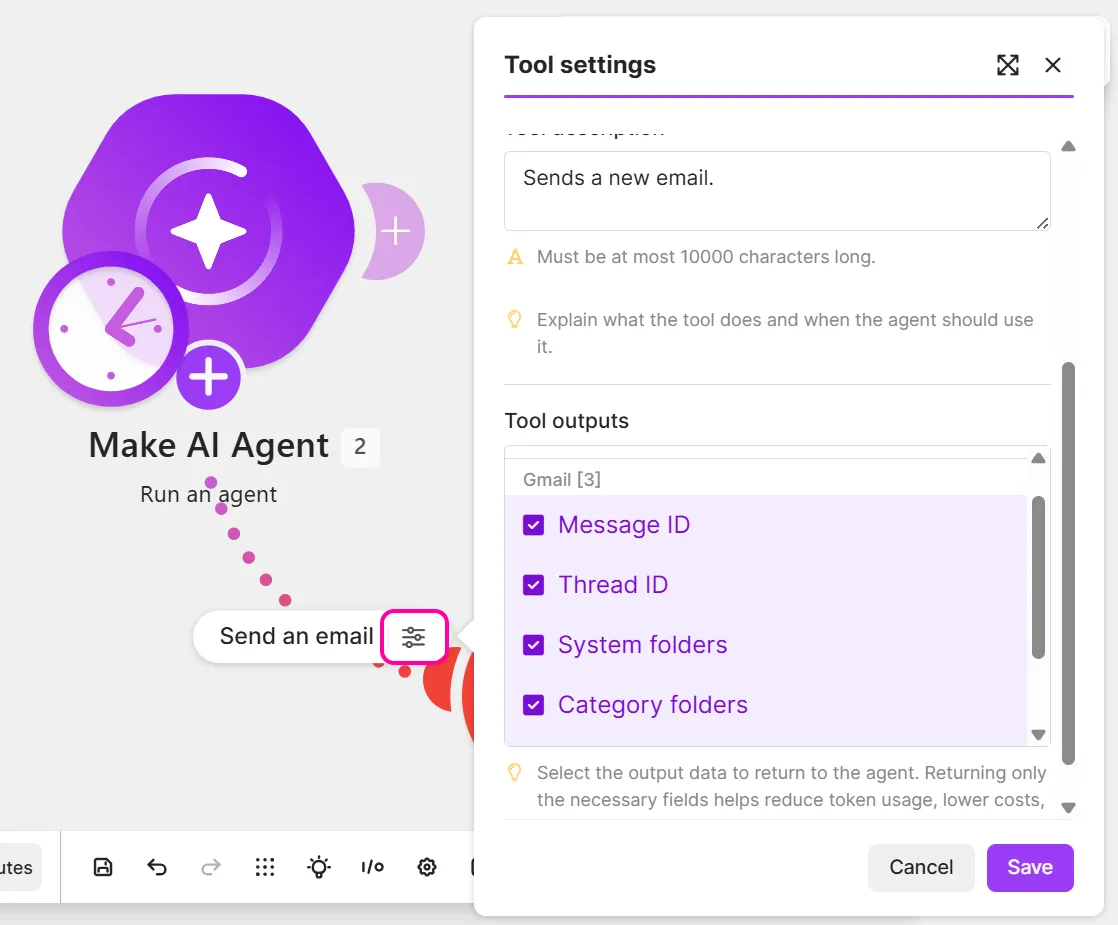
Filter tool outputs as well as prompt inputs. Make's current AI Agent guide supports selecting the outputs returned to an agent, which reduces unnecessary context and token use. The interface screenshot above illustrates that control; it does not prove a support configuration.
Store a triage proposal, not a paragraph
A summary is useful only when an agent can verify it without rereading the whole thread. Return a schema that separates source facts, model interpretation, and the business action.
{
  "ticket_id": "T-18422",
  "source_revision": "18422:17",
  "summary": "Workspace admins cannot invite new members after an SSO change.",
  "customer_ask": "Restore member invitations and confirm whether existing users are affected.",
  "issue_family": "identity_access",
  "product_area": "sso",
  "affected_scope": "workspace",
  "explicit_deadline": null,
  "risk_signals": ["admin_blocked", "access_change"],
  "proposed_route": "identity_support",
  "proposed_priority": "review_required",
  "evidence": [
    {"comment_id": "c-9921", "span": "No admin can invite users since we changed SSO."}
  ],
  "unknowns": ["number_of_affected_workspaces", "production_outage"],
  "model_version": "provider/model-version",
  "prompt_version": "support-triage-v4"
}
Use controlled enums for issue family, risk signals, and proposed route. Reject unknown enum values, missing evidence, malformed output, and stale source_revision. A model confidence score may be retained for analysis, but it must not unlock automation. A model can be confidently wrong; evidence and tested policy decide what can run.
Keep the summary factual. It should state the customer request, observed symptom, affected scope, and relevant time constraint. Do not add root cause, outage scope, sentiment, legal exposure, churn risk, or promised resolution unless the ticket or linked system supports it.
Route in three passes
1. Apply hard rules before AI
Use ordinary lookups and conditions for facts the model should not reinterpret:
- existing owner, active incident, account tier, language, geography, and support entitlement;
- verified product or tenant ID;
- security, privacy, legal, abuse, payment, and account-access keywords that require a protected review path;
- SLA clocks and after-hours coverage;
- explicit customer requests to escalate or reach a person.
Hard rules can assign the final route, restrict the allowed route set, or require review. They should never be hidden inside a prompt. Version them separately from the model instructions.
2. Ask AI to extract ambiguous evidence
Use the model where language is variable: condense a long thread, map a symptom to an approved issue family, identify product/version mentions, and locate evidence for a risk signal. Make it return unknown when the record does not establish an answer.
Prompt injection can arrive in ordinary ticket text or attachments. Treat customer content as data, not workflow instructions. The model should have no direct tool that changes queue, priority, status, requester, refund state, or customer-visible text. Its output crosses a schema validator before any ticket API call.
3. Resolve route with policy
Map validated evidence to an allowed queue using a deterministic table. For example:
| Evidence and current state | Result | Why |
|---|---|---|
| Existing linked incident | Preserve incident route; add triage proposal | Avoid fragmenting an active response |
| Verified account-access or security signal | Protected review queue | Consequence is too high for model-only routing |
| Product and issue family agree with one tested route | Propose or automate that route, depending on rollout state | Decision is bounded and explainable |
| Model route conflicts with account/product lookup | Human triage | Source systems disagree |
| Missing product, unsupported enum, or weak evidence | General triage with needs_information | Unknown stays visible |
| Ticket changed after inference | Discard proposal and rerun on current revision | Prevent stale write-back |
This ordering keeps escalation auditable. The model identifies a passage such as “all workspace admins are blocked”; policy decides whether that signal requires an incident, security, identity, or general queue.
Put evidence inside the ticket
Write proposed fields to namespaced custom fields or a structured internal note. Retain:
- source event ID and ticket revision;
- prior and proposed values;
- short evidence spans with comment IDs;
- model and prompt versions;
- rule version and the rule that won;
- final route, reviewer, timestamp, and correction reason.
Do not overwrite the raw customer message or erase existing tags. The current n8n Zendesk node documentation warns that its Update Ticket operation replaces the whole tag list when Tag Names or IDs is supplied. Retrieve and merge tags, use Zendesk's add-tags API path, or update dedicated fields instead.
Before write-back, fetch the ticket again and compare its revision, owner, status, and relevant fields. That check narrows the race but does not close it: another update can land between the read and write. Use the destination's conditional-write mechanism, such as an ETag or revision precondition, when available. If the ticket API lacks one, serialize writes per ticket and reconcile the destination after each update; route conflicts to review.
Use an idempotency key such as ticket_id + source_revision + triage_version. Claim it atomically in a store with a unique constraint before the first side effect. A retry should find that claim and resume from recorded state rather than append another note, reopen the ticket, or page the escalation channel again. Where neither the destination nor the workflow store supports an atomic guard, detect and reconcile duplicates; do not claim exactly-once delivery.
Escalate from evidence, not tone
Angry language can accompany a routine issue; calm language can describe a serious breach. Sentiment is a poor severity control. Define escalation from observable conditions and account context.
| Escalation type | Minimum evidence | Automated action |
|---|---|---|
| Service incident | Affected function and scope, plus monitoring or linked-case corroboration | Notify incident reviewer; do not declare an outage from one ticket |
| Security/privacy | Specific access, disclosure, credential, or data-handling signal | Restrict route and audience; require specialist review |
| Account access | Verified tenant/account plus login or authorization symptom | Route to identity queue; never expose account data in the model output |
| Billing | Invoice, charge, refund, or payment evidence | Route to billing policy; do not authorize refund or credit |
| Contractual/SLA | Entitlement lookup plus current clock | Apply deterministic priority and on-call policy |
| Customer-requested escalation | Explicit request in a cited comment | Preserve request and alert a human owner |
The reviewer should see the proposed route, exact evidence, conflicting system facts, and current ticket state. Approval expires after a defined interval; on resume, the workflow rechecks the record. Dify's Human Input node documents action branches and a default three-day timeout, but email review links can be answered by anyone who has the link and the first response closes the request. Treat link delivery as an authorization boundary, not merely a convenience.
Choose the builder by the operating constraint
Prices and packaging below were checked October 15, 2026. Recheck the live order form before buying.
| Decision | n8n | Make | Dify |
|---|---|---|---|
| Best fit | Technical support platform team joining ticket APIs, internal services, code, and self-hosted or managed orchestration | Support operations team building managed, visible branches across SaaS tools | Team exposing a ticket classifier or reviewer as an LLM application/API with retrieval |
| Ticket integration | Built-in Zendesk node can get, create, update, and delete tickets; HTTP requests cover unsupported operations | Zendesk app includes ticket/activity triggers plus create, update, merge, comment, and attachment modules | Use HTTP/tools around the LLM workflow; it is not primarily a ticket-system integration bus |
| Route control | IF/Switch/code plus error workflows; AI tool calls can be protected by human review | Router order, filters, and a fallback route are explicit; router and error-handler modules do not consume credits | Human Input exposes action IDs as separate branches and supports a timeout branch |
| Failure path | Error workflow receives execution ID, failed node, and retry reference when available | Incomplete executions can be retried or resolved, but storage is disabled by default | Node-specific fail branches; ticket-side conditional writes and an external idempotency claim remain necessary |
| Current entry economics | Starter €20/month billed annually for 2,500 full workflow executions; Pro €50 for 10,000 | At 10,000 credits, annual monthly equivalents were Core $9, Pro $16, and Teams $29. Free includes 1,000 credits/month | Professional $59 monthly or $590/year with 5,000 message credits and 20,000 trigger events/month; Team $159 or $1,590/year with 10,000 message credits |
| Material limit | Cloud concurrency and execution history depend on plan; self-hosted scaling adds Redis, Postgres, workers, keys, and monitoring | Incomplete-run and webhook storage scale with credit allowance; Make AI Agent (New) is in open beta and functionality/pricing may change | Message credits are model-dependent; external provider cost and rate limits remain separate |
n8n pricing bills a production workflow as one execution regardless of step count, which can suit a multi-stage enrichment flow. Make pricing and credit rules generally meter actions, so price the actual trigger, reads, AI calls, writes, notifications, and retries rather than “one ticket.” Dify pricing says credit consumption varies by model type; estimate every model call in the workflow instead of equating one ticket with one credit.
Make is usually the cleaner default when support operations needs to inspect and own deterministic branches. n8n is stronger when routing depends on internal APIs, custom validation, or deployment control. Dify earns a place when the AI classification/retrieval layer is substantial enough to operate as its own application; pair it with a ticket orchestrator rather than forcing it to own every SaaS side effect.
Design retries around partial success
Split the run into persisted stages: received, fetched, proposed, validated, reviewed, written, and notified. Store the stage outside model prose. If the ticket write succeeds and the alert fails, retry the alert only.
n8n error workflows expose failure metadata. In self-hosted queue mode, its main instance receives triggers, Redis queues execution IDs, workers run jobs, and the database persists data. That architecture adds operations work and some webhook latency; the diagram above is not evidence that a deployment meets a support SLA.
Make stores incomplete executions only when that feature is enabled; it is disabled by default. Enable it deliberately, monitor its allowance, and test a full store. Neither platform creates idempotency for a ticket API on your behalf.
Also monitor intake silence. An error workflow cannot alert on an event that never reached it. Record successful webhook receipt or poll completion, then alert when the expected heartbeat is absent. Send a synthetic case through the same external intake path when feasible; testing only the middle webhook leaves the real connector untested.
Prove route correctness before enabling writes
Build a dated fixture set from consented, sanitized historical tickets. Keep entire threads together and include duplicates, reopened cases, terse subjects, multilingual content, conflicting comments, forwarded logs, screenshots, prompt injection, known incidents, missing account data, and cases that legitimately belong in general triage.
Have support leads label the acceptable issue family, evidence, escalation state, and route without seeing model output. Where reviewers disagree, preserve the disagreement or resolve the policy before scoring automation.
Measure fields separately:
- summary factuality and omission of unsupported root cause;
- evidence precision and recall;
- issue-family accuracy;
- route accuracy and transfers after assignment;
- missed escalations and false escalations by risk type;
- correct use of
unknownandneeds_information; - stale-write rejection, duplicate-write count, and replay safety;
- human override rate, correction reason, and review time;
- intake-to-owner latency by queue.
Do not report one blended “triage accuracy” number. A workflow can summarize well while missing the rare security case that matters most. Set thresholds by route and consequence.
Run shadow mode first: store the proposal without changing queue, priority, status, or customer-visible content. Compare it with the final human route. Then automate one low-risk, high-volume route and sample accepted cases, including items where the model expressed high confidence. Expand by route only after the error mix is understood.
In a June 8, 2026 Reddit post, u/Warm-Reaction-456 described an unverified Zendesk routing project where opaque misroutes led staff to check the classifier's work manually; the author reported replacing it with explicit rules and a manual fallback. The decision point is traceability, not the post's self-reported performance. It is one anonymous practitioner's account, not independent accuracy, cost, or product evidence.
Log every correction as old value, new value, reviewer, and a root-cause enum such as model_misread, missing_source_data, schema_gap, routing_rule, or policy_exception. Better prompting cannot repair a missing account lookup or a bad queue policy.
Production gate
Before a route can write automatically, prove that malformed output fails closed; a conditional write rejects stale state; an atomic event claim prevents repeated processing in the test case; duplicate effects are detectable and reconcilable; protected categories always enter review; evidence links resolve to the cited comment; missing intake triggers an alert; retry resumes from the failed stage; and a support owner can disable the automation without disabling ticket intake.
Keep the first release boring: a short factual summary, controlled labels, cited evidence, and a proposed route. Customer replies, refunds, account changes, status transitions, and incident declarations are separate workflows with separate authority.
We did not connect a ticket system, run these products, or measure routing accuracy, latency, cost, or reliability for this guide. Product capabilities, current prices, and limits come from the linked first-party pages checked October 15, 2026. The practitioner account is attributed and remains anecdotal.
Sources & further reading
- n8n Zendesk node operations and tag behavior
- n8n error workflows
- n8n queue mode
- n8n human review for AI tool calls
- n8n pricing
- Make Zendesk app documentation
- Make routers and fallback routes
- Make incomplete executions
- Make AI Agent (New) app
- Make AI Agent tool-output filtering
- Make pricing and credit rules
- Dify Human Input node
- Dify workflow error handling
- Dify Cloud pricing
- Practitioner report on opaque ticket misroutes



Ordered for comparison, not as a universal ranking. Inclusion requires a direct fit with this page's stated workflow.