Use case
How to Automate Document Intake and Data Extraction with AI
Build a document intake workflow that captures files, runs OCR or parsing, extracts a strict schema, validates evidence, and routes exceptions safely.
Verdict: use AI to map extracted text into a schema, not to replace file receipt, OCR, validation, or record identity. A production document-intake flow should preserve the original file, page-level evidence, extraction version, and exception reason before it writes to a system of record.
Start with one document class and one destination. “All PDFs into the ERP” hides several different systems: attachment capture, file validation, OCR, field extraction, business-rule checks, duplicate handling, and exception review. Build those stages separately so a weak scan or changed supplier template fails visibly instead of becoming a plausible record.
The AI workflow automation shortlist covers the wider platform market. This guide is the implementation pattern for invoices, purchase orders, applications, claims, onboarding forms, and similar inbound documents.
Choose by intake topology
| Intake pattern | Best starting point | Why it fits | Boundary to test |
|---|---|---|---|
| Email or cloud-drive files moving across many SaaS apps | Make | Managed connectors plus a first-party AI Content Extractor for document text, invoices, and receipts | File size, page-to-bundle fan-out, credit use, data region, and beta/plan availability |
| Technical team, webhooks or internal storage, custom APIs, self-hosting | n8n | Binary-file handling, JSON transformation, code/API escape hatches, and a self-hosted Community Edition | Scanned-document OCR path, operations ownership, execution retention, and target-system idempotency |
| Upload becomes an LLM app, knowledge flow, or document Q&A product | Dify | Document Extractor feeds file text directly into workflows, models, and knowledge-oriented apps | Text-based PDF versus image-heavy input, Cloud quotas, provider egress, and self-host operations |
| Dense tables, handwriting, checkboxes, or regulated forms | Dedicated OCR/document AI plus an orchestrator | Layout-aware extraction can retain pages, coordinates, and specialized fields while the workflow layer handles routing | Vendor-specific accuracy on your templates, region, retention, page pricing, and review tooling |
This is a routing decision, not a universal ranking. The same company may use Make for mailbox intake, a specialist OCR service for scans, and Dify for a downstream document assistant.
1. Create an immutable intake record
Capture the file before extraction. Store the original object and a manifest containing:
| Field | Purpose |
|---|---|
document_id | Stable internal identity |
source_event_id | Trace back to email, upload, webhook, or drive event |
source_uri | Retrieve the original under access control |
filename, MIME type, bytes | Reject unsupported or disguised files |
received_at | Establish processing order and audit timing |
sha256 | Detect the same bytes arriving through another route |
pipeline_version | Reproduce parser, prompt, schema, and rule behavior |
Treat the source event ID and file hash as duplicate signals, not a mathematical promise of exactly-once processing. A resent email can carry the same file for a legitimate new case; two different files can also belong to the same business transaction.
Quarantine encrypted, corrupt, oversized, or mismatched files before they reach a model. Malware scanning belongs at this boundary. Do not make the model decide whether a file is safe to open.
2. Route text-native files and scans differently
Detect whether a PDF already has a usable text layer. Parse text-native PDFs, DOCX, spreadsheets, and similar formats with a deterministic extractor. Send image-only PDFs, photos, and low-quality scans to OCR. Preserve page boundaries and, when the extractor supplies them, coordinates or table cells.
n8n's Extract From File documentation says the core node converts binary CSV, HTML, JSON, ICS, ODS, PDF, RTF, text, XLS, and XLSX inputs into JSON. That is a useful native path for structured and text-bearing files; image-heavy scans still need an OCR-capable path chosen and tested by the builder.
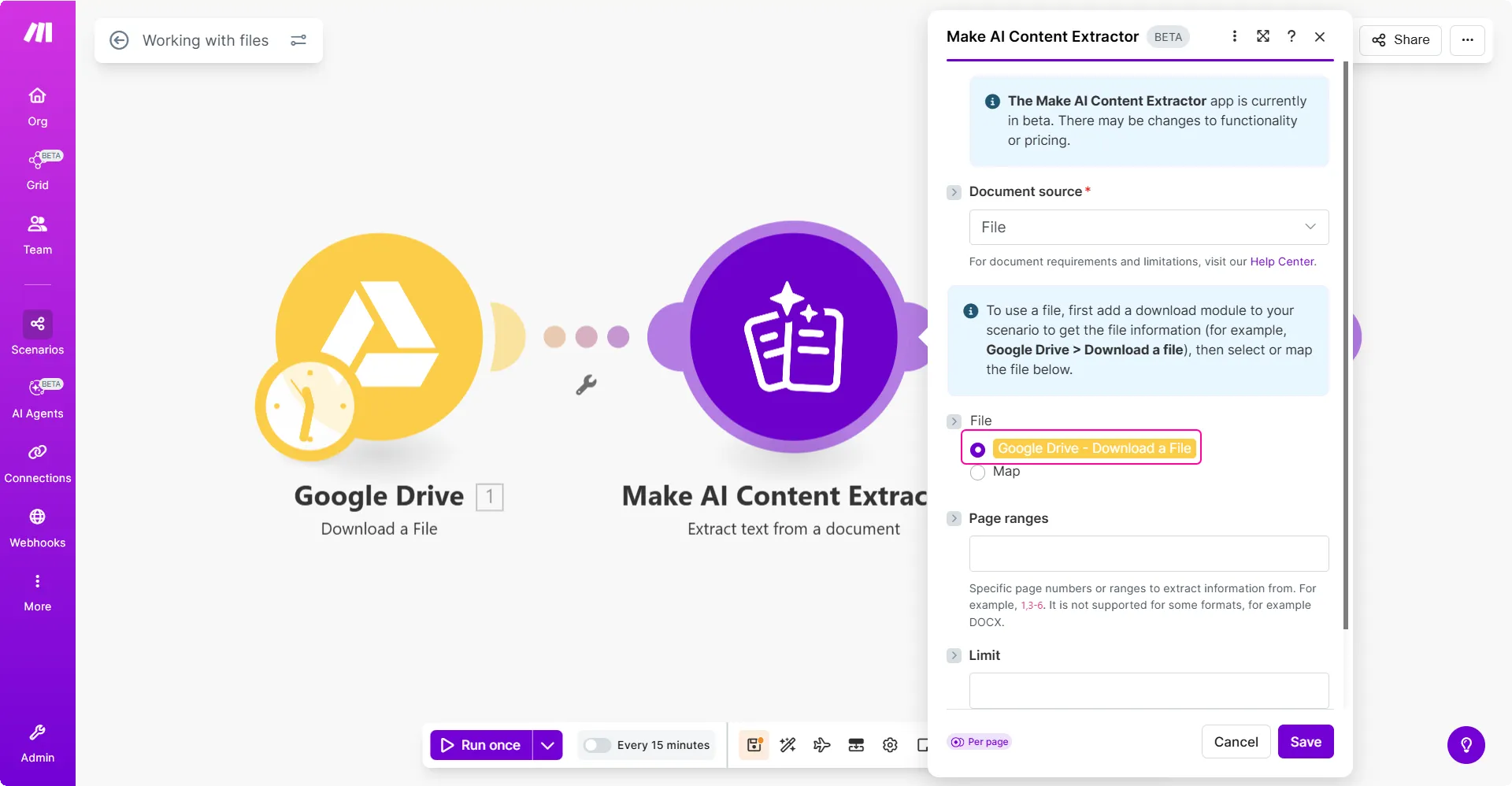
Make's file-handling guide shows Google Drive download feeding Extract text from a document, then passing the resulting text bundle into an analysis step. Dify's Document Extractor accepts a file or file array and returns a string or array of strings. Its current docs explicitly describe text-based PDFs and route image-heavy content to specialized processing.
Do not flatten the evidence too early. Keep page number, source block, table identity, and OCR text beside each extracted field. A single giant text blob is convenient for a prompt and poor for review.
3. Extract a field contract, not a summary
Define the target schema before choosing a model. For an invoice, one field should carry its value and evidence together:
{
  "invoice_number": {
    "raw": "INV-004218",
    "normalized": "INV-004218",
    "page": 1,
    "evidence": "Invoice No. INV-004218",
    "status": "extracted"
  }
}
Use an enum such as extracted, not_found, ambiguous, or invalid. Require not_found when the source is silent. Keep raw and normalized values separate so date, currency, decimal, and identifier cleanup does not erase what the document contained.
For line items, preserve row order and page. Do not let the model silently merge similar descriptions or repair totals. Prompt-injection text inside a document is document content, not a workflow instruction; the extraction prompt should state that boundary explicitly and the model should have no write tools.
4. Validate outside the model
Run deterministic checks after extraction:
- required fields exist and match allowed formats;
- currency and decimal separators are normalized under a declared locale;
- line totals, tax, and grand total reconcile within a written tolerance;
- vendor, customer, policy, or case IDs exist in the destination system;
- dates fall inside permitted windows;
- page citations point to non-empty source text;
- the proposed business key does not already identify another record.
Confidence is a routing hint, not proof. A model can be confidently wrong, and a correct rare format can receive a low score. Send failed rules, conflicting fields, and unsupported layouts to an exception queue with the original page and proposed value. For review-channel design, timeouts, and escalation, use the separate human-approved AI automation guide.
5. Make writes replayable and visible
Separate received, extracted, validated, exception, and written states. Save each stage before starting the next. Once the business key is validated, create a durable action identity from the tenant, destination, record type, and stable business key. Claim that action with a database unique constraint or atomic state transition before a worker writes.
Keep the extraction and proposal version beside the action, but do not put either version in the action identity: re-extracting the same invoice must not create permission to insert it again. Pass the same stable idempotency token to the destination when its API supports one. If it does not, serialize writes by business key and reconcile the remote record after a timeout. These controls reduce duplicate writes; they do not guarantee exactly-once behavior across every connector and API.
After creation or update, read the destination record back and compare the fields that matter. Keep its remote ID on the action record. Reprocessing should create a new extraction version linked to the same original, not overwrite the prior evidence or stable action identity. That lets operators compare a parser or prompt change without losing the history that produced the existing record.
6. Test the document distribution, not five clean samples
Build a labeled fixture set from sanitized real documents. Include every common template plus rotated scans, faint pages, photos, handwriting, merged documents, repeated pages, large tables, missing pages, password protection, wrong file types, duplicates, and adversarial instructions embedded in body text.
Score fields separately. Track exact match for identifiers, normalized match for dates and money, line-item precision/recall, page-citation validity, and reconciliation failures. Operational metrics should include extraction failure rate, exception rate, manual correction rate, duplicate candidates, cost per accepted document, and latency by page count.
Set launch thresholds from business consequences. A missed optional memo field and a wrong bank account number do not belong in the same average accuracy score. Keep high-impact fields on mandatory review until the labeled set demonstrates the required performance.
Current price and limit checkpoints
Checked October 15, 2026. These are planning inputs, not quotes; recheck checkout and the exact plan before purchase.
| Product | Current public checkpoint | Intake implication |
|---|---|---|
| n8n | Starter is €20/month billed annually for 2,500 workflow executions; Pro is €50/month billed annually for 10,000. The pricing page defines an execution as one run of the whole workflow with unlimited steps. | A multi-step document flow remains one n8n execution, while model, OCR, storage, and connected-service charges remain separate. Community Edition is self-hosted, so infrastructure and operator time remain costs. |
| Make | At 10,000 credits/month with annual billing selected, the live cards showed Core $9/month, Pro $16/month, and Teams $29/month; Free includes 1,000 credits/month. Most module actions use one credit, while AI Content Extractor can use more based on the module and processing. Published file ceilings are 5 MB Free, 100 MB Core, 250 MB Pro, 500 MB Teams, and 1,000 MB Enterprise. | One source file can create several bundles and downstream module runs. Estimate credits from representative page counts and routes, not documents alone; credit tier, billing term, AI processing, and extra credits change cost. |
| Dify | Sandbox is free with 50 knowledge documents, 50 MB knowledge storage, 3,000 trigger events, and 5,000 API calls/month. The pricing card does not state a reset cadence beside the Sandbox trigger allowance. Professional is $59/month or $590/year per workspace, with 500 knowledge documents, 5 GB storage, and 20,000 trigger events/month. | Knowledge-document quotas are relevant when intake feeds RAG; model responses and external providers have separate meters. Document Extractor workflow files and knowledge imports are related but not identical quota surfaces. |
Data handling also changes by extraction path. Make's current region table says its document-text, invoice, receipt, and image-text extraction modules use Microsoft Azure AI services in the EU for both Make US and EU data zones. That is a documented routing statement, not an independent packet capture or a substitute for retention and contract review.
One operator report worth designing around
In a March 15, 2026 Make Community thread, user Tyler reported that Google Cloud Vision OCR returned one PDF page per bundle and asked how to group those pages back into documents. Responder Stoyan_Vatov clarified that Make's array aggregator outputs an array, not a PDF, and suggested a separate PDF-processing app for merging.
That is one configuration report, not a Make or OCR reliability benchmark. It exposes a useful test case: record how many pages and bundles each document produces, keep a document key on every page, and measure the downstream credit multiplier before launch.
Production gate
Do not enable unattended destination writes until the workflow can reject unsupported files, preserve originals and page evidence, distinguish scans from text-native documents, return not_found without invention, reconcile required totals, surface exceptions with reasons, detect duplicate candidates, resume after a late failure, and verify the remote record after writing.
For adjacent intake flows, the support-ticket routing guide covers message-level classification and queue policy, while document comparison handles two-version evidence. The broader no-code AI workflow guide covers operational controls that apply after this document-specific pipeline is stable.
Sources & further reading



Ordered for comparison, not as a universal ranking. Inclusion requires a direct fit with this page's stated workflow.