
Tool
Apollo
Sales intelligence and engagement platform for prospect search, enrichment, sequences, dialing, lead scoring, and deal workflows.
TL;DR
- Best for combining B2B contact search, enrichment, and outbound sequences in one product.
- Includes AI research, lead scoring, extensions, CRM integrations, and a dialer, depending on plan.
- Free plan available; Basic starts at $49 per seat per month when billed annually.
- Data quality varies by segment, geography, and how current a contact's employment record is.
- Strong fit for lean teams; less specialized than dedicated data, engagement, or analytics products.
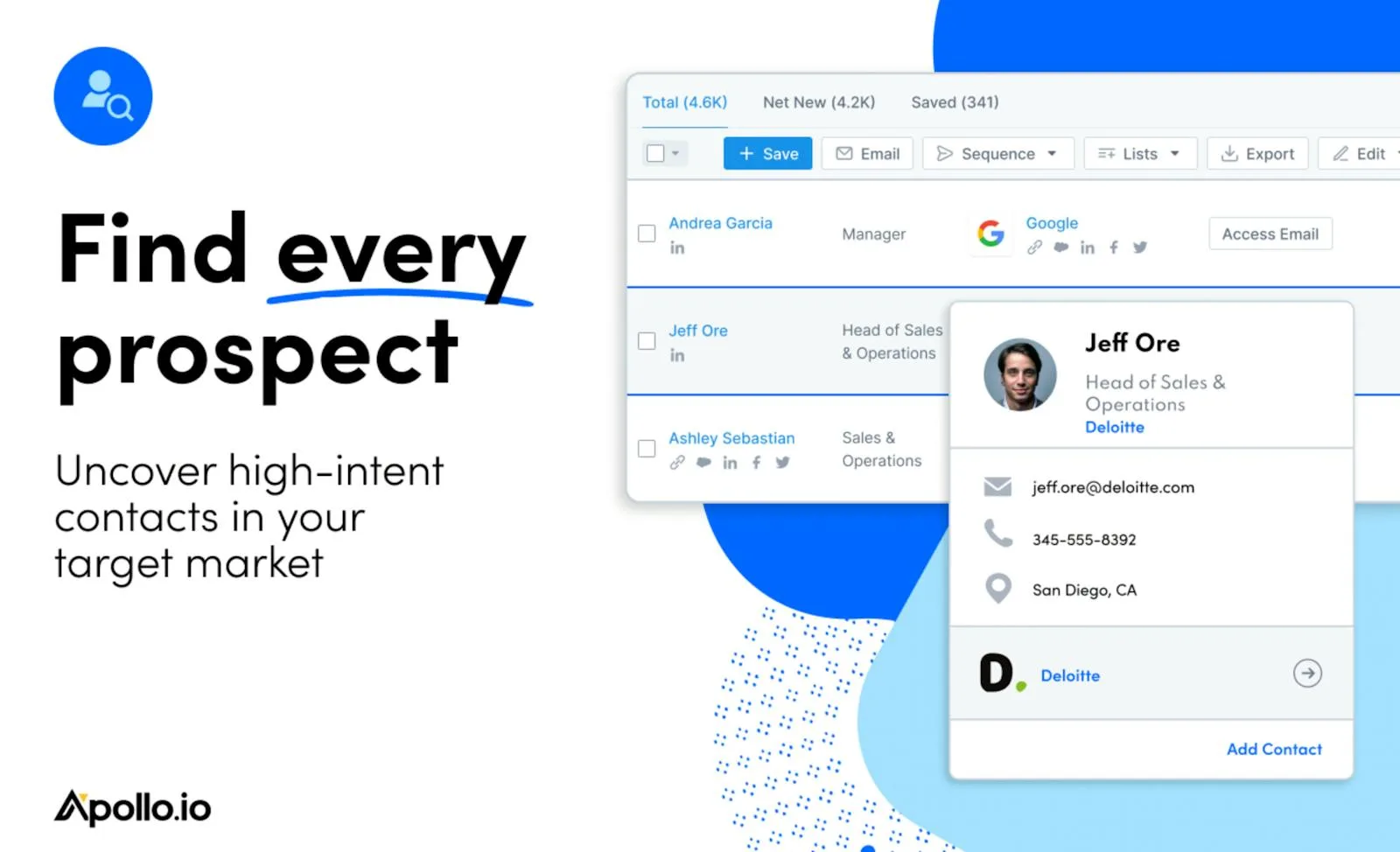
Apollo is a sales intelligence and engagement platform. It combines a B2B people and company database with filtering, enrichment, sequences, a dialer, meeting tools, CRM sync, and AI-assisted research. The subscription covers the application; usage credits and plan limits still shape how much data and outreach a team can run.
Decision snapshot
| Question | Answer |
|---|---|
| Primary interface | Web app plus Chrome extensions and API |
| Best use | Building lists and running outbound without stitching together a separate database and sequencer |
| AI role | Research, lead scoring, assistant workflows, and messaging support |
| Starting paid price | $49 per seat per month, billed annually |
| Main trade-off | Broad coverage is convenient, but contact freshness and depth are not uniform |
What Apollo does well
Apollo reduces stack seams. Reps can filter accounts and contacts, reveal or enrich data, put prospects into a sequence, call them, and sync activity to a CRM from one workspace. The free plan is useful for evaluating search coverage and workflow fit before purchasing seats.
The current Basic plan adds unlimited sequences, advanced filters, CRM integrations, waterfall enrichment, deliverability tools, and a US dialer. Higher tiers expand credits, record-selection limits, workflows, intent topics, and automation. This makes Apollo easier to adopt incrementally than enterprise tools that require a sales call before meaningful evaluation.
Where it falls short
No B2B database is equally accurate in every market. Apollo's contact and employment data can be strong in active technology segments and thinner among local businesses, less-visible industries, or people who rarely update public profiles. Validate a representative sample rather than relying on the headline database size.
Apollo also encourages high-volume execution because search, data, and sequencing are adjacent. That convenience does not fix weak targeting, generic copy, or sender reputation. Reporting and sequence controls may feel shallow to teams that need the governance of a specialist engagement platform.
What users report
Product Hunt reviewer Rabnoor Singh describes the useful seam Apollo removes:
“What it is genuinely good at is being the one place the data and the sending live together.”
The same review warns that data quality is “a distribution, not a number,” with thinner coverage outside technology, and says Apollo's defaults can encourage more volume than a modern outbound program should send. Test both coverage and deliverability discipline, not only feature count.
Bottom line
Choose Apollo when a compact team needs prospect data and outbound execution in one accessible system. Choose dedicated providers when a specific market demands deeper data, more controlled engagement, or more sophisticated revenue analytics.
Sources & further reading


Appears in