Use case
How to Personalize Cold Emails with AI
Build evidence-grounded cold email personalization with source capture, strict fallback rules, human review, and current Clay and Apollo costs.
Verdict
The reliable use of AI in cold email is an evidence pipeline, not a clever writing prompt. Research a relevant fact, preserve its source and date, decide whether it supports outreach, and only then draft. Choose Clay when research logic, provider choice, and reusable enrichment matter most. Choose Apollo when prospect search, AI research, email writing, and sequences should live in one system. In either case, make missing evidence a hold condition and review every draft until factual corrections are rare and measured.
AI can make a bad campaign more specific without making it more relevant. A prospect's recent post, office move, or funding announcement is not automatically a reason to contact them. Useful personalization connects a verified account or role signal to a problem the sender can credibly address.
This guide covers that narrow job. Use research target accounts with AI for the full account brief and automate sales prospecting for sourcing, enrichment, sequencing, suppression, and CRM handoff. For product selection, start with the AI sales prospecting tools shortlist or the broader AI sales tools guide.
Judge personalization tools on the right criteria
| Criterion | What good looks like | Reject or redesign when |
|---|---|---|
| Evidence traceability | Every variable has a source URL, retrieval date, and short supporting extract | The system returns prose without showing which input supports it |
| Signal relevance | The fact changes the likely problem, priority, stakeholder, or timing | The opener merely proves that a page or profile was scraped |
| Null behavior | Missing, stale, or conflicting evidence stops the draft or routes it to research | A blank field silently becomes a generic compliment |
| Prompt control | The model receives approved facts, offer context, banned claims, and an output schema | Fit, research, and copy are collapsed into one opaque instruction |
| Review surface | A reviewer sees the evidence beside the completed message | Approval requires reopening several tools or trusting a score |
| Cost visibility | Usage is modeled per researched record, generated field, workflow step, and send | “Credits” are translated into a fixed number of leads without replaying the workflow |
| System ownership | One system owns research fields and the CRM owns suppression and campaign state | Several tools can overwrite evidence or enroll the same contact |
A writing score can help with clarity. It cannot verify a claim, prove the account fits, or tell you whether the offer deserves attention.
1. Store evidence before copy
Create a research record with fields that can be inspected independently of the email:
| Field | Rule |
|---|---|
fit_reason | Stable, observable reason the account matches the ICP |
timing_signal | Dated event that may change priority now |
source_url | Direct page supporting the signal, preferably a primary company source |
source_date | Publication or event date, separate from retrieval date |
supporting_extract | Short text that supports the fact without adding interpretation |
approved_fact | Human-readable statement the email is allowed to use |
confidence | Defined scale with reasons, not model vibes in decimal form |
expires_at | Date after which the signal must be refreshed |
suppression_status | CRM-controlled send eligibility checked after research and again before send |
Prefer product documentation, company newsrooms, filings, public job descriptions, and clearly dated company posts. Treat third-party summaries as discovery paths when a primary source exists. Do not infer budget, internal pain, project ownership, or personal enthusiasm from a weak signal.
One strong fact is usually enough. Adding three researched details can make a short email feel more like surveillance than relevance.
2. Separate research, qualification, and writing
Run three explicit stages:
- Research: return structured facts and sources. Do not write outreach.
- Qualification: decide whether the evidence supports this offer for this role. Record the reason and route uncertain records to review.
- Writing: generate from approved facts only. The drafting step must not browse for extra material or repair missing inputs with invention.
A compact drafting contract can be stricter than a long style prompt:
Use only approved_fact, contact_role, offer, and proof supplied below.
Do not infer pain, budget, intent, familiarity, or product use.
If approved_fact is empty, stale, or irrelevant to contact_role, return HOLD.
Write: subject, 1 evidence-based opener, 1 value sentence, 1 low-friction CTA.
Also return used_fact and unsupported_claims[].
Compare used_fact with the approved field before a draft becomes eligible to send. If the model adds a claim to unsupported_claims, the workflow should hold the message rather than delete the warning and keep the copy.
3. Make the fallback explicit
There are three honest outcomes for a record:
- personalized draft backed by approved evidence;
- segment-level draft that does not pretend to know something individual;
- no message.
The second option is useful when the segment and offer are strong but person-level research is unavailable. Label it as such. Do not disguise a generic opener with a first-name token or an unsupported observation.
Apollo's writing assistant exposes this decision directly: when it lacks data for a personalized opener, the user can choose a generic opener or pause the sequence. For evidence-grounded campaigns, pause is the safer default until the team has deliberately approved a segment-level fallback.
4. Review the claim, implication, and message
For the first production batch, put every draft beside its evidence and require a person to answer:
- Does the source support the exact fact?
- Is the source current enough for this campaign?
- Does the fact matter to this recipient's role?
- Does the email turn an observation into an unsupported pain or intent claim?
- Would the personalization feel reasonable if the recipient opened the cited page?
- Is the offer specific enough to justify the interruption?
- Is suppression, ownership, and existing-opportunity state current?
Record rejection reasons such as wrong company, stale signal, unsupported inference, irrelevant to role, creepy, generic, and offer mismatch. Those labels tell you whether to fix sourcing, qualification, or copy. “Needs work” tells you almost nothing.
Move from full review to sampling only after you can measure factual-correction rate by source, prompt version, segment, and model. Keep automatic holds for missing evidence, changed employment, duplicate enrollment, suppressed contacts, generation failures, and credit exhaustion.
Clay or Apollo for this workflow?
| Product | Best fit for personalization | Current pricing and limits checked October 6, 2026 | Main operating risk |
|---|---|---|---|
| Clay | Custom research and qualification across multiple providers, live web sources, enriched table fields, and reusable copy agents | Free: 500 Actions + 100 Data Credits monthly and 200 rows/table. Launch: $185 monthly with 15,000 Actions + 2,500 Data Credits; $167/month equivalent annually with 180,000 Actions + 30,000 Data Credits. Growth: $495 monthly with 40,000 + 6,000; $446/month equivalent annually with 480,000 + 72,000. | Each research, AI, enrichment, export, or downstream step can add Actions and Data Credits; flexibility needs an operator and a measured per-approved-draft cost |
| Apollo | One surface for database search, AI research fields, writing, previews, sequence enrollment, and sending | Free: 900 credits/seat/year granted monthly. Annual: Basic $49/seat/month + 30,000 credits/year; Professional $79 + 48,000; Organization $119 + 72,000 with 3-seat minimum. Monthly: Basic $65 + 2,500 credits; Professional $99 + 4,000. AI writing ranges from 5,000 words/month on Free to 1,000,000 on Organization. | AI Research costs one credit per record per output column; writing is English-only and capped at 50 generations per person per 24 hours; research, copy, and sending in one system can scale mistakes quickly |
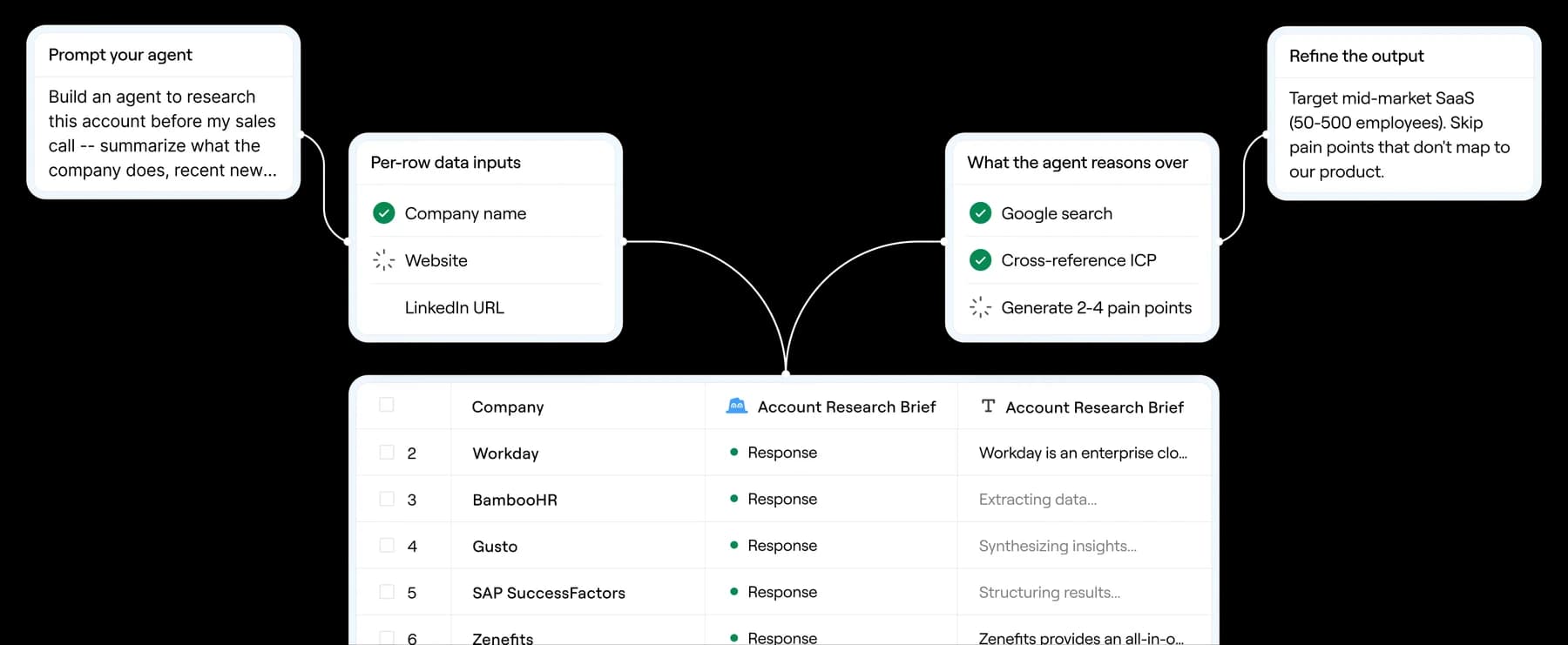
Claygent Builder supports reusable outbound agents, business context, uploaded messaging documents, optional web search, version history, and up to 10 free test inputs at a time. Standard deployed runs use one Action plus model-dependent Data Credits. Configure separate output fields for the fact, source, date, approval state, and draft; a polished paragraph alone removes the audit trail.
Apollo AI Research saves results to fields that can be reviewed, edited, regenerated, filtered, reused in messages, or passed into workflows. Its writing assistant can generate a full email, opener, PS, subject, or sequence variable. Apollo explicitly tells users to preview and proofread output. The integrated flow is convenient when Apollo's contact coverage matches the segment; test that coverage before treating the system as a complete outbound stack.
Read Clay vs Apollo when the decision is configurable research and orchestration versus a packaged data-to-sequence workflow.
What operators report
In a Hacker News thread, Poomba reported that enriching each desired field made a Clay workflow increasingly expensive. Another commenter, AznHisoka, argued that provider access and waterfalls can offset the cost of stitching tools together, while also linking an alternatives article they wrote. That self-promotion is a commercial/content interest, and neither comment supplies a controlled cost or coverage comparison.
In an older Hacker News discussion, twosdai described using Apollo mainly for prospecting inside a larger email pipeline and said deliverability required other tools and work. Y Combinator identifies the commenter as Daniel Wasserlauf, a founder of Champ, whose company profile promotes a cold-email AI agent. That is a direct commercial interest in outbound tooling. The report is useful as a system-boundary warning, not evidence that Apollo campaigns generally fail or that Champ performs better.
These are individual reports from different dates, stacks, and pricing eras. No community comment supports current prices, product entitlements, contact accuracy, reply rates, meetings, or revenue.
Pilot before scaling
Start with 30–50 records containing obvious fits, weak fits, stale signals, missing sources, changed roles, customers, open opportunities, and suppressed contacts. Measure source-retrieval success, human qualification pass rate, factual-correction rate, approval rate, cost per approved draft, and duplicate or suppression failures.
We did not create Clay or Apollo accounts, send a campaign, or run a head-to-head test for this guide. Product capabilities, prices, and limits come from first-party pages; media is first-party; community evidence is attributed anecdote. Recheck the live pricing selector and order form before buying, then validate quality on your own segment and sending setup.
Sources & further reading


Ordered for comparison, not as a universal ranking. Inclusion requires a direct fit with this page's stated workflow.