Comparison
Clay vs Apollo (2026)
Choose Apollo for a direct database-to-sequence workflow; choose Clay for multi-provider enrichment, research, and GTM orchestration.
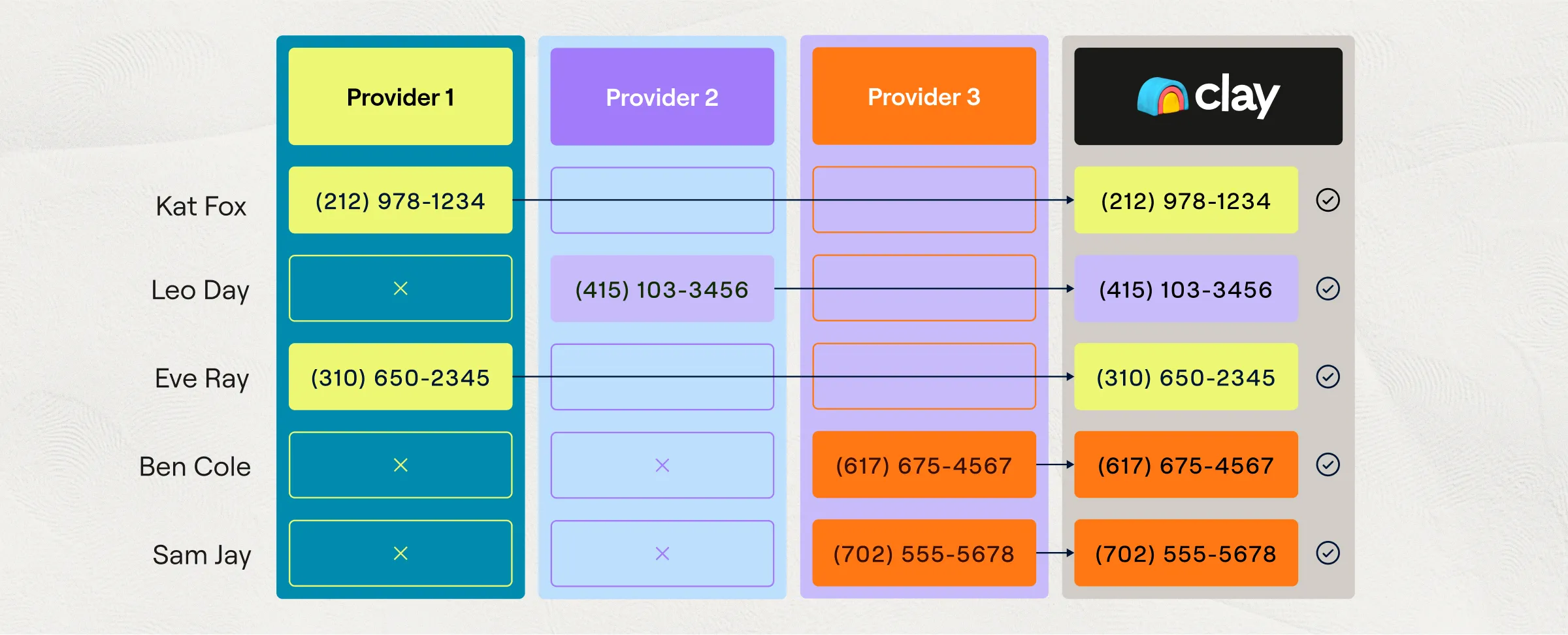
Verdict: Choose Apollo when one seller or a lean team wants to search a large B2B database, reveal contact data, and run email, call, and social-task sequences in the same product. Choose Clay when a GTM operator needs to combine providers, research custom facts, apply qualification logic, and route the result into a CRM or engagement system. Use both when Apollo is a useful data and execution endpoint but your targeting needs Clay's provider waterfalls and programmable research.
Apollo is the better default for a straightforward outbound motion. Clay is the stronger build layer for a differentiated one. Neither product makes contact accuracy universal, and adding both does not rescue a weak ICP or offer.
We did not run a controlled data-accuracy or campaign-performance test. This verdict uses current product documentation, live public pricing checked on October 5, 2026, and attributed community workflow reports. Vendor database-size, accuracy, and customer-outcome claims do not decide the ranking.
Clay vs Apollo decision matrix
| Decision | Clay | Apollo |
|---|---|---|
| Role in the stack | Data, research, segmentation, and orchestration layer | Integrated prospect database and sales-execution workspace |
| Best starting point | CRM, warehouse, CSV, Clay search, or another provider | Apollo's people and company database |
| Data strategy | Combine 150+ marketplace providers, owned accounts, and custom APIs; order them in waterfalls | Search Apollo's database, then use Apollo or partner enrichment inside the same workspace |
| Research | Claygent, AI columns, web research, formulas, functions, and conditional runs | Reusable AI Research fields with templates or custom prompts; results can feed filters, messages, and workflows |
| Outbound execution | Native email sequencing plus exports and integrations to engagement tools | Email, call, social, and task steps, with dialer, mailbox, sequence, and activity workflow in one product |
| CRM and warehouse workflow | Growth adds CRM and warehouse sync, HTTP API, webhooks, and web-intent orchestration | Native CRM integrations and enrichment; broader execution stays inside Apollo |
| Operating owner | GTM engineering, RevOps, growth, or a technically curious founder | Sales reps and managers who want fewer handoffs |
| Paid entry | Launch: $185 month-to-month or $167/month equivalent billed annually; unlimited seats | Basic: $65 per seat month-to-month or $49 per seat/month billed annually |
| Usage model | Two meters: Actions for platform work and Data Credits for marketplace data or AI | Per-seat plan plus a shared credit pool used by contact data, enrichment, AI research, dialing, and other features |
| Main risk | Workflow complexity and variable cost across two Clay meters plus connected providers | Treating one database as universally fresh, or spending one credit pool across several kinds of work without modeling the mix |
Pick Apollo for one database-to-sequence lane
Apollo shortens the common path from idea to outreach. A rep can filter people and companies by title, location, company attributes, intent, job changes, technology, and other fields; save the records; run AI research; and enroll qualified contacts in a sequence. Apollo's sequences can combine automatic or manual email, calls, LinkedIn tasks, and other actions. That is a more complete rep-facing execution loop than a configurable enrichment table.
The all-in-one design is the reason to buy Apollo, not proof that every underlying record is right for your market. Test a known sample from the exact geography, company size, and job family you sell to. Check employment match, reachable email, usable phone, and the proportion that survives your qualification rules. A headline database size cannot answer those questions.
Apollo also supports custom AI Research prompts and web context, so this is not a choice between “AI” and “no AI.” The difference is range. Apollo research enriches records inside an Apollo-centered sales workflow. Clay is designed to compose research and data from many providers, first-party systems, and custom APIs before deciding where a record goes.
Pick Clay for provider orchestration and custom research
Clay is strongest when the qualifying fact is not a normal database filter. An operator can import CRM, warehouse, CSV, or searched records; run providers in a defined waterfall; use Claygent or an AI model for a custom question; filter or score the result; and then write it back or send it onward. Conditions let expensive steps run only after cheaper disqualifiers pass.
That flexibility changes the job. Someone must choose providers, define fallbacks, test prompts, inspect samples, and monitor cost. Clay's own Audiences guidance recommends testing an enrichment on 10 rows before scaling. Teams without an owner for that work usually get more value from Apollo's packaged flow.
Clay now includes native email sequencing, so it can support a compact outbound workflow by itself. Its differentiation still sits upstream: multi-provider enrichment, custom research, signals, and routing. Apollo remains the more complete choice when the same users need database search, multichannel sequence execution, calling, and activity management every day.
Pricing: compare the workflow, not one credit label
Prices and allowances were checked on October 5, 2026.
Clay's pricing page lists Free with 500 Actions and 100 Data Credits per month, unlimited seats, and a 200-row table limit. Launch starts at $185 month-to-month or $167 per month equivalent on annual billing, with a base allowance of 15,000 Actions and 2,500 Data Credits per month. Growth starts at $495 monthly or $446 per month equivalent annually, with 40,000 Actions and 6,000 Data Credits per month. There is no public seat minimum on these self-serve plans; the plan cards say unlimited seats.
Clay's usage documentation says its two meters pay for different things. An Action covers orchestration such as an enrichment run, AI run, or export. Data Credits buy third-party data or AI from Clay's marketplace. Clay says a fully enriched record typically uses 6–20 Data Credits, but that is guidance, not a promise: phone data, waterfall depth, AI model, and provider choice change the amount. Actions do not roll over. Monthly Data Credits can accumulate up to twice the monthly allowance; one-time top-ups carry a 30% premium.
Bringing your own provider or AI key removes the Clay Data Credit charge for that run, but it still consumes one Action and the external provider bills you directly. BYOK changes who meters the data; it does not make the workflow free.
Apollo's pricing page lists Free with 900 credits per seat per year, granted monthly. On monthly billing, Basic is $65 per seat/month with 2,500 credits per month and Professional is $99 with 4,000. On annual billing, Basic is $49 per seat/month with 30,000 credits per seat/year granted upfront and Professional is $79 with 48,000. Organization is $119 per seat/month on annual billing, requires at least three seats, and includes 72,000 credits per seat/year. Apollo's monthly selector also displays $149 and 6,000 monthly credits for Organization while labeling it “Annual Only,” so treat Organization as an annual commitment and confirm the quote.
Apollo's current pricing table lists 1 credit for an email, 8 for a phone number, 1–8 for enrichment, 1 per AI Research run, and 1 per 30 seconds of US dialer use. The same pool can therefore support very different amounts of work. Apollo says team credits are pooled, reset at the billing boundary, and do not roll over. Model your own mix instead of converting a plan into a made-up number of “leads.”
Use Clay and Apollo together when each keeps a clear job
The products have an official integration. Clay can use a connected Apollo account to find or enrich people and companies, create or update contacts, and add contacts to Apollo sequences. A defensible joint workflow is:
- Search Apollo for a broad ICP-aligned account or contact set.
- Pull only plausible candidates into Clay. Run cheap filters first, then provider waterfalls or custom research on the smaller set.
- Review a sample, define hard qualification rules, and keep the research fields that a rep can actually use.
- Create or update the qualified contacts in Apollo and enroll them in the appropriate sequence.
Budget the combination as three possible cost layers: Apollo seats and credits, Clay Actions, and Clay Data Credits or direct provider charges. The stack makes sense when better coverage or a hard-to-find qualification signal is worth that operational overhead. For basic title-and-industry prospecting followed by a standard sequence, Apollo alone is usually the cleaner purchase.
What practitioners report
Community reports support the workflow split, not a universal quality winner. On Hacker News, Poomba described Clay becoming expensive when several enrichment fields each consumed credits; AznHisoka argued that the provider access and fallback workflow can still cost less than stitching and maintaining separate tools.
Product Hunt reviewer @rabnoor_s described Apollo's appeal as keeping data and sending together, while reporting thinner coverage outside technology and smaller consumer brands and defaults that can encourage volume. In a separate 2024 Hacker News discussion, twosdai described Apollo as the prospecting component of a broader outbound pipeline rather than a complete deliverability solution; that commenter also disclosed pivoting to an outbound-related product. AznHisoka linked an article about alternatives they authored, so that comment also has a commercial-interest caveat. These are individual reports from different dates, stacks, markets, and pricing eras. They support testing workflow ownership and cost; they do not establish current contact accuracy or campaign outcomes.
Practical verdict
- Pick Apollo when reps need to move from search to multichannel outreach with minimal setup, and one database performs well enough on your ICP sample.
- Pick Clay when custom qualification, multi-provider coverage, first-party data, or research logic creates the advantage, and someone will own the system.
- Use Clay + Apollo when Apollo is the source or rep execution surface and Clay adds a research or enrichment step you can justify with measured cost and acceptance criteria.
Compare the wider category in the best AI sales tools guide. Evaluate both products with one representative segment, record-level acceptance rules, and a cost log before migrating the full outbound motion.
Sources & further reading
- Clay pricing
- Clay Actions and Data Credits
- Clay Audiences
- Clay waterfalls
- Clay and Apollo integration
- Clay Apollo integration announcement
- Apollo pricing
- Apollo credit usage
- Apollo prospect search filters
- Apollo AI Research
- Apollo sequences
- Apollo user commentary on Product Hunt
- Clay cost discussion on Hacker News
- Apollo as one part of an outbound workflow on Hacker News


Ordered for comparison, not as a universal ranking. Inclusion requires a direct fit with this page's stated workflow.