Tool
ZoomInfo Copilot
ZoomInfo Copilot review: current GTM Workspace transition, custom pricing, buying signals, data/privacy limits, and enterprise pilot criteria.
Verdict
Choose ZoomInfo's Copilot workflow when an established B2B revenue team already depends on ZoomInfo data and wants buying signals, account research, buying groups, message drafting, and CRM action in one seller surface. Its advantage is context across ZoomInfo and connected revenue systems, not autonomous selling. Require a segment-level data test, a representative credit replay, and exact order-form entitlements before signing. ZoomInfo's own current pages disagree on whether Copilot remains standalone or has become GTM Workspace's native agent layer.
This review keeps the familiar ZoomInfo Copilot name because buyers still encounter live Copilot product and pricing pages. It does not pretend the lifecycle is settled. ZoomInfo's October 2026 llms.txt says GTM Workspace succeeds Copilot and that Copilot is no longer standalone. The current Copilot page, AI information page, and pricing page still present Copilot as a distinct product or package. Ask which name will appear on the order form, which surface users receive, and how current Copilot functions map to renewal.
Start with the AI sales-tools decision guide for the broader category or the sales-prospecting shortlist for a narrower choice. Compare Apollo when a smaller team wants public self-serve pricing and data plus sequencing, and Clay when RevOps wants to choose providers and build enrichment logic.
Sales-intelligence decision criteria
| Decision | ZoomInfo fits when | Validate before buying |
|---|---|---|
| Product lifecycle | Your team can adopt the current GTM Workspace direction instead of depending on one legacy interface name | Put product name, migration path, feature mapping, support dates, and renewal treatment in the order form |
| Market coverage | ZoomInfo's contact, company, org-chart, and signal coverage is strong in your exact territories and segments | Test known accounts by region, size, industry, current employer, usable email, direct phone, hierarchy, and missing-record rate |
| Prioritization | Reps have a defined ICP and can act on intent, website, hiring, funding, job-change, engagement, and CRM signals | Blind-review surfaced accounts against known opportunities; record false positives, stale events, duplicated signals, and reasons a rep ignored a recommendation |
| Portfolio design | A manageable set of offerings maps to distinct ICPs, buying groups, signals, and plays | Run the hardest multi-product territory; measure configuration load and whether sellers can tell why an account ranked highly |
| Revenue-stack fit | Salesforce, HubSpot, Dynamics, Outreach, Salesloft, Gong, email, and ZoomInfo already supply useful context | Test field permissions, source precedence, duplicate handling, writeback, excluded domains, deletion, failed sync, and rollback |
| Contract economics | Consolidated research and seller workflow remove enough separate tools or manual work to justify a negotiated contract | Itemize licenses, data and AI credits, integrations, intent, workflow modules, onboarding, services, overages, term, renewal, and exit/export rights |
| Governance | Admins can define what connected CRM, email, calendar, call, website, and contributor data may flow into the platform | Reconcile the privacy policy, DPA, subprocessors, retention, tenant/model-training terms, Contributory Network settings, audit logs, and data-subject workflows |
Current pricing and package limits
ZoomInfo publishes no dollar starting price for Copilot. Its pricing FAQ says cost depends on features, licenses, credits, add-ons, and integrations. The page describes a negotiated monthly credit allocation and says exporting a company or contact profile consumes one credit. It does not publish a Copilot seat minimum, package-specific credit allowance, AI-chat quota, signal cap, or overage price.
The current public Sales ladder is:
| Package | Publicly listed scope | Missing from public pricing |
|---|---|---|
| Professional | Contact/company profiles, search and export, CRM integrations, Chrome/mobile access, AI email generation, and dialing | Dollar price, seats, credits, intent entitlement |
| Copilot Advanced | Professional plus hierarchy data, account prioritization, alerts, intent clusters, website visitors, champion/job changes, buying groups, workflows, plays, and AI-generated buying groups/talking points | Dollar price, AI limits, exact signal/intent allowance, integration charges |
| Copilot Enterprise | Advanced plus real-time/custom intent, sales-activity automation, competitor and earnings-call signals, custom integrations, advanced workflows/reporting, account summaries, ICP creation, Copilot chat, dedicated success, and white-glove onboarding | Dollar price, credits, services scope, response terms, deployment and migration details |
The “free trial” CTA is not a permanent Copilot free tier. ZoomInfo now also advertises free GTM.AI accounts and separate API/MCP credits, but those developer offers do not establish Copilot or Workspace entitlements. Price the exact seller workflow from an itemized quote, then replay one real week of searches, exports, enrichment, research, signals, drafts, and writes against the proposed pools.
Where the workflow can earn its place
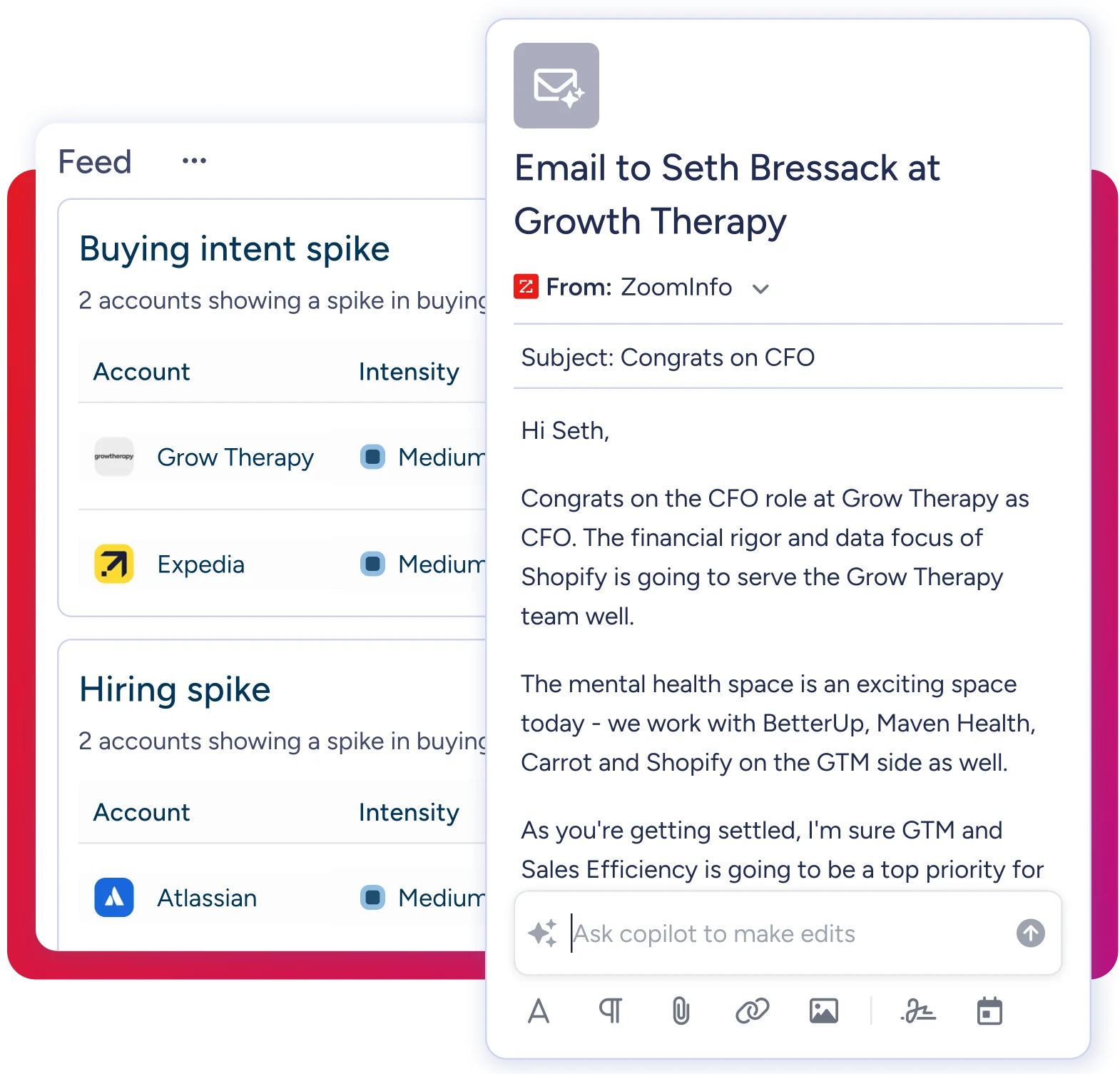
Copilot's useful seam is between signal and action. It can prioritize target accounts, assemble decision-makers and buying groups, summarize account changes, draft talking points or outreach, and push work into connected sales systems. A rep avoids stitching together a data provider, an intent feed, manual account research, and a separate prompt with no CRM context.
That value depends on inputs and operating discipline. “Verified” contact data can still age. Intent is an account-level clue, not proof that a named buyer is in market. An org chart can omit an informal influencer. AI-generated messaging can combine a true signal with the wrong commercial inference. Keep source evidence visible, require sellers to review outputs, and measure accepted actions rather than generated drafts.
The current GTM Workspace page makes the successor direction clearer: a Pulse Feed groups signals, AI Chat works across account context, AI Docs creates briefs and outreach, and Views synchronize account/contact/opportunity work with a CRM. The page advertises up to 1,000 daily signals across more than 15 signal types. That is a Workspace surface limit, not a universal Copilot allowance; confirm what your contract exposes.
Data quality needs a segment test
Database scale does not answer whether the records you need are current. Build a benchmark from known-good accounts in every important geography, employee band, vertical, and buyer role. Freeze the sample before the trial. Score current employer, correct title, usable business email, reachable direct phone, buying-group placement, hierarchy, signal date, and duplicate rate separately.
Then test prioritization without telling reviewers which accounts ZoomInfo ranked. Record why false positives surfaced and why known opportunities were missed. If the team sells several products, repeat the exercise per offering. A single broad ICP can blur the signals that matter to different buyers.
This is where the target-account research workflow and lead-prioritization workflow provide a safer evaluation structure. For data writes, use the controls in the CRM-enrichment guide.
Privacy and AI boundaries
ZoomInfo's privacy policy covers two different data relationships: its professional/business directory and customer data flowing through products and integrations. Depending on the feature, connected email or calendar access can include subjects, bodies, attachments, participants, meeting descriptions, and times. The policy says customers can control connected mailboxes, content/attachment collection, and excluded domains.
The policy also says participating customers may contribute certain integration data to ZoomInfo's Contributory Network, subject to agreement and admin settings. Its general purposes include fine-tuning or training LLMs or other AI models, but the policy does not map that broad statement to every product and data class. In contrast, the current GTM Workspace page says AI uses tenant isolation and aggregated patterns rather than individual customer data for model training.
Treat those statements as inputs to contract review, not a clean substitution for it. Obtain product-specific terms for prompts, generated content, CRM/email/calendar/call data, subprocessors, regions, retention, model training, contributor settings, auditability, deletion, and incident handling. Connect the smallest representative dataset first. Turn on writeback only after read-only results and field permissions pass review.
What users report
Reddit user u/FrostyBranch reported using Copilot for deeper ABM account research, especially to understand org charts. In a separate thread, u/Tricky-Apartment8246 described building separate Copilot segments, buyer groups, and personas for different sub-industries. The exact segment count in that historical report is not treated as a current limit.
The same segmentation thread contains a useful counterpoint: u/Popular-Leader1285 reported that a broad product portfolio became difficult without isolating ICPs and flows. That is the practical pilot question. Can RevOps express each motion clearly enough that reps understand why an account, person, and action surfaced?
These are individual self-reports without disclosed samples, contracts, or controlled outcomes. We did not log into ZoomInfo, validate contact records, connect a CRM, run a Copilot workflow, or measure accuracy, meetings, pipeline, or revenue for this profile.
Bottom line
Choose ZoomInfo's current Copilot/GTM Workspace path when ZoomInfo data already performs well in your segments and one signal-to-action surface can replace meaningful research and workflow friction. The larger the portfolio and revenue stack, the more this becomes an implementation and governance decision rather than a feature-box comparison.
Do not accept “Copilot” as a sufficient SKU description in October 2026. Resolve the first-party naming conflict, test your hardest territory, replay credits, and attach the promised features and migration treatment to the contract. If the goal is simply contact search plus outbound, Apollo is easier to price. If the goal is provider orchestration and custom research, Clay exposes more of the workflow design.
For adjacent decisions, review AI-assisted cold-email personalization and sales-call risk analysis.
Sources & further reading
- ZoomInfo Copilot product page
- ZoomInfo pricing and package comparison
- ZoomInfo GTM Workspace
- ZoomInfo official LLM product reference
- ZoomInfo AI information
- ZoomInfo privacy policy
- ZoomInfo responsible AI
- ZoomInfo Copilot account-research discussion on Reddit
- ZoomInfo Copilot segmentation discussion on Reddit