
Tool
Warmly
Warmly review for B2B inbound teams: visitor identification, AI chat, current pricing, match and timing limits, CRM controls, and privacy tradeoffs.
Verdict
Choose Warmly when a B2B team has enough high-intent website traffic to justify identifying visitors and acting while some are still on-site. Its clearest advantage is the combination of person- and company-level identification, routing, Slack and CRM activation, AI chat, human handoff, and follow-up. Do not buy it expecting complete or uniformly instant attribution. Warmly's own documentation describes incomplete identity coverage and identification methods that can take 15–45 minutes. Prove correct matches, timely delivery, reachable contacts, qualified conversations, and clean CRM writes on your traffic before moving beyond the identification tier.
Warmly is an active B2B visitor-identification and inbound-conversion platform. A JavaScript snippet collects website activity, Warmly tries to resolve the visitor to a company or person, and the platform can filter, score, alert, route, sync, retarget, or engage that visitor. Higher packages add AI chat and an Autopilot agent that can qualify a visitor, notify a rep, and offer a meeting.
Start with the AI sales tools guide for the stack decision and the AI sales prospecting shortlist for alternatives. Compare Common Room when the harder problem is joining product, community, CRM, website, and social signals into one operating layer. Compare Apollo when the priority is a packaged contact database and outbound execution rather than on-site conversion.
The visitor-identification decision
| Decision | Warmly fits when | Validate before purchase |
|---|---|---|
| Traffic economics | The site already attracts a meaningful number of target accounts that do not fill forms | Run a representative cohort through the pixel; count correctly matched ICP companies, correctly matched people, reachable contacts, and meetings rather than raw identified visitors |
| Timing | Reps or automation can act while intent is fresh | Separate page-load alerts from completed person identification; measure median and tail latency for each play |
| Conversion motion | AI chat, live human takeover, routing, booking, email, or retargeting can change the next step | Test qualified and unqualified paths, off-hours behavior, handoff, calendar ownership, suppression, and follow-up exits |
| Data operations | RevOps can own routing rules, enrichment, CRM matching, deduplication, and field precedence | Start read-only, replay known records, then enable narrowly scoped writes and audit new Leads, owner assignment, and overwritten custom fields |
| Governance | Legal can approve identity resolution, session observation, business-contact data, AI processing, and outreach | Review the DPA, signed order form, pixel disclosures, consent controls, regional rules, retention, data-subject handling, and subprocessors |
Warmly's marketing page describes a pipeline that can identify and assemble context in under three seconds. The support documentation draws a narrower boundary: some methods take 15–45 minutes. Its older data-quality guide says a visitor who leaves before full identification may not trigger the real-time Slack path, while the newer Slack guide offers a separate “after full identification completes” trigger that may take minutes or up to an hour. Warmly says its final Warm Accounts and Warm Visitors views can therefore contain people absent from page-load alerts. Treat “real-time” as a trigger-specific claim, not a universal identity-resolution guarantee.
The same support page publishes approximate coverage of 65% at company level and 15–20% at individual level. Those are vendor estimates, not our measurements. Warmly also says obvious bots do not consume credits, while about 5% of credits may go to sophisticated bots. Its Data Quality Slider changes what appears in the visitor views but does not change credit consumption. A higher displayed-quality setting can hide legitimate edge cases without lowering the underlying billable identification count.
Current public pricing
The pricing page was checked October 12, 2026. It renders these three product cards:
| Product | Annual starting price | Quarterly price | Published starting allowance |
|---|---|---|---|
| AI Web-Deanonymization | $10,000/year | $4,875/quarter | 10,000 credits/month |
| Inbound Chat | $20,000/year | $6,500/quarter | 10,000 credits/month |
| AI Inbound Autopilot | $30,000/year | $9,750/quarter | 10,000 credits/month |
Web-Deanonymization lists contact and company visitors, ICP filtering, real-time and Slack alerts, routing, CRM sync, SEP or webhook integrations, and retargeting. Inbound Chat adds one AI Studio agent, live chat, offers, chat metrics, and automated email follow-up. Autopilot adds unlimited AI Studio agents, agent-led qualification and decisions, AI-written follow-up, and a pricing-page reference to generated mini-demo slides. The April 2026 Autopilot guide instead calls presentations alpha and planned for beta, so confirm current entitlement and production readiness in the demo.
The page also lists a GTM Signals Package and Warm Experiences at $10,000 per year each; its AI 24/7 Video Chat Agent is quote-only. Two presentation issues need written clarification. The heading says “Four products,” but only three product cards are publicly rendered. The annual tab advertises a 30% saving, but the displayed annual and quarterly prices do not yield one uniform discount when quarterly prices are multiplied by four.
Every product card says “starting at,” and the public page does not define what one main-product credit represents, overage prices, rollover, seat counts, implementation fees, or traffic bands. Separate MCP/API documentation describes a workspace pool that charges one credit for company identification plus one for contact identification, capped at two per unique visitor per month. It also describes 250 monthly credits and paid tiers from $99. That page does not establish that these API prices or counting rules govern the 10,000-credit product packages, so require the order form to map each pool and action explicitly.
Warmly's public terms say paid services are billed in advance and are nonrefundable, prices can change at renewal with 60 days' notice, and subscriptions auto-renew unless non-renewal notice is given at least 30 days before term end, unless the order form specifies otherwise. The terms also allow overage billing, cancellation, or access revocation when order-form or subscription limits are exceeded. Confirm the purchased term, renewal basis, capacity, overage treatment, support, and service level in the signed agreement.
Identification is only useful with controlled activation
Warmly supports several activation paths, but they do not share the same timing or data requirements. A Slack “lands on a page” alert can fire in real time with company information and contact information if found. A “full identification” alert waits for both company and person details and may take minutes or up to an hour. Slack alerts require public channels, and each alert can target only one channel. Those constraints matter if a team uses private territory channels or assumes every identified visitor produces an immediate rep notification.
Salesforce is not available on the Free plan referenced in the integration docs. The connection uses OAuth and Salesforce API access, and installation requires a Salesforce administrator. Warmly reads Accounts, Contacts, Leads, and Opportunities for segmentation and routing. On writeback, it matches companies by domain and people by email, creates net-new people as Leads rather than Contacts, never creates Opportunities, and does not backfill visitor activity captured before connection. Standard fields are populated only when empty, while Warmly custom fields can be overwritten on each visit. Use a dedicated integration identity, validate in a sandbox, and test field ownership and duplicate behavior before production writes.
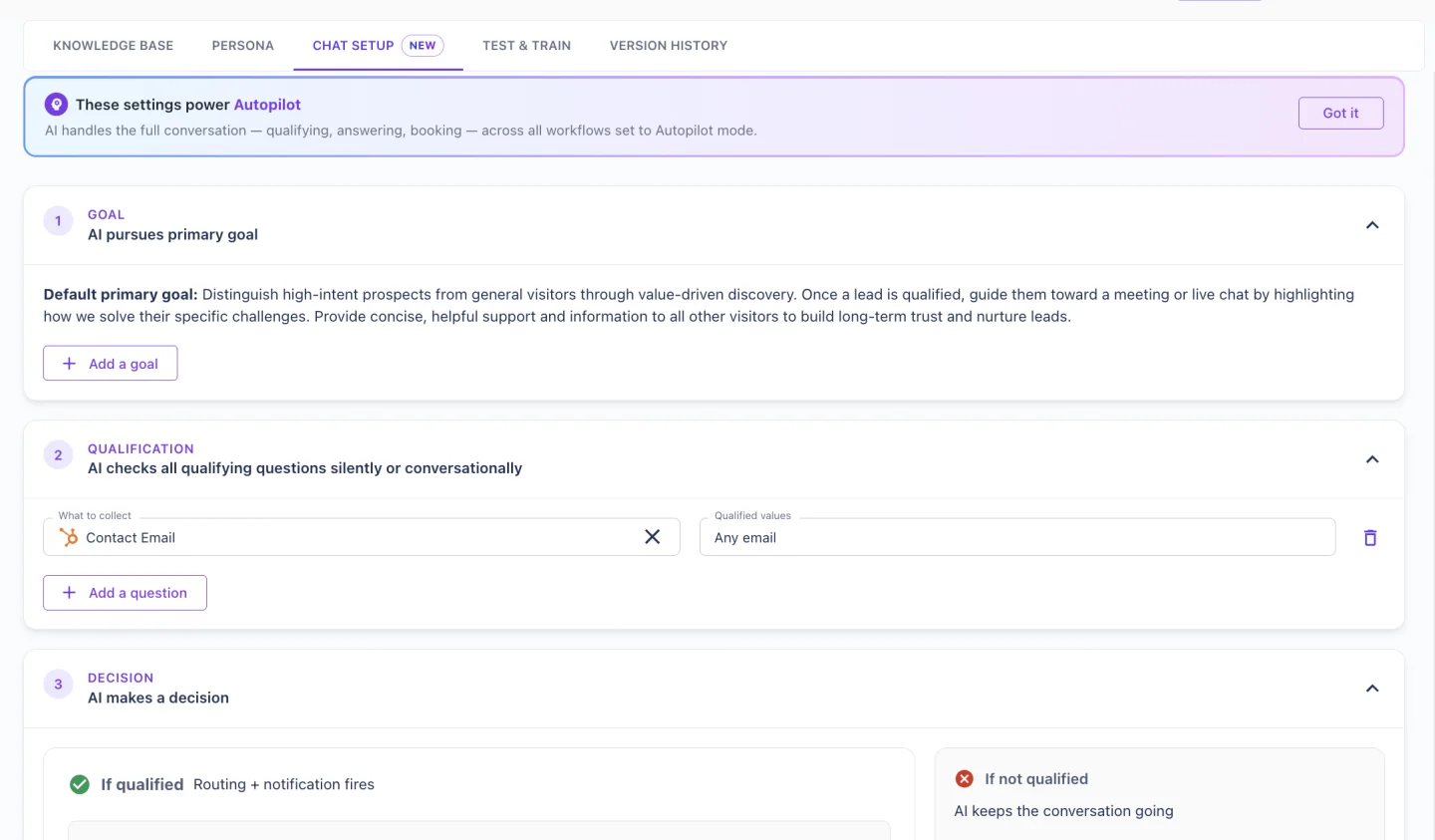
Autopilot has useful operator controls: a knowledge base, qualification questions, CRM mappings, goals, persona and tone, rules and constraints, routing, notifications, and a preview. Warmly's documentation says Test & Train checks only a single message; the widget preview is needed for a full exchange. V1 also cannot delay calendar display after qualification to give a human rep time to intervene. Test adverse inputs, false identity context, off-topic questions, bad qualification data, booking ownership, and escalation rather than judging the agent on a scripted demo.
Privacy and control boundaries
Warmly's July 12, 2025 privacy policy says the installed service can collect IP address, URL and UTM parameters, session cookie and status, form-fill information, user agent, chat messages, pages visited, time on page, and widget interactions. It also describes session-observing technology that can expose clicks, mouse movements, scrolling, typing, and other activity in real time. Warmly combines those signals with third-party data-provider records to infer identity and employment information.
Customers can choose read-only CRM access or enable writes, which is a useful deployment boundary. However, the public terms place responsibility for required notices, consent, opt-out, deletion, and other privacy mechanisms on the customer using the pixel and resulting personal data. A blocklist is an activation filter, not necessarily a collection control: Warmly's setup guide says blocked visits remain recorded but are excluded from reporting, Slack, chat plays, and automations.
The privacy policy says Warmly is a registered data broker in Texas. It also says that in the prior 12 months it sold, shared, or used for targeted advertising identifiers, internet or network activity, commercial information, and inferences. The retention section gives a purpose-based standard rather than a fixed deletion schedule. Warmly offers access, correction, deletion, objection, and opt-out request paths, including Global Privacy Control for its site. Review the customer DPA and product-specific data flow rather than assuming the website policy alone defines customer-data processing.
The public trust center lists CCPA, GDPR, the EU Data Act, and SOC 2, and makes reports, an AI FAQ, diagrams, policies, and other materials available through an access request. Those listings are useful diligence inputs, not evidence that a specific configuration, region, or plan is approved.
What a user reports
In a May 11, 2026 G2 review, Brendan F., an inside sales representative at a mid-market company, liked seeing job title, company, and viewed pages and described setup as easy. He also found the UI, visitor buckets, workflows, and orchestration membership confusing. The review is marked validated, sourced from a G2 invite on behalf of the seller, and incentivized. Use it as a prompt to test explainability and rep usability, not as performance evidence.
We did not install Warmly's pixel, use an account, measure identification accuracy or latency, exercise its agents, test CRM writes, or attribute pipeline to it. Vendor match-rate estimates and user-reported outcomes were not treated as independently verified results.
Choose Warmly when visitor intent is a proven input, conversion while the buyer is on-site is operationally valuable, and the team will own identity errors, latency, routing, and consent. If the real problem is joining signals from many channels into a governed buyer-intelligence layer, Common Room is the cleaner comparison. If the team mainly needs contacts and outbound sequences, Apollo is the more direct starting point.
Sources & further reading
- Warmly pricing, packages, credits, and add-ons
- Warmly website visitor identification product page
- Warmly data-quality, match-rate, timing, and credit guidance
- Warmly contact-level identification documentation
- Warmly AI Data Agent setup and blocklist behavior
- Warmly Slack integration and alert behavior
- Warmly Salesforce integration and write controls
- Warmly Autopilot setup, controls, and V1 limits
- Warmly MCP and API credit rules
- Warmly terms of service
- Warmly privacy policy
- Warmly trust center
- Brendan F. Warmly review on G2


