Tool
Amplemarket
Amplemarket review for outbound teams: 2026 pricing, Duo Copilot, intent signals, sequences, credit limits, privacy, and fit.
Verdict
Choose Amplemarket when an outbound team wants prospect data, person-level signals, AI research and copy, multichannel sequences, calling, and deliverability controls in one governed workflow. Its advantage is the connection from a reason to act to a researched lead and reviewable sequence. The $7,200 annual Startup commitment is poor value for contact lookup or cold email alone. Buy after a trial proves verified-contact yield, signal relevance, rep adoption, and clean CRM write-back in your actual market.
Amplemarket combines sales intelligence and sales engagement. Searcher finds people and companies; Duo Copilot monitors signals and proposes actions; Sequences coordinates email, LinkedIn, call, and task steps; Workflows routes records; and its deliverability tools monitor domains and mailboxes.
Start with the AI sales tools guide for the wider stack decision and the sales prospecting shortlist for pre-opportunity tools. Compare Apollo when a lower entry price and packaged database matter most. Compare Clay when you want to select enrichment providers and control research logic instead of adopting one vendor's outbound system.
Outbound-platform decision criteria
| Decision | Amplemarket is a fit when | Validate in the trial |
|---|---|---|
| Data coverage | One database should feed prospecting and execution | Check at least 100 known contacts per market for current employer, valid email, usable direct phone, duplicates, and missing records |
| Signal quality | Reps can act on person-level events | Replay wins and false positives; require a named person, source, time, and credible reason to act |
| Sequence execution | Email, LinkedIn, calls, and tasks belong in one cadence | Confirm automated versus manual steps, daily limits, throttling, opt-outs, failures, and pause/resume behavior |
| AI control | Admins need reusable positioning and signal playbooks | Review outputs for evidence, stale activity, language, persona fit, and approval before launch |
| CRM ownership | Salesforce or HubSpot remains the system of record | Test matching, field precedence, duplicates, ownership, write-back latency, deletion, and failed-sync recovery |
| Economics | Consolidation can replace enough existing software and labor | Count validations, enrichments, phone reveals, AI pools, mailboxes, seats, implementation, and add-ons |
Current pricing, credits, and contract terms
The live pricing table checked October 11, 2026 lists a free trial for every plan. Startup costs $600 per month on an annual term, includes two users, and creates a $7,200 base-year commitment. Growth and Elite require custom quotes.
| Plan | Public price | Included scale | Annual credits per user |
|---|---|---|---|
| Startup | $600/month, annual term | 2 users; 27,000 contacts; 2 mailboxes/user; 500 job-change contacts | 13,500 email; 600 phone |
| Growth | Custom | 4 users; 140,000 contacts; 4 mailboxes/user; 1,000 job-change contacts | 35,000 email; 5,000 phone |
| Elite | Custom | 10 users; 400,000 contacts; 8 mailboxes/user; 2,000 job-change contacts | 40,000 email; 9,600 phone |
All tiers list Searcher, Duo Copilot, multichannel sequences, workflows, analytics, outbound dialer, Domain Health Center, and Deliverability Booster. Growth adds Duo Voice. Elite adds Duo Inbox; the table marks Inbox as a Growth add-on. SSO appears only on Elite.
Two first-party pages conflict. The March 2026 pricing explainer says Startup includes 15,000 email and 480 phone credits per user, while the current plan table says 13,500 and 600. Use the current table for comparison, then put the actual allowance in the order form. The explainer prices an email reveal at one credit, validation or enrichment at half an email credit, and a phone reveal at one phone credit. Allocations renew annually; phone credits can be converted or purchased at $0.50 each. Duo products have separate pools whose sizes are not public.
Current terms make the order form controlling for price, licences, duration, limits, and renewal. Subscriptions renew automatically unless either party gives written non-renewal notice at least 60 days before term end. Standard payments are non-refundable, renewal increases are capped at 7%, and exceeding order-form limits can trigger charges, cancellation, or revoked access. On termination or expiry, the terms also require customers to delete Service Output Data, so define post-termination deletion scope and CRM field ownership before signing.
Where Amplemarket earns its place
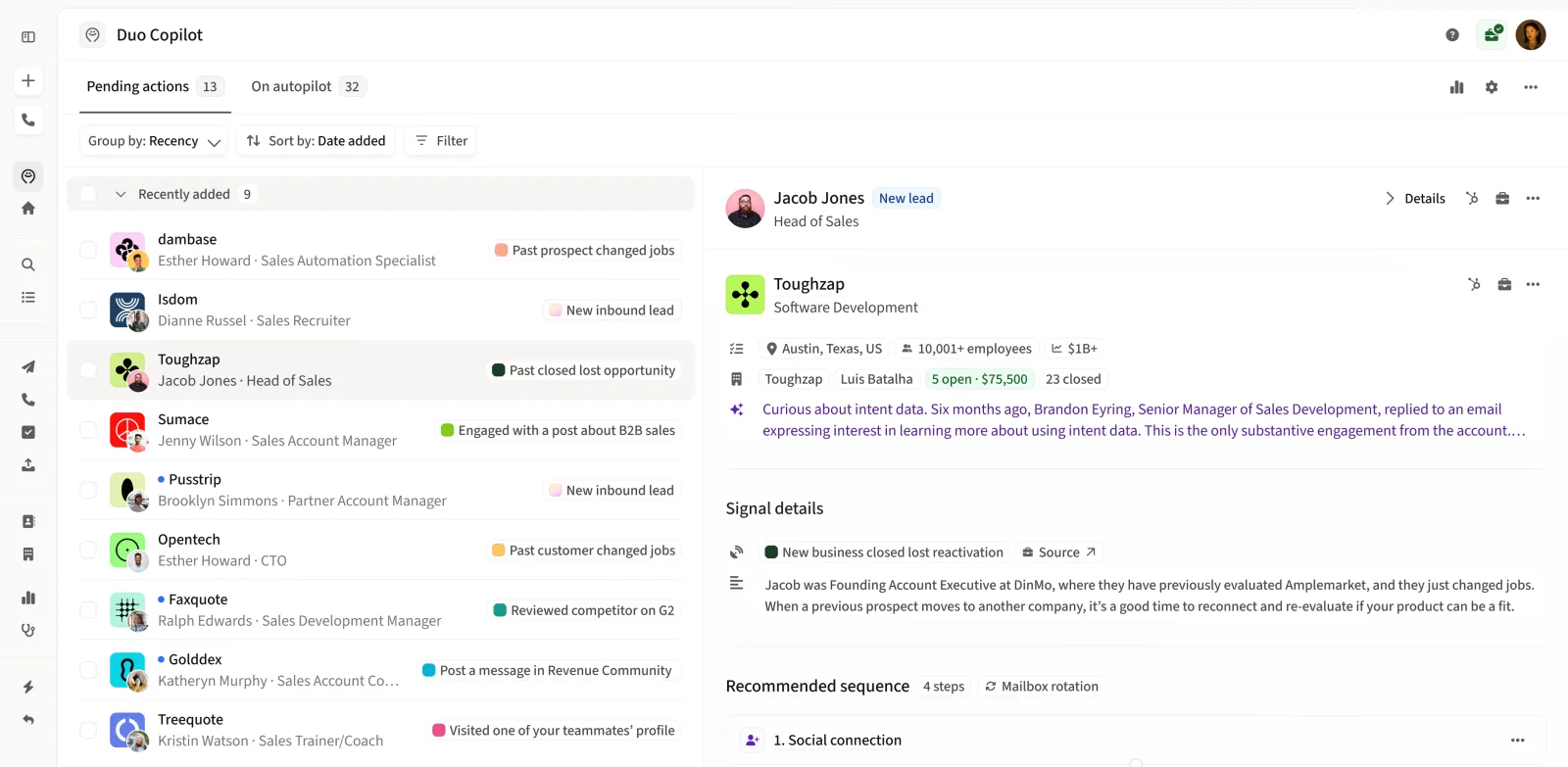
Duo Copilot joins targeting and timing. Admins can define personas, positioning, tone, sequence instructions, and signal rules. The product example shows a queue with pending and autopilot actions, account history, signal explanation, and a recommended sequence. That is useful when reps need a reviewable reason to contact someone, rather than another unprioritized list.
Sequences cover email, phone, LinkedIn, and task steps. CRM connections can push records and activity, while pull rules support exclusion lists. The Salesforce FAQ says pushes generally appear within minutes and pulls occur every three hours; it also requires Enterprise, or Professional with API access. Validate the specific objects and fields your team needs instead of treating “bidirectional” as a completeness guarantee.
The remote MCP server can search people and companies, enrich records, create lists, manage sequences, enroll leads, and inspect activity through compatible AI clients. Each user authenticates with OAuth and keeps their Amplemarket permissions. Enrichment costs 0.5 credit, email and phone reveals cost extra, cached enrichment avoids another charge for 24 hours, and the server is limited to 100 requests per minute per user.
MCP is also a write surface, not an automatic approval boundary. The current tool directory says update_sequence_status can launch a draft so it starts sending, and act_on_duo_lead can accept or schedule a lead. A June sequence guide still says launch requires the dashboard. Treat the newer directory as the safer assumption: inspect the tools exposed to each role, test in a controlled workspace, and require an explicit review step in the operating process. The same guide documents linear sequences, no branching or webhook steps, append-only stage creation, and dashboard-only stage deletion.
Use automated sales prospecting to design the surrounding workflow, account research for evidence standards, and cold-email personalization for review gates.
Limits buyers should test
Breadth creates implementation work. Signals, CRM mappings, mailboxes, sending rules, templates, territories, suppression, and ownership all need operators. Contact data and intent accuracy also vary by segment; published database size and vendor accuracy percentages cannot predict coverage for a specific geography or persona.
In an organic, validated G2 review dated November 19, 2025, Ben S. valued the automated sequence task flow and lead finding, but reported that pausing a sequence did not pause all steps and tasks; resuming created a backlog. A March 10, 2026 r/revops post by u/Infamous-Ebb6617 said an incumbent account had used roughly 10% of the platform, mainly for enrichment and list building, before the author began rolling out signals and Duo. These are individual anecdotes, not measured performance. Together they support two trial checks: pause/resume a live-like cadence, and measure whether reps actually adopt the features meant to justify consolidation.
Privacy and data boundaries
Amplemarket separates its business service from its data-broker operation. The broker notice says it licenses business-professional information and retains that directory data indefinitely while refreshing it. It offers access, correction, deletion, and opt-out processes, but customers still own lawful basis, notices, suppression, and regional outreach rules.
The public documents create a diligence question. The business privacy policy says customer personal information is kept under the written agreement and then for at least five years. The current terms grant Tagis broad, perpetual rights to use customer-submitted content to provide and improve the service, analyze it with machine learning, and use aggregated or de-identified forms. The public trust page, meanwhile, lists customer-data deletion on departure as a control. These statements may apply to different data classes or negotiated terms; they do not reconcile that boundary publicly. Require the signed DPA and order form to define customer content, mailbox data, service-output data, AI/model use, subprocessors, deletion, backups, and post-termination retention.
We did not operate an Amplemarket account, test its database, measure signal precision or deliverability, or audit its integrations. Vendor accuracy claims and case-study outcomes are excluded from this verdict.
Choose Amplemarket after a replay proves that its signals identify the right person at a useful moment, its contact data holds up in target markets, and reps use the connected workflow. Otherwise, start with Apollo for a lower-cost packaged system or Clay for configurable data orchestration.
Sources & further reading
- Amplemarket plans, prices, credits, and limits
- Amplemarket 2026 pricing and credit explainer
- Amplemarket subscription and customer-content terms
- Amplemarket MCP capabilities, credits, permissions, and rate limit
- Amplemarket MCP sequence limitations
- Amplemarket Salesforce integration behavior
- Amplemarket roles and permissions
- Amplemarket business-services privacy policy
- Amplemarket data-broker privacy notice
- Amplemarket security and trust center
- Amplemarket practitioner discussion on Reddit
- Amplemarket user review on G2