
Tool
Tines
Tines review: compare 3B and Stories, current plans, Tines Units, AI, approvals, retries, hosting, security controls, and operational limits.
Verdict
Choose Tines when Security or IT owns important API-driven workflows and needs protected credentials, granular access, auditability, isolated code execution, deployment choice, and controlled promotion to production. Tines 3B is strongest for governed agents, internal apps, and automations that must reach sensitive systems. Tines Stories remains the established visual security-automation product. Do not treat them as one plan: their builders, limits, AI metering, approval patterns, and free editions differ. Teams that mainly connect ordinary SaaS apps and want public, predictable entry pricing will usually get to value faster with a general automation service.
Tines now presents two live product surfaces. Tines 3B is the current AI-native environment for building, running, and monitoring agents, apps, and automations. Its steps are code-backed, run in isolated containers, and can be edited through chat, the browser, Git, CLI, API, or MCP. Tines Stories is the mature visual workflow product built around storyboards, actions, events, Pages, Cases, Workbench, and security operations. The public pricing page leads with 3B, while its startup offer and separate documentation still refer to Stories.
Start with the AI workflow automation shortlist if the category is still open. Compare n8n for a broader developer automation ecosystem and free self-hosting, Workato for enterprise integration governance across business applications, and Microsoft Power Automate for Microsoft 365 and desktop automation. Make is the more approachable visual option for ordinary SaaS operations.
Use these criteria before choosing Tines
| Criterion | Tines fits when | Validate before rollout |
|---|---|---|
| Workload | Security response, identity lifecycle, infrastructure, compliance, or other high-consequence API work is the core job | Prove the complete alert, ticket, identity, and evidence path with production-shaped payloads |
| Product line | 3B's code-backed runtime or Stories' visual actions match the team that will own the workflow | Get the order form to name 3B, Stories, or both; do not rely on the generic Tines label |
| Integration model | The team can work from HTTP APIs, MCP, code, and protected connectors instead of requiring a polished connector for every action | Test pagination, provider rate limits, attachment handling, webhook authentication, and credential rotation |
| Access control | Spaces, groups, service accounts, connector grants, SSO, SCIM, and audit logs are purchasing requirements | Model exactly who can view a space, edit a workflow, use a credential, and push live |
| Human review | Review can be implemented as a route, Page, chat action, or external ticket step | Test identity binding, expiry, replay, mutable targets, and fail-closed behavior; 3B and Stories use different patterns |
| Recovery | Per-step retries, run records, branches, and version recovery are enough for the failure model | Exercise ambiguous API timeouts, duplicate writes, partial completion, rollback, history retention, and evidence export |
| Hosting | Vendor cloud, dedicated infrastructure, Kubernetes, or an air-gapped deployment is needed | Price infrastructure, upgrades, backup, monitoring, storage, support, and disaster recovery together |
| Cost | A custom platform contract plus capacity and model usage is acceptable | Benchmark representative runs because Tines does not publish the Tines Unit formula or dollar overage rate |
Current 3B pricing is capacity-based, with no public paid price
The pricing page and 3B packaging guide were checked October 19, 2026.
| 3B edition | Public price | Infrastructure | Included runtime and key boundary |
|---|---|---|---|
| Explore | $0 | Multi-tenant | 5,000 Tines Units/month, 3 live workflows, one-time $50 AI allowance, no public website URLs |
| Core | Custom | Multi-tenant AWS stack | 100,000 Tines Units/month and unlimited workflows |
| Scale | Custom | Dedicated stack | 300,000 Tines Units/month and unlimited workflows |
| Power | Custom | Premium dedicated stack | 900,000 Tines Units/month and unlimited workflows |
All editions advertise unlimited users, spaces, and connectors. A live workflow is an agent, app, or automation pushed live in a private or shared space; the three-workflow cap applies only to Explore.
A Tines Unit combines compute, storage, and data transfer. The docs say complexity and frequency affect consumption, but they do not publish a reproducible formula, a dollar overage rate, or public plan prices. Overages are billed after a one-month grace period. Ask Tines to meter the same workload shape used in the proof of value, including code builds, retries, stored artifacts, outbound data, and AI-related tasks. A quota number without a unit formula is capacity vocabulary, not a forecast.
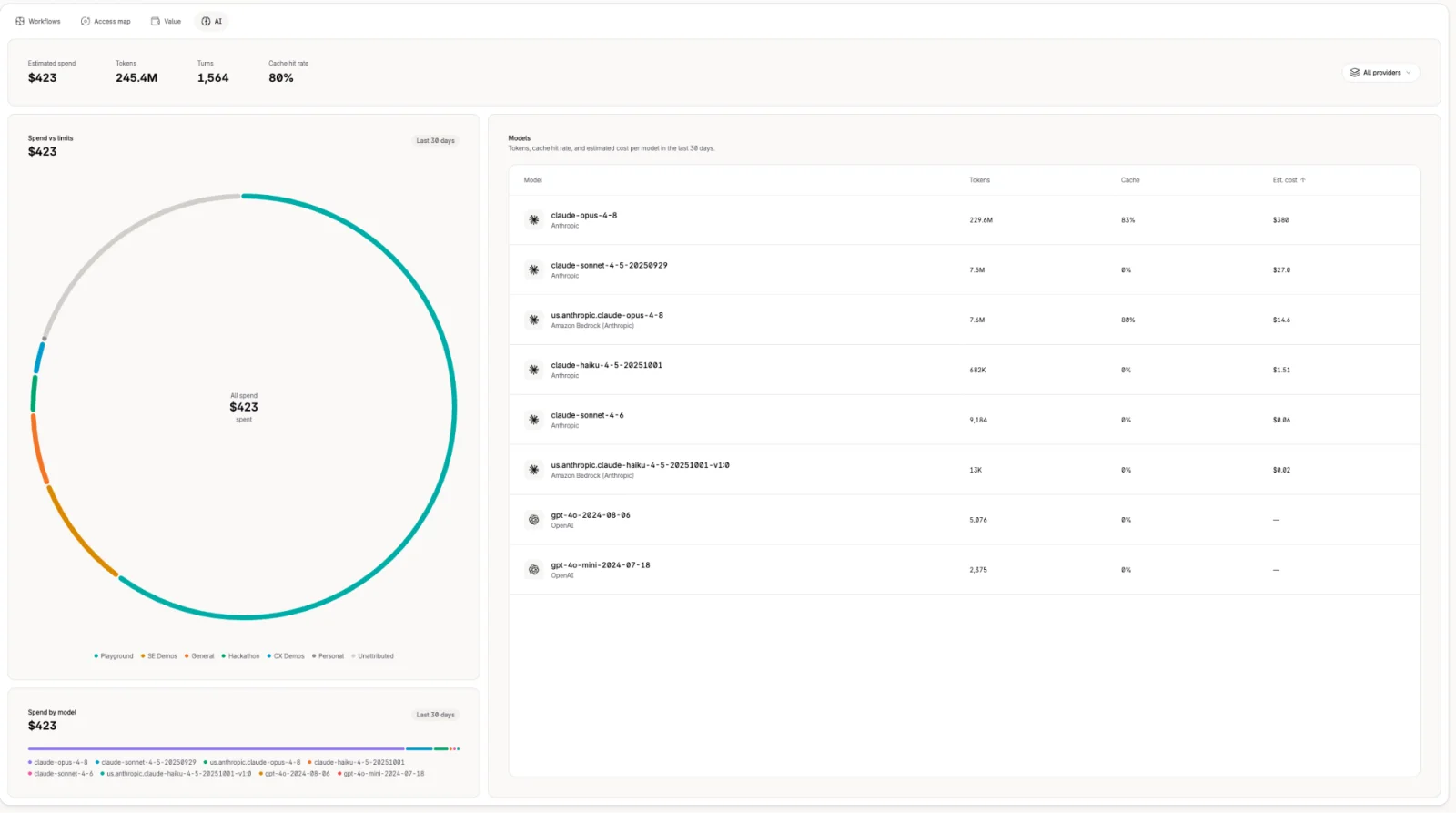
Paid 3B uses bring-your-own-model. Model tokens remain a separate provider cost, and the platform's AI-cost dashboard estimates spend from rates configured by the customer rather than reading the provider bill. Explore's one-time $50 allowance is different from Stories Community's 50 monthly AI runtime credits.
3B and Stories are separate buying decisions
The current Stories packaging guide gives Community Edition one builder, three flows, 25,000 events per month, and 50 monthly AI runtime credits. Business starts at 100 users, 30 flows, and 1.5 million events per day, with contract pricing. Those are Stories limits. They are not 3B limits, even though both products use the Tines name and both free plans allow three live workflows or flows.
Stories is the more direct continuation of classic security orchestration: a visual storyboard, prebuilt action types, Pages for human input, Cases, event histories, and change control. 3B treats a workflow as code and files, with Python, TypeScript, shell, React, and agent templates in containerized steps. Every space can also act as a Git repository. This makes 3B unusually flexible, but it shifts review toward code, permissions, runtime behavior, and operational ownership.
Tines' Stories AI-credit documents currently conflict on Community top-ups. The AI-credit guide says Community users can buy non-expiring top-up credits; the current usage-calculation page says they cannot. Confirm the live billing screen or contract before using top-ups in a capacity plan.
Credentials and execution are built for sensitive systems
In 3B, a connector stores credentials and injects them through the network proxy rather than exposing the secret directly to step code. Each step runs in a fresh gVisor-backed sandbox with a read-only filesystem outside its scratch area, stripped privileges, memory and time limits, and shaped network throughput. Persistent data must be placed deliberately in a volume.
Access is explicit across users, groups, service accounts, spaces, connectors, skills, and networks. A person can edit a space without automatically receiving the right to use a connector. In fact, a connector is available in a space only when everyone with relevant space access has the required connector access. That conservative rule reduces accidental credential sharing, but it can surprise teams adding a viewer or collaborator. Test the access map with real job roles before migration.
MCP follows the same permissions. A service-account bearer token can explore, trigger, and ask 3B to build, but direct build-and-publish tools require OAuth acting as a user. Mutating MCP actions are recorded in the audit log. This is a meaningful governance boundary; it is not approval of the workflow's downstream business action.
Human approval is composable rather than a universal pause button
The public 3B documentation does not describe one native runtime approval action that pauses any workflow. In an official Tines Community answer, leah explained on July 30, 2026 that the recommended 3B pattern is two runs: the first sends approve and deny links, ends, and a later authenticated route request starts the approved or denied branch. Tines' own example adds an SSO-protected review page, editable draft, current-record check, and duplicate prevention before publication.
That pattern is flexible, but the builder owns state and security. Bind approval to a named identity and immutable request ID, expire links, revalidate the target, consume the decision once, and make the write idempotent. A bare /approve URL sent to chat is not an authorization design.
Stories uses a different model. Pages and chat prompts can collect input inside a story, and change control can require review before production promotion. Validate the actual edition because Stories approval behavior is not evidence of a 3B feature.
Recovery is inspectable, but retries still need application design
3B records each step execution's input, output, log, status, queue time, and runtime. A retry becomes a new linked execution rather than overwriting the failed attempt. The documented code configuration allows a 1–300 second timeout, default 45 seconds, and an explicit list of retry delays. Each retry restarts the whole step, so automatic replay is safe only when the external side effect is idempotent or guarded by a durable key.
Live runs are tied to the workflow version that started them. Run views show a waterfall and separate queue time from execution time. Draft branches isolate code, manual tests, and volumes from the live branch; automatic triggers do not fire on drafts. A past version can be forked into a new branch for recovery. Optional Autofix analyzes a live failure, proposes and tests a change in a separate branch, and waits for a person to accept, iterate, or reject it. It cannot repair provider outages or credentials, and its test does not prove a replay is free of duplicate external effects.
The public docs say execution records follow configurable retention settings but do not publish a universal hosted retention period. Put the required history, audit-log export, deletion, and legal-hold windows in the order form. Forward audit logs to durable storage when compliance evidence must outlive the application UI.
Cloud convenience and self-hosting have different operating costs
Core runs on a multi-tenant AWS stack; Scale and Power use dedicated stacks. Tines also documents customer-hosted 3B on Kubernetes and an air-gapped bundle. The single-server installer is explicitly for evaluation: it has no redundancy or high availability. Production self-hosting uses Helm on Kubernetes.
Self-hosting does not outsource operations to Tines. The Helm guide assigns the customer responsibility for the cluster, load balancer, TLS, DNS, PostgreSQL, persistent storage, backups, monitoring, alerts, upgrades, and recovery. 3B does not ship a metrics dashboard or alerting stack for the cluster. Its docs recommend connecting Prometheus, Datadog, CloudWatch, or an equivalent pipeline. Price those duties and test database plus blob-storage restore before calling self-hosting a resilience feature.
For AI privacy, the current Tines privacy policy says it does not use Personal Data to train public or third-party foundation models. Stories' Tines-hosted models have more specific no-training and in-region documentation. 3B's paid model is BYOM, so the selected provider's endpoint, logging, retention, training, and region terms also apply. Review the DPA, AI addendum, hosting region, subprocessors, and provider contract together.
What practitioners report
In a May 7, 2024 r/cybersecurity comment, u/tglas47 said their team used Tines for most alerting plus user provisioning and de-provisioning after about a month with the platform. In the same May 2024 discussion, u/TacticalCheerio said they had used Tines and XSOAR heavily and preferred Tines' architecture and scaling approach.
These are unattributed-to-employer practitioner reports, not benchmarks. They predate the July 2026 launch of 3B and therefore support the established Stories/security-automation context only. They do not validate current 3B reliability, paid pricing, support, or capacity.
This is a desk-researched profile; we did not use an authenticated Tines tenant or validate workflow reliability hands-on.
Choose Tines when the team needs a security-first orchestration control plane and is prepared to validate cost and failure behavior in a proof of value. Choose n8n when deployment control and general developer automation matter more than security-specific governance, or Make when visual SaaS automation and easier handoff are the priority.
For implementation, read build human-approved AI automation flows and automate employee onboarding workflows.
Sources & further reading
- Tines pricing
- Tines 3B pricing and packaging
- What is Tines 3B
- Containerized execution
- Build with coding tools
- Tines 3B roles and permissions
- Connector availability and access
- Tines 3B MCP access
- Tines 3B workflow execution monitoring
- Tines 3B monitoring dashboard
- Tines 3B AI cost monitoring
- Tines 3B retries and execution history
- Tines 3B branches
- Tines 3B version recovery
- Tines 3B autofix
- Tines 3B self-hosting requirements
- Tines 3B Helm installation responsibilities
- Tines 3B self-hosted monitoring responsibilities
- Tines 3B approval pattern
- Tines 3B human-approved publishing example
- Tines Stories pricing and packaging
- Tines Stories AI credits
- Tines Stories usage calculation
- Security and privacy for AI in Tines Stories
- Tines AI and privacy
- Practitioner security automation report
- Practitioner Tines versus XSOAR report