Use case
Enrich and Route Inbound Leads with AI (2026)
Turn inbound forms into accountable CRM handoffs with identity checks, bounded enrichment, owner precedence, replay protection, and an explicit fallback queue.
Verdict
Keep the CRM's existing owner and account rules authoritative. Use AI to extract the request and propose missing routing facts, then assign through a deterministic rule table. Choose Make for an operations-owned visual flow, n8n for custom APIs and a durable processing store, or Workato when an integration team needs governed cross-system recipes. Preserve intake before enrichment: a provider outage must delay classification, not lose the enquiry.
This guide starts with a person who has submitted an inbound request and ends with a recorded owner, reason, and handoff deadline. CRM enrichment owns field maintenance on existing records; lead scoring owns prioritization. Neither substitutes for deciding who must act on a new enquiry. Compare the broader builders in AI workflow automation tools.
Define the handoff before the model
Agree on the smallest useful result: one retained enquiry linked to the right person/account, one accountable owner or staffed fallback queue, and one auditable reason. A sales alert is not ownership, and a high model score does not establish territory eligibility.
| Routing input | Authority | What AI may do |
|---|---|---|
| Existing account/contact owner and open opportunity | Current CRM lookup | Summarize context; never replace ownership |
| Product request and use case | Submitted message with evidence span | Extract into a controlled enum, or return unknown |
| Region, employee band, industry | Form plus approved enrichment sources | Propose missing values with source and retrieval time |
| Suppression and communication preference | Authoritative CRM or consent record | Preserve; never infer permission from an enquiry |
| Territory, coverage hours, capacity | Versioned routing policy and current roster | No free-form owner selection |
Avoid buying enrichment that cannot change the route. If existing account ownership already resolves the handoff, retain that route immediately and run optional research later. Define a deadline for enrichment; when it expires, route to a staffed queue with enrichment_pending and reconcile later without silently stealing ownership.
Capture an event and a person separately
Validate the form source, required fields, payload size, and expected event type before model inference. Authenticate webhooks using the source's supported mechanism and keep secrets outside the payload. The n8n Webhook node distinguishes test and production URLs and supports authentication settings; verify the production endpoint receives a real source event before retiring the old path.
Persist the accepted event in a durable intake ledger before acknowledging your own successful processing. A platform's automatic queue acknowledgement can mean only “received,” so maintain a separate completion status and reconciliation job. Retain minimal personal data, access controls, and a documented retention period.
Use three identifiers:
event_key: source plus the provider's stable submission/event ID;person_ref: a resolved CRM contact or lead identity;request_ref: the specific enquiry being handled.
One person can submit two legitimate requests. One request can be delivered repeatedly. Normalizing an email address helps matching but is not enough to merge ambiguous people or choose between two CRM records. Preserve the request while a reviewer resolves identity conflicts.
In a September 15, 2026 n8n community thread, template author Medac describes a Data Table demonstration and explicitly limits it to lower-concurrency use. Walid_Chibi points out that different submission keys can still represent the same person; Medac acknowledges that distinction. This is an attributed implementation discussion, not our test or evidence of production reliability.
Enrich into a proposal
Look up existing CRM identity and ownership first. Then request only the missing fields required by the route: for example company domain, account segment, region, or requested product. Cache source results under an explicit freshness rule, and record source URL or provider record ID. Never turn an empty provider response into an instruction to erase a verified field.
Use AI for language extraction rather than guessing hidden commercial facts. Give it the submitted text and an allowed list of request types; require supporting spans. Do not ask it to invent employee count, infer buying authority from a name, or choose a sales representative.
An illustrative proposal could be:
{
  "event_key": "demo-form:submission-1842",
  "request_ref": "inquiry-1842",
  "crm_contact_id": "contact-291",
  "crm_revision": "rev-17",
  "request_type": "product_demo",
  "product": "analytics",
  "evidence": [{"field": "message", "span": "Can we see an analytics demo?"}],
  "enrichment": {"employee_band": null, "status": "provider_unavailable"},
  "route_reason": "existing_account_owner",
  "policy_version": "inbound-v3"
}
Treat the form message and retrieved pages as untrusted data. Keep the model away from write-capable CRM tools; validate enum values and evidence before policy evaluation. An instruction inside a form saying “assign me to the CEO” must remain message text.
Apply owner precedence once
Define an ordered policy whose output is a single route. Do not create independent overlapping branches that each assign someone.
| Condition, in precedence order | Handoff |
|---|---|
| Suppression or disallowed processing condition | Restricted review; no automated outreach |
| Existing opportunity or protected named account | Current accountable owner, subject to roster validation |
| Existing contact/customer relationship | Existing-owner policy; support requests go to the agreed service path |
| Verified territory and product match | Eligible pool; allocate using atomic capacity/rotation state |
| Conflicting identity, unknown territory, unavailable owner, or expired enrichment wait | Staffed fallback with explicit reason and deadline |
For round robin, reserve the next eligible owner atomically. Two concurrent executions must not both read the same rotation counter and overwrite each other. Respect leave and coverage windows, and distinguish assignment time from the time a human accepts the handoff.
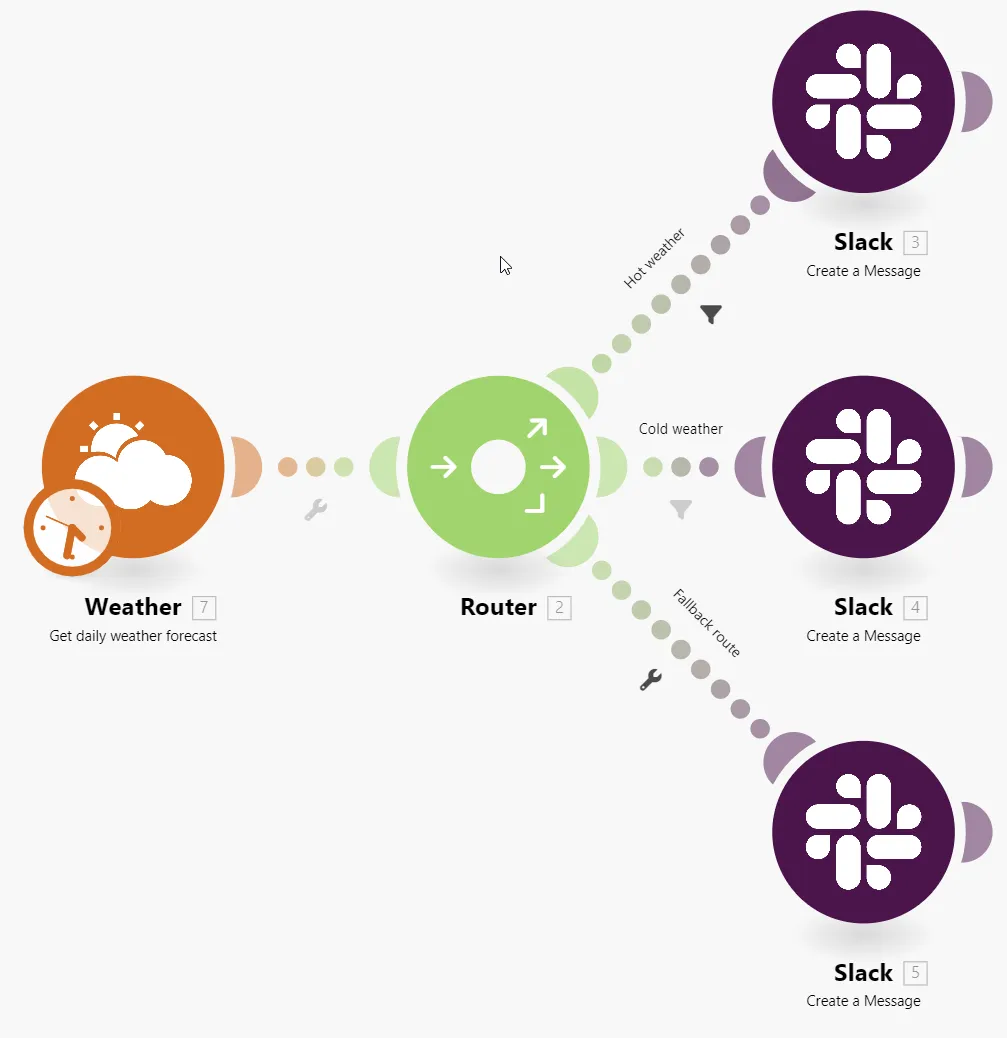
Make's router processes branches in sequence and supports a fallback. Sequential branch order alone does not make filters mutually exclusive. Calculate a route code first, then have each branch accept only that code. Also distinguish branch sequencing from whole-run concurrency: instant webhook runs are parallel by default. Process data in order serializes that scenario, but a shared database constraint is still needed when other workflows can write the same records.
Write without erasing a human decision
Re-fetch the destination immediately before assignment. If the owner, record revision, opportunity, or suppression state changed during enrichment, discard the stale proposal and reevaluate. Use destination conditional writes where available; otherwise serialize writes per record and reconcile conflicts. A last-second read alone does not eliminate the race.
Write the accepted owner, route reason, policy version, deadline, source request, and supporting evidence. Update only approved fields. The n8n HubSpot node supports contact create/update, search, and recent records; Make's HubSpot modules provide contact and CRM actions. Availability of an action does not prove its field mapping or scopes fit your account—verify those against a sandbox record.
Workato's Salesforce upsert matches a chosen external ID, creates on no match, and errors on multiple matches. Configure the destination field as unique where appropriate. The screenshot shows that selector in a batch action; it does not establish that two different external IDs belong to different people. Keep person matching separate from event idempotency.
Recover each effect independently
An atomic claim on event_key prevents two workers from owning the same intake event, but does not make an external API call exactly once. Store processing stages and the destination result ID. Give claims leases or another explicit recovery policy so an interrupted worker cannot strand the lead indefinitely.
If a CRM request times out after possibly succeeding, look up the result by the destination idempotency/external key before sending another create. If the destination cannot support that lookup or deduplication, send the ambiguous result to reconciliation. A successful record write followed by a failed Slack notification should retry only the notification.
Workato reruns reprocess the full recipe using cached trigger data and can create duplicates. Make incomplete executions are disabled by default; enable and monitor them deliberately. Neither is a substitute for your record and notification guards.
Monitor intake count, oldest unassigned request, expired claims, enrichment backlog, and failed notifications. Reconcile the source's submission list against the ledger where the source exposes one. An error alert cannot detect an event that never arrived.
Choose by operations and billing limits
Public prices checked October 17, 2026. These are platform entry prices, not the cost per accepted lead; CRM subscriptions, data providers, external models, and infrastructure may add cost.
| Builder | Fit for inbound routing | Current entry economics | Limit that changes the design |
|---|---|---|---|
| n8n | Technical owner needs API/code steps and control of event persistence | Starter €20/month billed annually, 2,500 executions and five concurrent executions; Pro €50/month billed annually, 10,000 executions | Price per complete workflow run, not per step; avoid equating one enquiry with one run if callbacks and recovery trigger additional workflows |
| Make | Operations team needs visible filters, mappings, and fallback routes | Free 1,000 credits/month; at 10,000 credits, annual monthly equivalents Core $12, Pro $21, Teams $38 | Free scheduled polling minimum 15 minutes; webhook queue allowance is 667 items per 10,000 licensed monthly credits, capped at 10,000 items per webhook; a full queue rejects intake |
| Workato | Integration team owns Salesforce and multiple business systems | Billing docs list Pro $75/month for 2,500 credits; marketing features $100/month for 3,500; Free grant is 50,000 credits once | Credits are not leads. Environment separation is plan-specific; verify entitlement rather than assuming the entry plan includes enterprise governance |
Sources: n8n pricing, Make pricing, Workato billing, public plan cards, and environment documentation. Workato's billing page describes Free and Pro as sharing platform capabilities, while its plan cards distinguish features; obtain the specific connector, user, and governance entitlement before purchase. Make's annual selector was verified at 10,000 credits; confirm the selected cadence and allowance at checkout.
Acceptance cases before automated assignment
Use sanitized fixtures and shadow mode; compare proposed ownership with an independently reviewed expected owner before enabling writes.
| Test | Required result |
|---|---|
| Same event delivered twice concurrently | One persisted intake claim and no extra business effect |
| Same key with changed business payload | Conflict visible; no silent replacement |
| Same person submits a different request | New request preserved, identity reused when confirmed |
| Existing account owner changes during enrichment | Old proposal rejected or reconciled |
| Enrichment rate limit, timeout, or missing result | Intake retained; fallback deadline still met |
| CRM accepts write but response is lost | Lookup/reconciliation before another create |
| Notification fails after assignment | Owner unchanged; only notification retried |
| Unknown territory or owner on leave | Staffed fallback, never an unowned dead end |
Track intake-to-owner and intake-to-human-acceptance separately, duplicate effects, wrong-owner corrections, unresolved identity conflicts, fallback age, and total enrichment/model cost per retained enquiry. Include unknown and failed cases in the denominator. These are proposed acceptance criteria, not measured results.
For external actions that need a reviewer, use the human-approved automation guide. For requests arriving by email, start with shared-inbox triage. This guide is based on public documentation and attributed community discussion; we did not connect these products to a CRM or benchmark routing accuracy, delivery time, or conversion.
Sources & further reading
- n8n Webhook node
- n8n HubSpot node
- n8n pricing
- Make webhooks and queue limits
- Make routers and fallback routes
- Make HubSpot CRM modules
- Make incomplete executions
- Make pricing
- Workato Salesforce upsert
- Workato job reruns
- Workato environment entitlements
- Workato self-service billing
- Workato public plan cards
- Community discussion distinguishing request and person deduplication



Ordered for comparison, not as a universal ranking. Inclusion requires a direct fit with this page's stated workflow.