
Tool
Synthesia
AI avatar video platform for training, onboarding, internal communications, localization, and governed business production.
TL;DR
- Best for repeatable training, onboarding, and internal videos built from approved scripts.
- Combines stock or custom avatars, templates, narration, screen content, translation, and team controls.
- Evaluate plans using finished video minutes and localization volume, not the avatar count alone.
- Less convincing for emotional brand storytelling or footage that depends on natural physical performance.
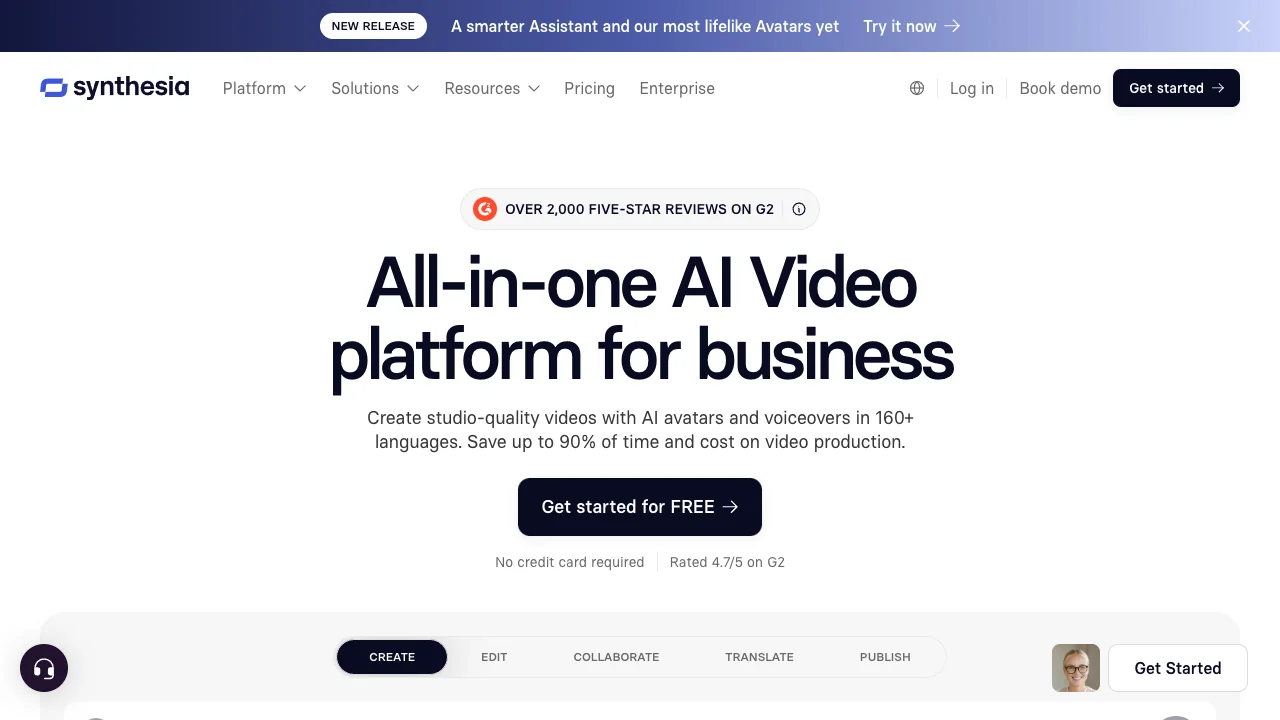
Synthesia turns a script and slide-like scenes into presenter-led video. Its center of gravity is business communication: learning teams, enablement teams, and operations groups that need consistent output across many topics or languages without scheduling a studio shoot for every update.
Decision snapshot
| Question | Answer |
|---|---|
| Best use | Employee training, product education, onboarding, and localized internal communication |
| Production model | Script, scene, avatar, voice, supporting media, then render |
| Strongest advantage | Repeatability and governance across a library of business videos |
| Main constraint | Avatar delivery can feel synthetic, especially in long or emotionally nuanced segments |
What Synthesia does well
The editor is structured around scenes, so subject-matter experts can update one policy step without reshooting an entire lesson. Templates preserve layout, branded elements keep output consistent, and translation can reuse the visual sequence instead of rebuilding it language by language. Enterprise buyers also get a more deliberate approval and governance story than consumer-first generators usually provide.
This is a practical replacement for a recurring production process, not for human presence itself. It works best when the presenter's job is clarity: introduce a module, explain a process, or connect screen recordings and diagrams.
Where it falls short
Viewers notice repetitive gesture patterns and flat delivery when a synthetic presenter carries too much of the runtime. Break long lessons into short scenes, alternate the avatar with screen content, and keep a human review of names, pronunciation, pacing, and translated claims.
In an instructional-design discussion, practitioners described Synthesia as useful when turnaround and localization mattered, while cautioning that stakeholders can overestimate how engaging an avatar makes weak training. That is the right warning: fix the script and instructional design before rendering it.
Bottom line
Choose Synthesia for governed, repeatable business video libraries. Choose HeyGen for faster creator-style avatar experimentation, or a human presenter when credibility and emotional delivery are central to the message.
Sources & further reading


Appears in