
Tool
ResearchRabbit
Evaluate ResearchRabbit for citation discovery by seed limits, RR+ pricing, Zotero import and export, search coverage, sharing, and privacy boundaries.
Verdict
Choose ResearchRabbit when you already have relevant papers and want to discover connected work through citations, references, authors and a visual map. Start with Free; pay for RR+ when larger seed sets, advanced filters or separate projects solve a specific research bottleneck. Keep a reference manager and a reproducible database-search log alongside it.
The deciding question is whether iterative exploration helps you find useful material beyond your starting library. A persuasive graph does not establish exhaustive coverage, methodological quality or support for a scientific claim. Use the research-tools shortlist for category selection and the literature-review workflow for the broader review process.
Decision snapshot
| Criterion | Current boundary | Decision implication |
|---|---|---|
| Starting material | A seed set drives connected discovery | Compare results from several independent starting papers |
| Free allowance | Unlimited searches and collections; up to 50 seeds | A large saved library does not require a paid plan by itself |
| RR+ allowance | Up to 300 seeds, advanced controls and multiple projects | Pay for the search constraint you actually encounter |
| Search method | Connection-based candidates with fixed ranking | Preserve separate keyword/database searches and exclusion records |
| Zotero workflow | Authorized import; export back to the reference manager | Do not assume background two-way synchronization |
| Sharing | Editors/viewers or a public collection link | Review notes and subcollections before sharing |
What the map can and cannot tell you
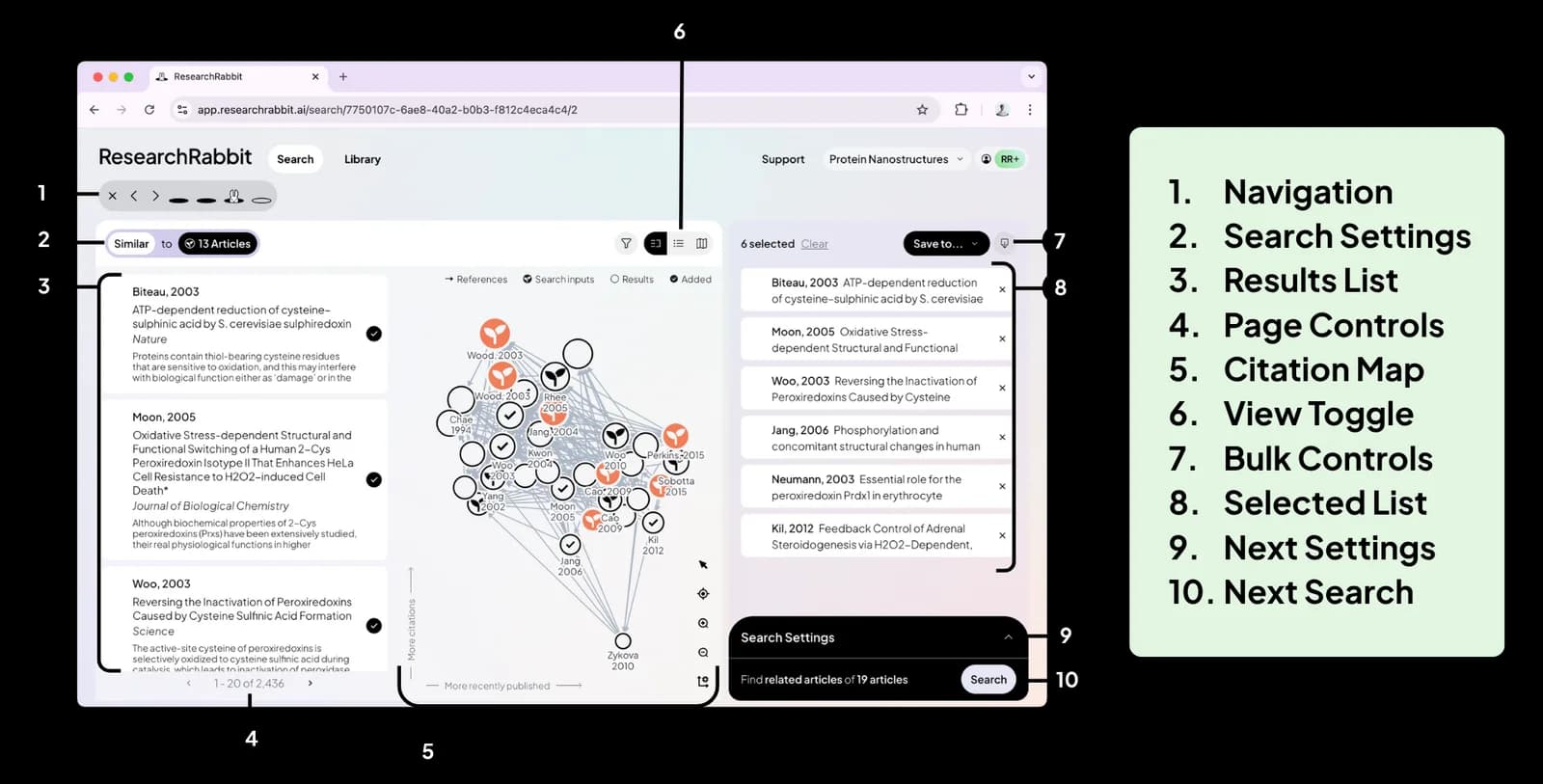
ResearchRabbit's algorithm documentation describes candidate discovery from relationships to seed papers: direct or shared citations and references, authorship connections, and sometimes title/abstract similarity. It then ranks candidates by connectedness. “Similar,” “References” and “Citations” change the candidate pool; the ranking itself cannot currently be fine-tuned.
That is useful for following a research lineage or finding vocabulary you did not know to search. It also makes the starting set consequential. Our editorial recommendation is to use seeds from different research groups and include contradictory findings, then check what each starting set fails to surface. This is an evaluation method, not a claim that we measured ResearchRabbit's recall.
The same documentation says advanced keyword filters use loose matching rather than Boolean operators. Do not paste a database query into a keyword filter and assume equivalent semantics. Journal quartiles and H-index filters concern journals; they are not assessments of an individual study's design or validity.
The search guide supports starting with keywords, a DOI, a saved collection or a BibTeX import. Select useful results and continue into another search step; save papers during exploration rather than relying on a final map as your only record.
Pricing and limits checked October 26, 2026
The live pricing page shows different prices when its billing selector changes:
| Plan | Public price | Relevant scope |
|---|---|---|
| Free | $0 | Unlimited searches, library and collections; collaboration; up to 50 seed articles |
| RR+ annual option | $10 per month displayed with Annual plan selected | Up to 300 seeds, advanced controls, multiple projects and Signals alerts |
| RR+ monthly option | $12.50 per month | Same listed RR+ feature set |
| Institution | Contact sales | RR+ plus volume pricing, LibKey integration, user management, usage statistics and dedicated support |
Country-specific discounts are advertised. The FAQ still describes $10 as the default and subscriptions as monthly payments; that wording does not distinguish the two visible billing options. Use the selected plan and checkout terms to confirm charge timing, renewal and local eligibility. No annual invoice amount was verified here.
The Free tier guide includes citation maps, collections/subcollections, notes, Zotero import, collaboration and BibTeX transfer. Its paid boundary is chiefly advanced discovery and organization. The 50/300 limits apply to starting articles in a search, not total papers saved in the library.
Zotero import is not two-way sync
The current Zotero integration guide describes authorizing an account, selecting a Zotero collection and choosing articles plus a destination ResearchRabbit collection. It says two-way sync is being developed. For the return trip, it directs users to export and import BibTeX into Zotero.
The separate sharing/export guide lists BibTeX, RIS and CSV exports. Before committing a review, try a small round trip with duplicate records, missing DOIs, non-English titles and any notes you need to preserve. Verify each field after re-import; the existence of an export button does not establish complete annotation transfer.
Keep the reference manager as the publication bibliography and ResearchRabbit as the discovery workspace unless your own round-trip check supports another arrangement. This avoids confusing an exploratory collection with the review's screened and deduplicated evidence set.
Signals is a screening aid
The July 2026 release introduced Signals indicators for RR+ based on citation behavior and citation networks, alongside a reading list and configurable map-result counts. The map can show 10, 20 or 40 results at a time; that display setting is not the number of papers searched or saved.
Treat an integrity flag as a reason to inspect the paper and publisher record. Likewise, an absent flag is not proof that the methods or conclusions are sound. Follow the scientific-claim verification guide to check full text, study population, corrections and the exact claim before citing it.
Privacy and shared collections
The vendor's data-responsibility summary says articles and notes are not used to train AI models; it also describes storage, communications and analytics. That summary does not mean the service stores nothing or uses no external processors.
The DPA identifies Litmap Limited as processor where it applies, permits subprocessors, and provides for deletion or return after termination with legal-retention and backup exceptions. It does not give a fixed backup-deletion deadline. The subprocessor list includes AWS, Stripe, Mixpanel, CloudWatch, Amazon SES, Brevo and Intercom for distinct service functions. Confirm the applicable agreement and retention schedule before uploading confidential annotations.
Sharing has a practical privacy boundary: the guide says collection recipients can see notes, and included subcollections are shared too. Use a separate private collection for tentative or sensitive annotations, and inspect editor/viewer settings plus public-link access before distributing a research map.
Community evidence: re-evaluate the redesigned interface
In a November 1, 2025 Reddit discussion, u/Medical-Parfait-7912 reported finding the redesigned interface more complicated than the older version. u/pschola said they could not locate the network-graph function. These are historical, self-selected usability reports, not a current feature inventory or a retrieval benchmark.
The current documentation illustrates a citation map and describes free discovery features, so the thread does not establish that mapping disappeared or a subscription became mandatory. Its useful buying lesson is narrower: returning users should retry their actual import, exploration and export workflow before buying RR+ based on memories of the old interface.
When to choose another tool
Compare Litmaps when maintaining and monitoring a visual literature map is your central decision. Start with Semantic Scholar when the job begins with broad paper lookup and scholarly metadata. Consider SciSpace when you need structured findings from full text rather than a network of candidate papers.
A useful ResearchRabbit pilot ends with a saved seed set, dated discovery log, reviewed exports and a list of newly found papers that survive your inclusion criteria. Decide from those artifacts, not the size of the graph or an unsupported promise of a complete literature review.
Sources & further reading
- Current pricing with annual and monthly selectors
- Free tier and paid feature boundaries
- Search workflow and vendor interface illustration
- Candidate selection and ranking algorithm
- Zotero importer and upcoming two-way sync
- Sharing permissions and export formats
- Reading list and Signals release
- Vendor data-responsibility summary
- Data Processing Addendum
- Subprocessor list
- November 2025 community reaction to redesigned interface


