
Tool
Semantic Scholar
Evaluate Semantic Scholar for free paper discovery, citation chaining, research alerts, AI reading aids, and academic-graph API use.
Verdict
Use Semantic Scholar as a free first-pass discovery, citation-chaining, and monitoring layer. It is especially useful when you have one credible seed paper and want related work, influential citations, newer papers, or daily recommendations without buying another subscription. Do not make it the only database for a systematic review: browser search lacks Boolean operators and wildcards, coverage and full-text availability vary, and the workflow does not provide protocol-grade screening and extraction controls.
The browser experience is free, and an account is optional for accessing paper records. Account features add saved folders, bulk citation export, alerts, and recommendation feeds. That is a different decision from building on the Academic Graph API: programmatic access has rate limits, attribution requirements, and a license whose standard grant is limited to non-commercial research or education. Commercial builders need expanded permission.
Decision snapshot
| Criterion | What Semantic Scholar offers | Decision boundary |
|---|---|---|
| Discovery coverage | Product page advertises 214 million paper records | Large index does not establish complete coverage for your topic |
| Search control | Relevance, recency, citation and influence sorting; field, date, author, venue and type filters | No Boolean operators or wildcards in browser search |
| Citation exploration | References, citing papers, citation intent where full text is available, and “Highly Influential” predictions | Predicted influence is a prioritization signal, not study quality |
| Ongoing monitoring | Paper and author alerts plus daily folder-based Research Feeds | Feed candidates come from papers published in the last three months |
| Reading | TLDRs, paper pages, PDF access routes, and limited Semantic Reader overlays | TLDR and Reader availability is uneven; original paper still decides inclusion and claims |
| Reproducibility | Citation export, Zotero capture, public folders, REST API and datasets | Browser workflow lacks a review protocol, deduplication log and exclusion ledger |
Where it earns a place in the research stack
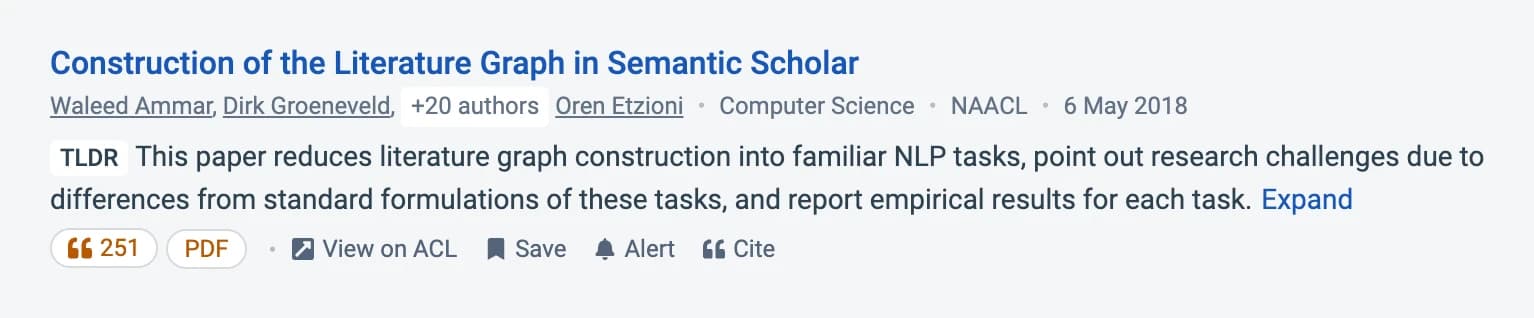
The current product page says the index contains 214 million papers and supports filters for journals and conferences, authors, publication types, and date ranges. Paper results expose citations, access links, save, alert, and cite actions in one compact surface. TLDRs provide one-sentence machine summaries for nearly 60 million papers in computer science, biology, and medicine. Use those summaries to decide what to open, never as extracted evidence.
Citation traversal is the stronger differentiator. Semantic Scholar predicts “Highly Influential” citations from citation counts and surrounding context. Its FAQ also documents citation-intent labels, but notes that intent data exists only where it can access full text. Treat both as navigation aids. Neither says a cited study is rigorous, supports your claim, or belongs in a review.
For ongoing work, save a coherent set of seed papers in one Library folder and enable its Research Feed. The current FAQ says feeds refresh daily, learn from saved and “not relevant” ratings, and recommend papers from the corpus published during the previous three months. That makes the feature useful for horizon scanning. It does not backfill an older field comprehensively.
Why it is not a systematic-review database by itself
Semantic Scholar says browser search supports quoted phrases but does not support Boolean operators or wildcards. That prevents exact translation of many review search strategies and makes a search harder to reproduce across databases. The index combines publisher partnerships, data providers, and web crawling; its publisher page reports more than 50 direct partnerships covering 500+ journals, presses, and societies, but does not publish topic-level recall.
For a defensible review, document a conventional database strategy, dates, deduplication, inclusion criteria, full-text decisions, and exclusions. Then use Semantic Scholar to supplement backward and forward citation searching. The managed literature-review workflow and scientific claim verification workflow provide the audit trail this search UI does not.
Reader and full-text limits matter
Finding a record does not grant the paper. Semantic Scholar routes users to available PDFs, publishers, or institutional access; the publisher or author still controls reuse rights. Its FAQ says an account is unnecessary to access paper records, while institutional sign-in can unlock subscribed full text.
Semantic Reader is a separate beta surface. It adds in-context citation cards and AI skimming highlights for goals, methods, and results. The current Reader FAQ limits it to 250,000+ arXiv papers and limited English-language papers on desktop for skimming highlights. The FAQ says built-in annotation was discontinued in January 2024 and directs users to the Hypothesis extension, while the Reader product page still advertises built-in annotation. Verify current account behavior before choosing it for annotations. If cross-paper PDF chat or explanation is the core job, compare SciSpace. If visual citation maps and collection workflows dominate, compare ResearchRabbit and Litmaps.
Free browser product versus API licensing
The public research product is free. Users can search without signing in; a free account adds Library folders, bulk citation exports, alerts, shared folders, and personalized recommendations. There is no paid browser plan or published usage quota to compare.
The API overview describes a different operating boundary. Most endpoints work without authentication, sharing a pool capped at 1,000 requests per second across all unauthenticated users and subject to extra throttling. Some endpoints require a key; the introductory keyed limit is 1 request per second on all endpoints. “1,000 RPS” is therefore not a per-application free allowance.
Licensing is more consequential than rate. The current API license limits standard use to internal training, evaluation, and dataset transformation for legitimate non-commercial research or education. Public data displays require Semantic Scholar attribution and links. Commercial use, including embedding the API in a product for commercial gain, requires an expanded license. Ask Ai2 for written scope before sizing infrastructure or promising a customer feature.
Privacy and AI-feature checks
Ai2's February 2025 privacy notice covers saved papers, alerts, favorites, search queries, and prompts entered into AI demonstrations as user submissions. It also covers browsing and device information. Retention is described as only as long as needed for stated purposes, agreements, or law; no fixed deletion period is published for these categories.
The FAQ says Ask This Paper sends the current paper and question to OpenAI for processing, is available only on a subset of English-language papers, and can produce subtle or serious factual errors. Do not enter confidential research questions without confirming acceptable data handling, and open the cited paper passage before reusing an answer.
Community evidence is mixed on freshness
In an October 2026 r/MachineLearning thread, u/GoodRazzmatazz4539 said Semantic Scholar often counts recent citations better than Google Scholar. In a separate r/PhD discussion, u/largelanguidmonkey reported Semantic Scholar as more conservative and slower in their computational-linguistics workflow. These are individual observations, not coverage measurements. Together they justify a simple control: run known recent papers, older canonical papers, preprints, and venue versions through every candidate database before trusting citation counts or alerts.
Start with ten known papers and five expected citations from your field. Record whether Semantic Scholar resolves versions correctly, exposes full text, finds both citation directions, exports usable metadata, and refreshes alerts in time. If it passes, keep it as the no-cost discovery layer beside Best AI Research Tools. This profile is source-based research checked October 26, 2026; no relevance, recall, citation-freshness, summary-accuracy, or API-load benchmark was run.
Sources & further reading
- Semantic Scholar product overview and vendor interface samples
- Semantic Scholar current FAQ
- Semantic Reader product page
- Semantic Scholar publisher and data sources
- Semantic Scholar Academic Graph API overview and rate limits
- Semantic Scholar API license agreement
- Ai2 privacy notice
- October 2026 Reddit discussion of citation freshness
- Reddit report of slower Semantic Scholar citation coverage


