Use case
Run a Literature Review with AI (2026)
Run a controlled AI literature review with a written protocol, reproducible search, audited screening, evidence-linked extraction, and exportable records.
Verdict
Use AI as the workbench for a literature review: collect records, apply explicit criteria, prepare extraction cells, and keep an audit trail. Keep the protocol, database coverage, final eligibility decisions, risk-of-bias assessment, and conclusions under researcher control. Elicit is the clearest current fit for a managed screening-and-extraction pipeline. Consensus is better for fast orientation and follow-up discovery than for owning the review record.
This is a desk-researched operating guide, not a hands-on accuracy benchmark. Visible quotes and citations make output easier to inspect; they do not establish that the search found every eligible study or that an extracted value is correct.
Pick the deliverable before the tool
| Deliverable | Useful AI role | Required control outside the answer |
|---|---|---|
| Topic orientation | Generate vocabulary, subquestions, and an initial reading list | Treat omissions as unknown; do not call the result a systematic review |
| Scoping or evidence map | Organize a broad record set and chart consistent fields | Define scope, source coverage, charting rules, and amendment policy |
| Systematic review | Prioritize screening, expose source passages, and prepare extraction tables | Protocol, reproducible searches, duplicate handling, independent eligibility decisions, appraisal, and synthesis method |
| Living review | Re-run a saved process and flag new records | Version every search, decision, correction, and changed conclusion |
A polished generated report is the last artifact, not the review method. If the work will support publication, clinical guidance, regulation, or a high-stakes policy decision, start from the applicable methodology and reporting standard. The PRISMA 2020 checklist asks authors to report eligibility criteria, every information source and search date, full search strategies, the selection and automation process, data collection, and variables sought. It does not certify the quality of those choices.
1. Freeze a protocol-shaped brief
Write this before searching:
Review question:
Population / setting:
Intervention or exposure:
Comparator:
Outcomes + time points:
Eligible study designs:
Publication dates + languages:
Databases and registers:
Known seed studies:
Title/abstract decision rule:
Full-text decision rule:
Data fields to extract:
Risk-of-bias method:
Who makes and adjudicates decisions:
Turn every inclusion criterion into one independently answerable test. Avoid criteria such as “relevant to the question.” Write “adult participants aged 18+,” “reports the prespecified outcome,” or “random allocation described.” Define what happens when a paper does not report enough information. Unclear should route to full text or author contact; it should not silently become exclude.
Record protocol amendments with a date, reason, and affected records. Editing the question after seeing favorable results without preserving the change breaks the audit trail.
2. Build a reproducible candidate set
In Elicit's dedicated Systematic Review workflow, use Boolean keyword searches for the reproducible core and semantic search as a supplementary discovery route. Current documentation says the Gather step can combine Elicit's 138-million-paper corpus, PubMed, ClinicalTrials.gov, uploads, and Library records. That list is not automatically the right source universe for your field.
For each source, retain:
- database or register name, platform, exact query, filters, and search date;
- exported RIS, BIB, or CSV before cleanup;
- number retrieved from each source;
- source label on every record;
- inaccessible full texts as a named status, not a disappearing row.
Search discipline databases and institutional subscriptions required by the protocol, then import those records. Do not let one vendor's corpus boundary rewrite the review question.
Elicit currently starts with up to 1,000 search results and lets a review contain up to 5,000 papers on Pro, 20,000 on Scale, and 40,000 on Enterprise. Those are workspace limits, not evidence that the search is complete.
3. Deduplicate records without collapsing studies
Deduplicate reports by DOI, title, authors, year, journal, trial registration, and content. Then link multiple reports from the same underlying study. A protocol, conference abstract, primary outcome paper, and follow-up can belong to one study without being duplicate documents.
Elicit's Library can flag likely duplicates, but its own help page says it may miss some. Review every proposed merge and keep a reversible log:
record_id | study_id | duplicate_of | action | basis | reviewer | timestamp
The Cochrane Handbook similarly separates removing duplicate records from linking multiple reports of one study. Mixing those jobs can double-count participants or delete a report that contains a needed outcome.
4. Calibrate screening before running the queue
Create a small calibration set containing obvious inclusions, obvious exclusions, ambiguous records, and known eligible studies. Have reviewers decide it without the AI recommendation visible. Resolve disagreements by changing the written criterion, not by memorizing exceptions.
Then run AI screening and compare:
| Check | Failure signal | Action |
|---|---|---|
| Known-study recall | A seed study is excluded or not retrieved | Repair search or criterion before scaling |
| Criterion fit | Recommendation relies on a different population, outcome, or design | Rewrite criterion + rerun affected records |
| Evidence location | Explanation cites background text instead of methods/results | Inspect full text + override |
| Missing information | Absence is treated as a negative finding | Route to unclear/full-text review |
| Exclusion stability | Small wording change flips many decisions | Narrow criterion + increase human review |
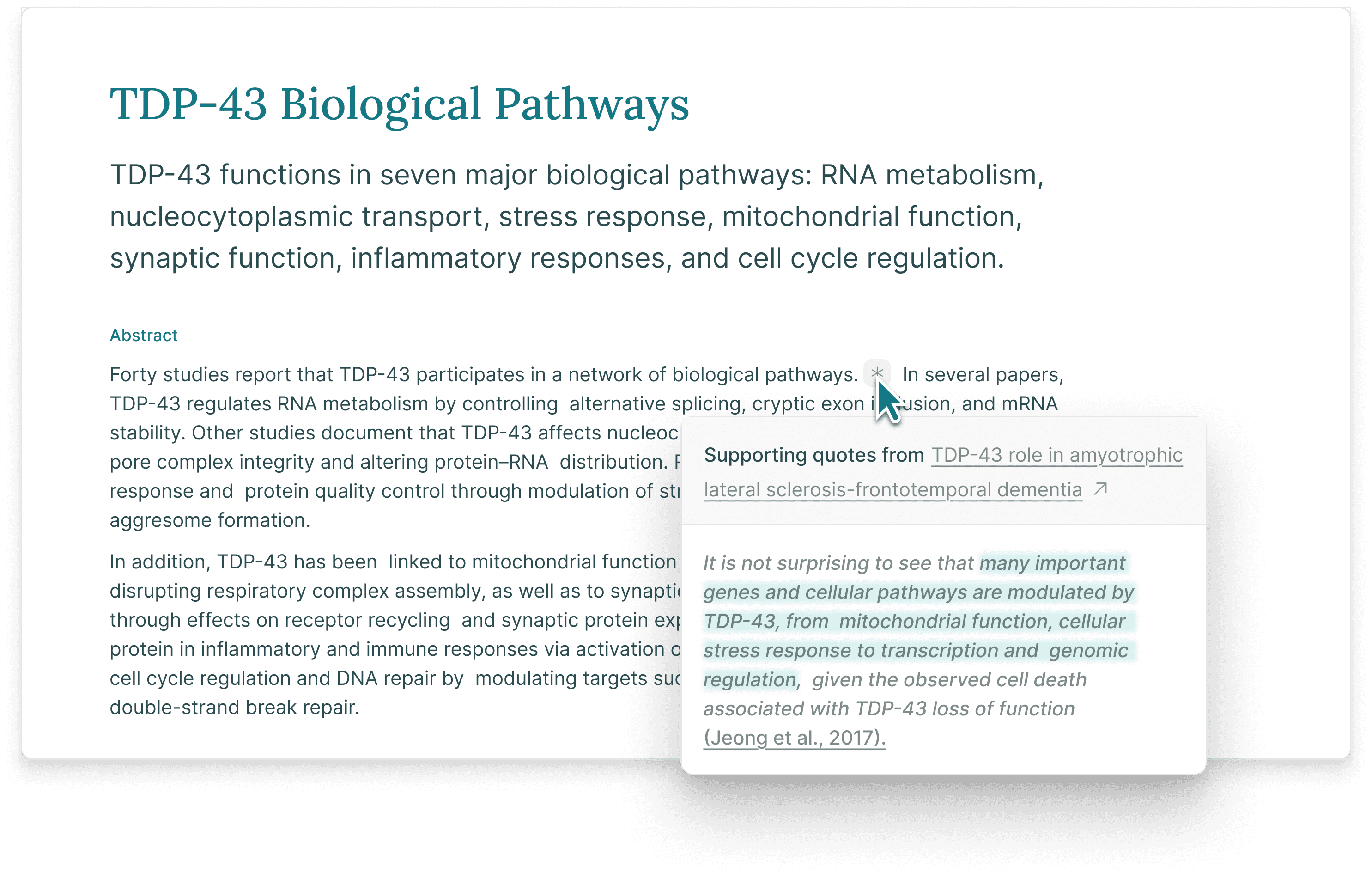
Elicit exposes per-criterion decisions, reasons, source quotes, and manual overrides. Treat these as review inputs. For Cochrane intervention reviews, final full-text eligibility decisions require two independent people; requirements vary by discipline and journal, so define the human review rule before automation. Elicit's built-in dual-review and adjudication workflow is currently Enterprise-only.
Sample AI-excluded records throughout the relevance range, not just near the threshold. Agreement on a pile of obviously irrelevant abstracts can hide the error that matters: an eligible study excluded with confidence.
5. Pilot the extraction schema
Design one row per study and preserve report-level provenance. A useful minimum schema is:
study_id, report_id, design, setting, sample_size,
population, intervention_or_exposure, comparator,
outcome_definition, time_point, effect_estimate, uncertainty,
analysis_population, attrition, funding, conflicts,
risk_of_bias, extracted_value, source_quote, page_or_section,
full_text_or_abstract, extractor, verifier, verification_status
Pilot three to five heterogeneous studies before extracting the full set. Use precise field instructions: “Between-group adjusted mean difference at the prespecified primary endpoint” is safer than “effect.” Separate unreported, not applicable, inaccessible, and zero.
Elicit recommends piloting columns on a subset and lets reviewers open the quote behind a generated cell. Verify every field that changes eligibility, effect direction, magnitude, certainty, or subgroup interpretation. Figure extraction requires Scale or Enterprise plus Premium PDF parsing; tables and prose can still contain transcription, unit, arm, and time-point errors.
6. Synthesize from verified rows
Lock the verified extraction table before writing the conclusion. Group studies by the prespecified synthesis logic, not by whether their findings agree. Keep these separate:
- what each study measured;
- what its results show;
- the authors' interpretation;
- your appraisal of bias and applicability;
- the review-level conclusion.
An AI report may help draft structure and surface contradictions. It should not decide that a missing cell proves a research gap, that a statistically non-significant result proves no effect, or that more papers outweigh better study design.
Elicit's report uses 80 top-screening papers by default when more are included; current limits extend to 135 on Pro and 200 on Scale or Enterprise. If the included set is larger, reconcile the report's cited subset against the locked table before using the narrative.
7. Export a review someone else can resume
At handoff, export the screening recommendations and extraction table as CSV or XLSX, references as RIS or BIB, and the report as PDF or DOCX. Systematic Review table export starts at Pro. Preserve the protocol, raw search exports, deduplication map, exclusion reasons, overrides, unresolved records, extraction verification status, and software/version/date notes beside them.
The acceptance gate is simple: another reviewer can reconstruct where every record came from, why it moved stages, which report supports each extracted value, who verified it, and what changed after the protocol was frozen.
Current Elicit prices and plan boundaries
Pricing is audience-sensitive. The values below were rendered on October 24, 2026; confirm the selected audience, billing interval, taxes, and checkout total.
| Audience | Monthly billing | Yearly billing shown as monthly equivalent |
|---|---|---|
| Industry | Pro $75; Scale $375 | Pro $49/user/month, $588/year; Scale $229/user/month, $2,748/year |
| Academic | Plus $19; Pro $69; Scale $149 | Plus $11/user/month, $132/year; Pro $39/user/month, $468/year; Scale $89/user/month, $1,068/year |
Basic is free and Enterprise is custom. Elicit's help center says the dedicated Systematic Review workflow is available on Pro, Scale, and Enterprise. The Academic Plus card currently mentions standard usage for “Systematic Literature Reviews,” while only Pro explicitly lists the dedicated workflow. Use Pro as the documented self-serve entry point for the managed workflow and verify the exact entitlement in the account before paying.
Community reports support the validation step, not a product score. In a 2026 r/PhD thread, u/Apple_Rhubarb_4568 reported that reviewers accepted AI supplementing a standard search when it was documented in the flow; their planned AI screening and extraction work would be thoroughly validated. In another thread, u/Lit-Rev-Pro, a self-described evidence-synthesis practitioner, considered Elicit useful but not reliable enough for formal meta-research. These are individual reports from different product versions with no disclosed benchmark. Run a known-answer pilot on your own field and protocol.
For the broader product decision, see Best AI Research Tools and Elicit vs Consensus. When the task is checking whether a sentence and its cited paper actually match, use the separate scientific claim and citation verification workflow.
For related research decisions, see source-grounded market research workflow.
Sources & further reading
- Elicit Systematic Reviews workflow and limits
- Elicit workflow selection
- Elicit export formats and entitlements
- Elicit duplicate handling
- Elicit pricing
- Elicit academic and nonprofit pricing
- PRISMA 2020 checklist
- Cochrane Handbook chapter on finding and selecting studies
- Community discussion of AI-assisted review screening
- Community discussion of Elicit review results


Ordered for comparison, not as a universal ranking. Inclusion requires a direct fit with this page's stated workflow.