Comparison
Elicit vs Consensus (2026)
Choose Elicit for controlled screening and extraction; choose Consensus for fast answers, paper discovery, and Deep research workflows.
Verdict
Choose Elicit when the deliverable needs a controlled paper set, recorded screening decisions, custom extraction fields, and review tables you can export. Choose Consensus when the immediate job is asking a scientific question, seeing a cited synthesis, and finding papers worth opening.
Elicit is the better fit for a managed systematic-review workflow. Consensus is the better default for fast evidence orientation. Consensus Deep now performs multi-step literature-review-style work, citation snowballing, reverse citation search, and citation checking, so the gap is smaller than the old “table versus chatbot” comparison suggests. Elicit still provides the clearer workflow for moving a defined set through screening and extraction.
This verdict uses vendor documentation checked October 21, 2026 and attributed community reports. We did not run a controlled recall, extraction-accuracy, or time-saved benchmark. A cited answer is inspectable; it is not proof that the search found every eligible study or that the synthesis weighted each study correctly.
Elicit vs Consensus decision matrix
| Decision | Elicit | Consensus |
|---|---|---|
| Best fit | Structured evidence review and reusable extraction | Fast question answering, discovery, and evidence orientation |
| Quick research mode | Research Agent and Research Reports | Paper Search, Pro messages, and Deep reviews |
| Source scope | Research Agent: 138 million academic papers, larger web, and up to 20 uploads per session | Full search offers a broad research-paper corpus, plus Medical, uploaded papers, saved Collections, and My Library |
| Formal review controls | Dedicated Systematic Review gathers papers from Elicit search and uploads, then screens, extracts, and produces a PRISMA-style report | Deep runs multi-step searches and structured synthesis; current docs do not describe an equivalent protocol-level screening and exclusion table |
| Extraction | Custom table columns; Pro supports 20 columns at a time | Pro and Deep can compare studies and generate tables; Study Snapshots expose common study details |
| Evidence trail | Sources and explanations for generated answers; exportable screening recommendation and extraction tables on eligible plans | Inline citations; full-text checkmark versus abstract/metadata; recent Skills return papers and passages behind findings |
| Export | Reports: PDF/DOCX; tables: CSV/XLSX; references: RIS/BIB, with workflow-specific plan gates | Reports: PDF or copied text with citations; results: CSV, RIS, or formatted bibliography |
| Paid entry for the compared job | Industry yearly view: Pro $49/user/month, billed $588 annually | Pro $20 monthly or $144/year; Deep $65 monthly or $540/year |
| Main limit | Pro screens up to 5,000 papers, adds 20 columns, and reports extract from up to 135 sources; monthly agent usage is plan-limited | Pro includes 15 Deep reviews/month; Deep includes 200; Deep generally analyzes 50–100 papers |
| Main reason to reject | You only need a readable answer and shortlist, not a managed review workspace | You need explicit screening decisions, custom extraction across a large set, and a defensible review handoff |
The key distinction: Elicit has two different research paths
Do not buy Elicit based on a Research Agent demo and assume it is the Systematic Review workflow.
The Research Agent is available on every plan. It can search Elicit's academic corpus and the larger web, accept up to 20 uploaded resources in a session, and produce reports, tables, slides, figures, and other artifacts. Research Reports are also available on all plans and export to PDF or Word. These are flexible question-to-output workflows.
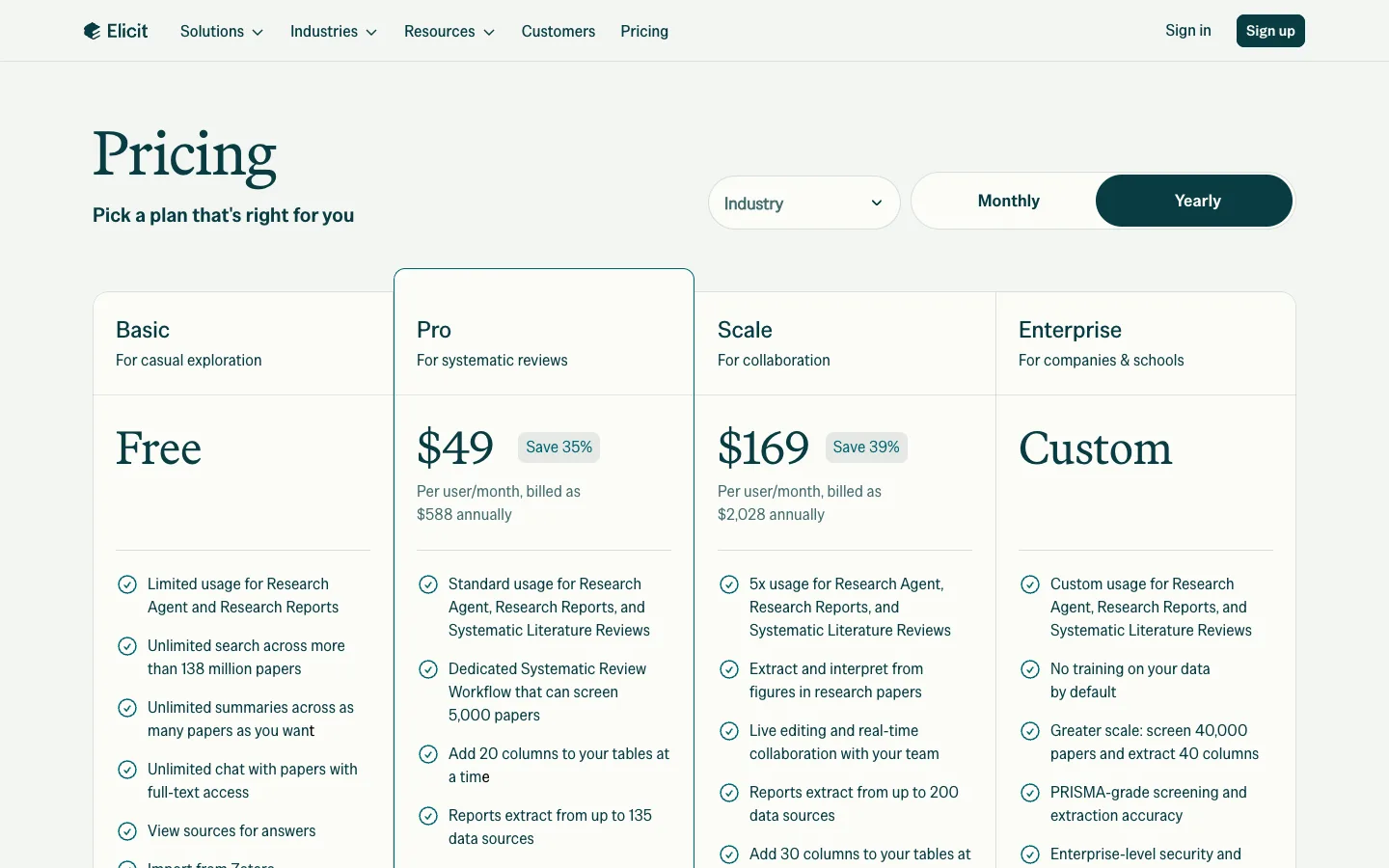
The dedicated Systematic Review workflow is explicitly documented for Pro, Scale, and Enterprise. It gathers papers from Elicit search and uploads, applies inclusion and exclusion screening, extracts defined data, and produces a PRISMA-style report. Elicit's current Industry yearly view lists Pro at $49 per user/month billed annually and Scale at $169, with Pro screening up to 5,000 papers. The pricing page contains other audience and billing variants in its source, so confirm the selected audience, billing period, and checkout total rather than quoting a hidden plan card.
Exports have their own gates. Research Agent table export starts at Plus; Systematic Review screening and extraction table export starts at Pro. Reports export on every plan. References can move to a reference manager as RIS or BIB. That difference matters if the artifact must survive outside the product.
Consensus is built around the question, then adds depth
Consensus offers three useful layers. Paper Search returns papers without an AI synthesis. Pro analyzes up to 20 papers for a fast answer. Deep breaks a question into multiple searches and typically analyzes up to 50 papers, sometimes up to 100. Its October 2026 Skills add Literature Review, Citation Snowballing, Reverse Citation Search, and Verify Citations.
That makes Consensus stronger than a simple yes/no meter. It can build a reading list, follow a citation neighborhood, find evidence for a claim, and show the passages used to assess a citation. For a product manager, clinician, policy analyst, or student asking “what does published research say about this focused question?”, that path avoids requiring a screening and extraction project before reading a synthesis.
Deep is still a generated review over a selected result set. Consensus says it may analyze more papers than it cites. A missing paper or empty research-gap cell is therefore a prompt for another search, not proof that the literature contains nothing.
Pricing and limits checked October 21, 2026
Elicit’s rendered pricing in the Industry + Yearly view shows Basic free, Pro at $49 per user/month billed $588 annually, Scale at $169 billed $2,028 annually, and Enterprise custom. Basic has limited Research Agent and Research Report usage. Pro is the relevant self-serve entry point for the dedicated Systematic Review workflow. Usage is described comparatively rather than as a fixed number of agent runs, so a serious pilot should record how quickly the monthly allowance moves on your papers.
Consensus Free includes 10 Pro messages, 3 Deep reviews, 10 Study Snapshots, and 30 API/MCP calls per month. Pro costs $20/month or $144/year and includes unlimited Pro messages, 15 Deep reviews, and 500 API/MCP calls monthly. Deep costs $65/month or $540/year and raises Deep reviews to 200 and API/MCP calls to 2,000. Team pricing depends on size. The Deep help FAQ still mentions 15 free Pro messages, conflicting with the subscription page’s 10; this comparison uses the plan page and recommends checking the in-app allowance.
The prices do not buy the same unit of work. Elicit Pro pays for a controlled review workspace and larger paper pipeline. Consensus Pro pays for frequent question answering; Consensus Deep pays for many multi-step reviews.
Traceability, exports, and privacy
For traceability, test the last mile. In Elicit, export the screening recommendations and extraction table, then verify a sample of values against full text. In Consensus, open the passage behind every decisive citation; its checkmark indicates that full text was used, while no checkmark means the analysis used abstract and metadata. Neither marker establishes study quality or search completeness.
Consensus says user data is not used to train its or third-party models. Its security page also says anonymized query text is logged to improve the search engine, with a custom option for separate logging or no logging. Elicit's public privacy policy is dated September 2023 and allows data use to improve its products. Its newer security material gives Enterprise stronger, specific commitments: no training on Enterprise data, encryption, and isolated infrastructure options. Do not generalize that Enterprise promise to every self-serve account; route sensitive or unpublished material through procurement and the applicable agreement.
Community reports reinforce testing, not a universal quality score. In a 2024 r/PhD thread, u/Good_Lobster_375 preferred Elicit after reporting that Consensus sometimes misrepresented paper details. In the same evolving thread, a later commenter, u/Efficient-System4204, called Consensus a favorite for initial search and valued its MCP. Separately, u/Lit-Rev-Pro described Elicit as an interesting aid but not reliable enough for formal meta-research. These are individual reports from different product versions and fields; they support a known-answer pilot, not a current accuracy ranking.
Run this pilot before subscribing
Use one completed or well-understood review with 25–50 papers. Seed both tools with the same question and a small gold set. Record which known papers are retrieved, duplicates, unsupported claims, citation-to-passage matches, screening disagreements, corrections to five extraction fields, full-text availability, export quality, and reviewer minutes.
Pick Elicit if the winning artifact is a review table another researcher can audit and continue. Pick Consensus if the winning artifact is a defensible answer plus a reading list. If the protocol must satisfy a journal, regulator, or evidence-synthesis standard, validate either product against your databases, librarian-designed search, and human review process.
Compare the wider field in Best AI Research Tools. For the neighboring open-web-versus-bounded-corpus decision, see NotebookLM vs Perplexity.
Sources & further reading
- Elicit pricing and plan limits
- Elicit workflow selection
- Elicit export formats and entitlements
- Elicit privacy policy
- Elicit enterprise security
- Consensus subscription plans
- Consensus search modes
- Consensus Deep review
- Consensus Skills
- Consensus security and query logging
- Elicit and Consensus community comparison
- Elicit evidence-synthesis discussion


Ordered for comparison, not as a universal ranking. Inclusion requires a direct fit with this page's stated workflow.