Comparison
NotebookLM vs Perplexity (2026)
Choose Gemini Notebook for a controlled source pack and Perplexity for current web discovery. Compare citations, imports, privacy, access, prices, and limits.
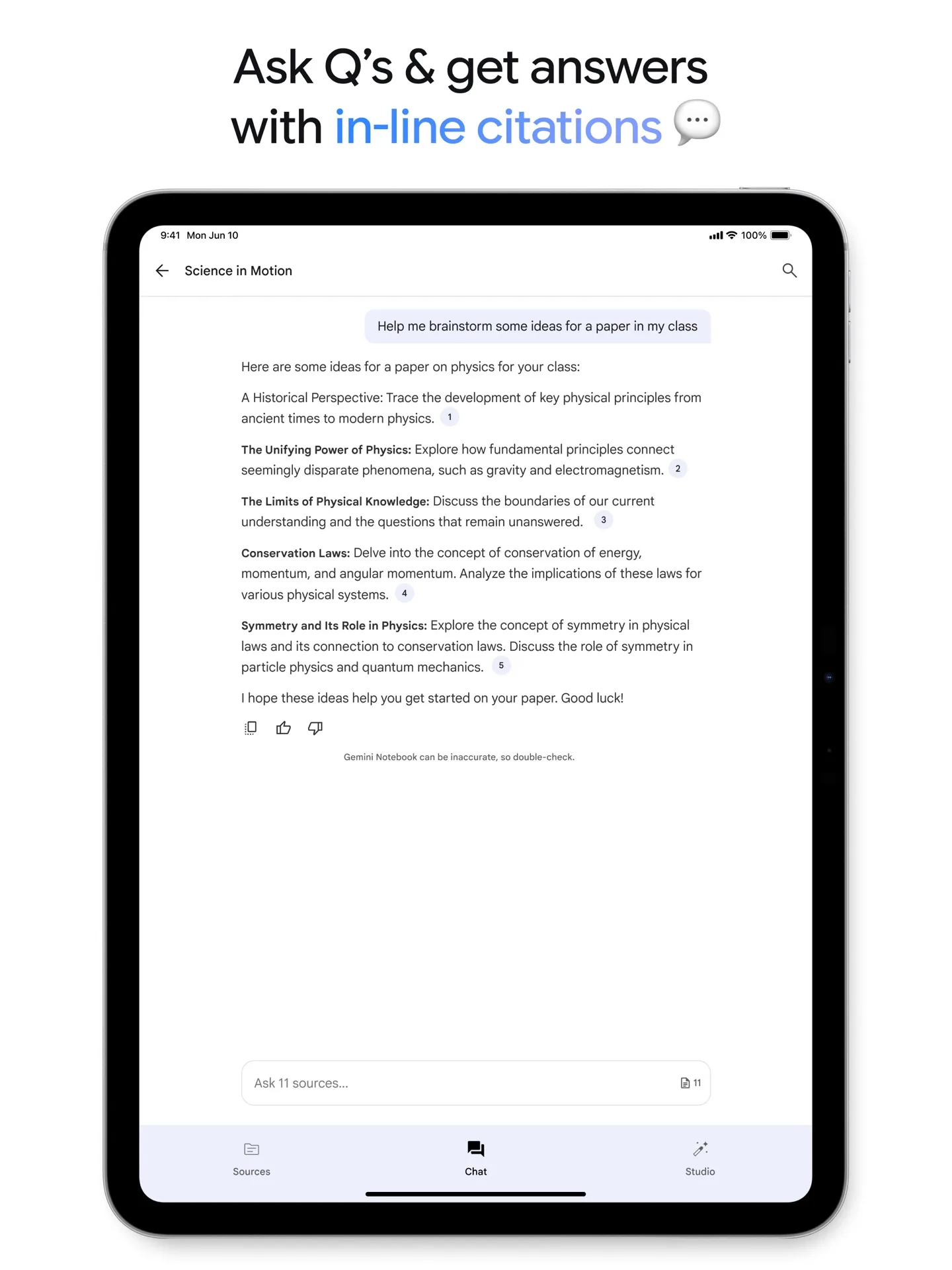
Verdict: Choose Gemini Notebook, formerly NotebookLM when you want to organize and audit answers against a source pack you select. Choose Perplexity when you need to discover what the current web says and follow links outward. Gemini Notebook is the better evidence workspace; Perplexity is the better reconnaissance engine. Many research workflows need both, in that order or the reverse depending on whether the corpus already exists.
This comparison uses current vendor documentation and attributed community reports checked October 21, 2026. It is documentation-based research, not an accuracy benchmark. Citations in either product make an answer easier to inspect; they do not prove that each sentence is supported or that the source set is complete.
NotebookLM vs Perplexity decision matrix
| Research decision | Gemini Notebook | Perplexity |
|---|---|---|
| Primary intent | Interrogate and synthesize a defined collection | Discover and summarize current external information |
| Default source boundary | Sources added, discovered, and selected inside a notebook | Web results across articles, papers, forums, videos, and focused indexes |
| Best evidence control | Select or deselect named sources for a question | Choose a search focus such as Web, Academic, Finance, or Files |
| Citation inspection | Opens the quoted passage in notebook context | Opens the original external page |
| Import strength | Broad document, media, Drive, URL, and copied-text support | Files can join a search session or Project; Pro allows up to 50 uploads per Project |
| Freshness model | Drive sources auto-sync; other imports need explicit freshness checks | Re-searches the current web, subject to indexing, retrieval, and source selection |
| Reusable outputs | Reports, notes, tables, audio, slides, quizzes, mind maps, and other artifacts | Search threads, Research output, Projects, and plan-dependent files/apps |
| Privacy decision | Consumer feedback can expose included content to human review; qualifying Workspace core-service terms are stronger | Consumer paid plans offer a training opt-out; Enterprise says data is not used for training |
| Best fit | Due diligence packs, course readings, project archives, policy comparison | News, market scans, vendor discovery, fact orientation, source finding |
| Main rejection reason | You mainly need discovery across an evolving web corpus | You need a stable, deliberately bounded corpus |
The real choice is who builds the corpus
Gemini Notebook centers work on a selected collection and can also help discover sources. You can add PDFs, Word and PowerPoint files, CSV, Markdown, ePub, audio, images, copied text, Google Docs, Slides and Sheets, web pages, public captioned YouTube videos, eligible Play Books, and Gemini chats. Each source can contain up to 500,000 words; local uploads can be up to 200 MB. You then choose which sources should answer a question.
The import is not always the original object. A web URL contributes page text rather than embedded media, nested pages, or paywalled content. YouTube contributes its transcript. Google files omit comments and footnotes. Drive imports auto-update every few minutes and when the notebook opens; Google does not make the same continuous-sync promise for ordinary URLs and local uploads. Record retrieval dates and re-import changing material.
Perplexity centers work on search and can also organize uploaded files. Pro Search documents multiple searches across articles, academic papers, forums, videos, and focused databases, then returns a synthesis with direct source links. That makes it a useful fit for “what changed?” and “which sources should I read?” Its source universe is broader but less controlled: ranking, retrieval, plan access, and query wording influence what enters the answer.
Perplexity also supports file and image uploads. Paid plans raise upload access, and Pro lists up to 50 files per Project. That does not turn it into the same product. Files remain one possible focus within a search-first system; Gemini Notebook makes the selected source collection the organizing object. Neither is exclusively a file tool or a web tool; compare the default workflow and enabled actions.
Citations solve navigation, not truth
Gemini Notebook citations expose quoted text and jump to the passage in context. Perplexity citations take the reader to the external source. The first is better for auditing a known packet; the second is better for following a discovery trail.
Both still need claim-level review. A citation can point to a weak page, support only part of a sentence, or leave a decisive qualification outside the extracted passage. Google’s current chat documentation also contains a boundary worth watching: it says chat responses use notebook sources, then describes experimental actions that can search the web, run code, and import research. Treat selected sources as the intended evidence boundary and check the activity trace when newer agentic functions are enabled.
Community reports reinforce the workflow split without proving a winner. In a literature-review discussion, Reddit user scipio42 described finding and vetting papers first, loading the chosen sources into NotebookLM, then taking new gaps back to Perplexity. In a separate Perplexity thread, EverydayPhilisophy praised academic and social search while servarus advised checking the references. These are individual experiences with unknown prompts, plans, and versions.
Pricing and limits checked October 21, 2026
Gemini Notebook Standard is free. Google currently lists 100 notebooks with 50 sources each. Plus raises that to 200 notebooks and 100 sources; Pro to 500 and 300. On Google’s US monthly plan page, the broader Google AI Plus bundle is $9.99/month and Google AI Pro is $19.99/month. These are Google One bundles, not Notebook-only subscriptions.
Google now documents compute-based allowances instead of a stable consumer chat count. Prompt complexity, model, feature, and chat length affect usage. Limits refresh every five hours until the weekly ceiling is reached. Plus gets 2× Standard compute and Pro 4×; Google does not publish a stable prompt equivalent. The signed-in Settings → Usage meter is the useful limit.
Perplexity Standard is free. Its current Help table lists 3 Pro Searches per day and 1 Research query per month. The current public pricing page displays $17/month for Pro and $167/month for Max, both when billed annually. These are displayed monthly equivalents, not month-to-month charges; check the checkout total and region before subscribing. Education Pro is $10/month with verification.
Perplexity’s allowance language conflicts across first-party pages. The plan table describes paid Pro Search as variable weekly “average use,” while other marketing copy has called Pro Search unlimited; the pricing FAQ describes free access as limited weekly use while the plan table gives 3/day. Do not convert those labels into a guaranteed workload. Check billing cadence, the signed-in meter, Research limits, and file allowances before buying.
Privacy and access boundaries
For consumer Gemini Notebook accounts, Google says notebook content is not used to directly train foundational models unless the user submits feedback. Submitted feedback can include prompts, sources, uploads, and outputs; trained reviewers may inspect it, and reviewed feedback may be retained for up to three years disconnected from the Google Account. Qualifying Workspace and Education core-service accounts receive stronger no-human-review and no-training terms. Verify the actual license, not merely the email domain.
For Perplexity Pro, Education Pro, and Max, the plan documentation says users can opt out of data collection in settings. Enterprise Pro and Max say customer data is never used for model training and add organization controls. Consumer opt-out and enterprise default protection are different promises. Sensitive research should follow the applicable contract, retention controls, connector permissions, and deletion policy.
Practical verdict
- Pick Gemini Notebook when the source list is part of the method and reviewers must trace synthesis back into the supplied documents.
- Pick Perplexity when speed of discovery, freshness, and links across the open web matter most.
- Use Perplexity → human screening → Gemini Notebook when you need to discover candidates, freeze a defensible packet, and compare it repeatedly.
- Use a dedicated review system when reproducible database search, deduplication, exclusion reasons, and structured extraction matter. Elicit vs Consensus covers that decision.
See the broader AI research tools guide for literature-review and market-intelligence alternatives.
Sources & further reading
- Google Gemini Notebook rename announcement
- Google Gemini Notebook source imports
- Google Gemini Notebook chat and citations
- Google Gemini Notebook plans
- Google Gemini Notebook flexible usage limits
- Google Gemini Notebook privacy
- Google One US plans
- Perplexity plan comparison
- Perplexity Pro Search documentation
- Perplexity public pricing
- Perplexity App Store listing
- Community discussion of a mixed discovery and synthesis workflow
- Community discussion of Perplexity citations


Ordered for comparison, not as a universal ranking. Inclusion requires a direct fit with this page's stated workflow.