Best tools
Best AI Research Tools in 2026
Choose NotebookLM, Perplexity, Elicit, Consensus, or AlphaSense by source universe, review controls, citations, limits, and research workflow.
Verdict
Choose NotebookLM, now branded Gemini Notebook when you already have the sources. Choose Perplexity to scan the current web. Choose Elicit for controlled paper discovery, screening, and extraction. Choose Consensus for a fast answer across scientific papers. Choose AlphaSense when premium business and financial content justifies an annual sales-led subscription.
These tools solve external research jobs. They do not replace a permission-aware system for finding internal policies, project history, or customer records. For that decision, use the AI workplace search tools guide. For an end-to-end brief with claim-level verification, use the source-grounded market research workflow.
This ranking is based on current vendor documentation and attributed community reports. It is desk research, not a fabricated hands-on accuracy test. A visible citation makes a claim inspectable; it does not prove that the source supports the sentence, that the source set is complete, or that the underlying study is sound.
Compare the source universe first
| Pick | Best for | Source boundary | Main reason to reject it |
|---|---|---|---|
| NotebookLM / Gemini Notebook | Comparing a known reading pack | Sources you add or deliberately discover for a notebook | You need defensible literature discovery or broad live-web coverage |
| Perplexity | Current open-web reconnaissance | Web, academic, finance, social, files, and plan-dependent premium data | You need a reproducible screening and extraction protocol |
| Elicit | Literature search, screening, extraction, and systematic-review workflow | Research Agent: 138 million academic papers, the larger web, and up to 20 uploads per session; Systematic Review: Elicit search and uploads | Your question is a quick orientation, not a managed review |
| Consensus | Quickly checking what published research says | Scientific papers available to Consensus | You need custom extraction across thousands of records |
| AlphaSense | Market, company, investment, and competitive intelligence | Filings, transcripts, broker research, expert interviews, news, financials, permitted internal content, and optional web search | Premium content and enterprise workflow do not justify sales-led annual pricing |
The source boundary is the buying decision. A polished report built from the wrong corpus is still the wrong report.
Current prices and limits checked October 20, 2026
| Tool | Current published entry point | Limit or commercial boundary to inspect |
|---|---|---|
| NotebookLM / Gemini Notebook | Standard is free; US Google AI Plus $9.99/month and Pro $19.99/month are broader bundles | Standard: 100 notebooks and 50 sources per notebook. Plus: 200 and 100. Pro: 500 and 300. Google marks limits subject to change |
| Perplexity | Free Standard; Pro displays $17/month billed annually; Max $167/month billed annually | Free currently lists 3 Pro searches/day and 1 Research query/month. Pro and Max use variable weekly or monthly limits; Enterprise Pro starts at $40/month or $400/year per seat |
| Elicit | Basic free; the industry yearly view shows Pro at $49 and Scale at $169 per user/month | Pro's dedicated review workflow screens up to 5,000 papers and reports extract from up to 135 data sources. Pricing changes by audience and billing view |
| Consensus | Free; Pro $20/month or $144/year; Deep $65/month or $540/year | Free includes 10 Pro messages and 3 Deep reviews/month. Pro includes 15 Deep reviews; Deep includes 200 |
| AlphaSense | Annual subscription, per-seat or enterprise-wide; contact sales for price | Access depends on package and content entitlements. Enterprise Intelligence adds internal content; permitted sources vary by account |
Perplexity’s public page displays rounded monthly equivalents for annual billing; confirm the full charge at checkout. Its Help Center lists the free daily/monthly quotas above while the marketing FAQ describes limited weekly use, so verify the signed-in allowance rather than converting one into the other.
Do not compare these prices as equivalent bundles. AlphaSense sells content access and enterprise research infrastructure; NotebookLM's free tier assumes you supply or select the corpus; Elicit and Consensus sell increasingly deep scientific workflows.
1. NotebookLM / Gemini Notebook: best for a bounded source pack
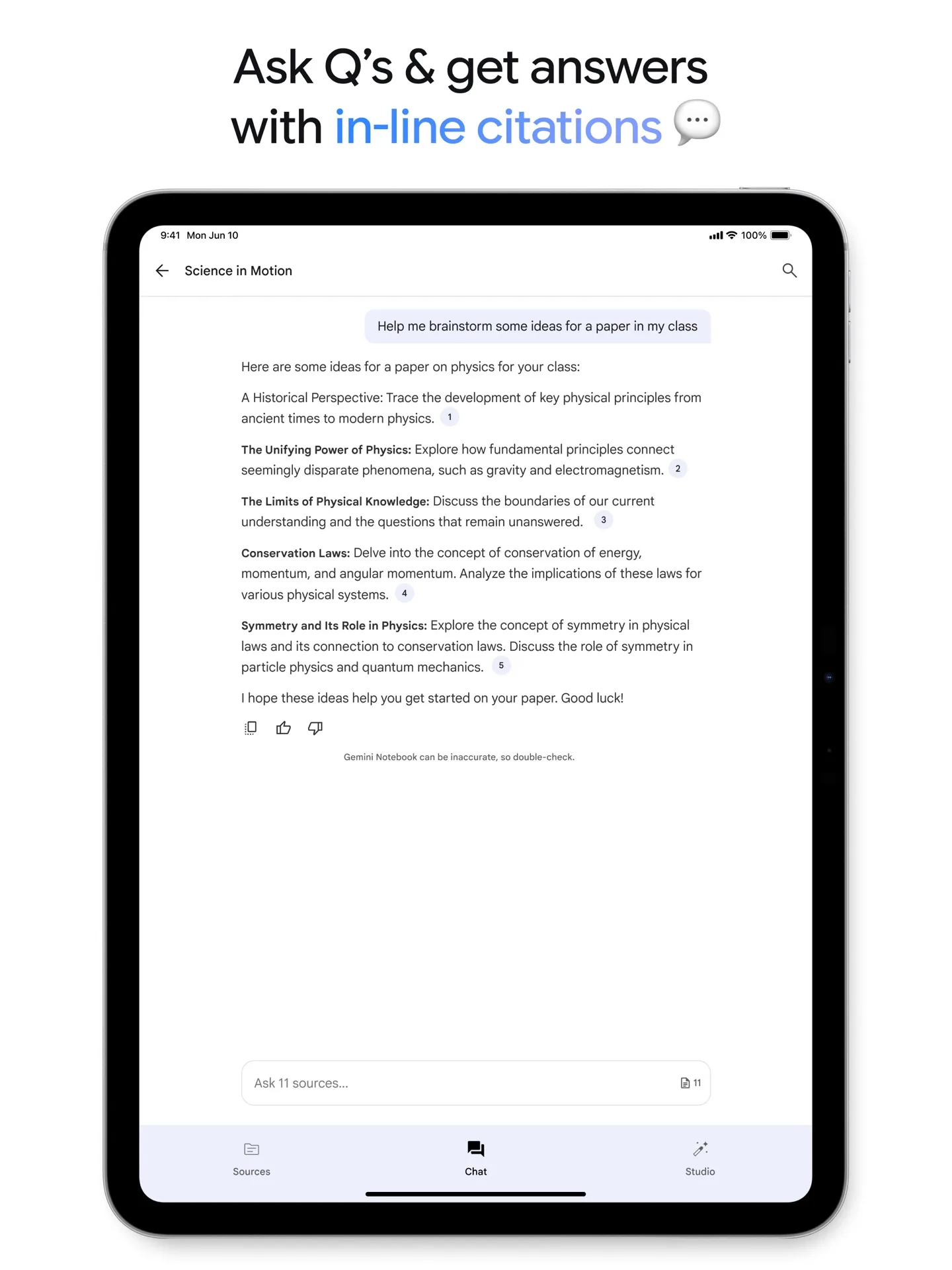
Current source facts: Google's current help pages call the product Gemini Notebook. It accepts PDFs, websites, YouTube videos, audio, Google Docs, and Google Slides, then answers from notebook sources with inline citations. It can also turn sources into briefings, study guides, mind maps, and audio outputs. The free Standard tier currently allows 50 sources per notebook.
Editorial call: Start here when the hard part is comparing documents you already trust: interview transcripts, standards, product research, reports, or a course pack. It is weaker as the only discovery layer for a formal literature review because source selection and coverage still need an independent method.
In a Reddit thread, u/Patello warned that the product can fill gaps incorrectly, while u/damian20 reported trouble with spreadsheet questions. Those are user reports, not controlled tests, but they support a practical check: ask questions with known answers, open every decisive citation, and test tables separately from prose.
2. Perplexity: best for current open-web reconnaissance
Current source facts: Perplexity's Pro Search documentation describes multiple web searches across articles, academic papers, forums, videos, and focused databases, with direct source links. The free plan offers basic search plus small Pro Search, Research, and file allowances. Paid plans raise access but retain plan-dependent limits.
Editorial call: Use Perplexity to build the first map of a market, find candidate sources, and notice recent developments. Do not copy its synthesis into a deliverable before opening the underlying pages and recording which passage supports each claim.
Reddit user u/EverydayPhilisophy praised its academic and social search. In the same discussion, u/servarus advised double-checking references. That disagreement is more useful than a star rating: discovery speed and citation correctness are separate tests.
3. Elicit: best for controlled literature review work
Current source facts: Elicit's current workflow guide separates Research Agent and Research Reports from a dedicated Systematic Review workflow. Research Agent can use Elicit's 138 million-paper academic corpus, the larger web, and up to 20 uploaded resources per session. The Systematic Review workflow is narrower and more controlled: it guides paper gathering from Elicit search and uploads, inclusion and exclusion screening, extraction, and a PRISMA-style report. The pricing page publishes plan-specific paper, column, collaboration, and data-source limits.
Editorial call: Elicit is the strongest choice here when repeatable screening decisions and a structured extraction table matter more than a conversational answer. Export the records, preserve inclusion reasons, and verify extracted fields against full text before analysis.
4. Consensus: best for fast scientific orientation
Current source facts: Consensus offers unlimited basic paper searches on its free tier, with limited Pro messages, Deep reviews, Study Snapshots, and API/MCP calls. Pro messages summarize up to 20 papers; a Deep review can cover up to 50 papers. Paid tiers raise the monthly allowance.
Editorial call: Choose Consensus when you need a readable first answer and a shortlist of papers around a focused empirical question. Move to Elicit or a conventional database workflow when the job requires explicit search strings, duplicate handling, exclusion reasons, and custom extraction.
In a literature-review discussion, u/Suitable_Command7109, who said they were not conducting serious literature reviews, described using Perplexity and Consensus for discovery, then moving selected papers into NotebookLM. That modular pattern is sound editorially because it separates finding sources from reasoning over the chosen set; the comment does not prove completeness.
5. AlphaSense: best for premium market and financial research
Current source facts: AlphaSense says Generative Search retrieves across filings, transcripts, sell-side research, expert interviews, financials, and other structured and unstructured sources. Users can constrain content sets, add permitted internal documents, or enable web search. Answers include inline citations that open the source passage. Its pricing page offers annual per-seat and enterprise packages without a public dollar amount.
Editorial call: Shortlist AlphaSense when missing a broker note, expert transcript, or historical filing would cost more than the subscription. Require a trial against named companies, sources, geographies, and date ranges. Generic web research alone does not justify this category of spend.
Verify coverage, price, and usability with your own entitlement set. AlphaSense's permitted corpus varies by package, so a generic product demonstration cannot establish that your team will receive the decisive broker research, transcripts, or internal-content access.
Run one decision test before buying
Give every viable tool the same question and a frozen acceptance sheet. Record source recall against a small gold set, unsupported statements, citation-to-passage matches, duplicate papers, extraction corrections, export quality, and reviewer minutes. For market research, include one filing, one first-party product page, one credible trade source, and one deliberately stale page. For literature review, include known relevant and irrelevant papers plus one study with a decisive detail buried in full text.
Pick the tool that leaves the smallest auditable gap for your actual deliverable. Research speed matters only after the evidence trail survives review.
Related knowledge and research decisions
Sources & further reading
- Google Gemini Notebook product capabilities
- Google Gemini Notebook plans and limits
- Perplexity current public pricing
- Google One US bundle prices
- Perplexity plan comparison
- Perplexity Pro Search
- Elicit pricing and plan limits
- Elicit workflow selection
- Consensus subscription plans
- Consensus Pro plan
- AlphaSense pricing
- AlphaSense Generative Search configuration
- AlphaSense citation workflow
- NotebookLM community workflow discussion
- Perplexity community citation discussion
- Literature-review toolchain discussion


Ordered for comparison, not as a universal ranking. Inclusion requires a direct fit with this page's stated workflow.