Use case
Verify Scientific Claims and Citations with AI
Verify scientific claims against papers with atomic claim checks, citation identity and status review, passage matching, study appraisal, and an audit log.
Verdict
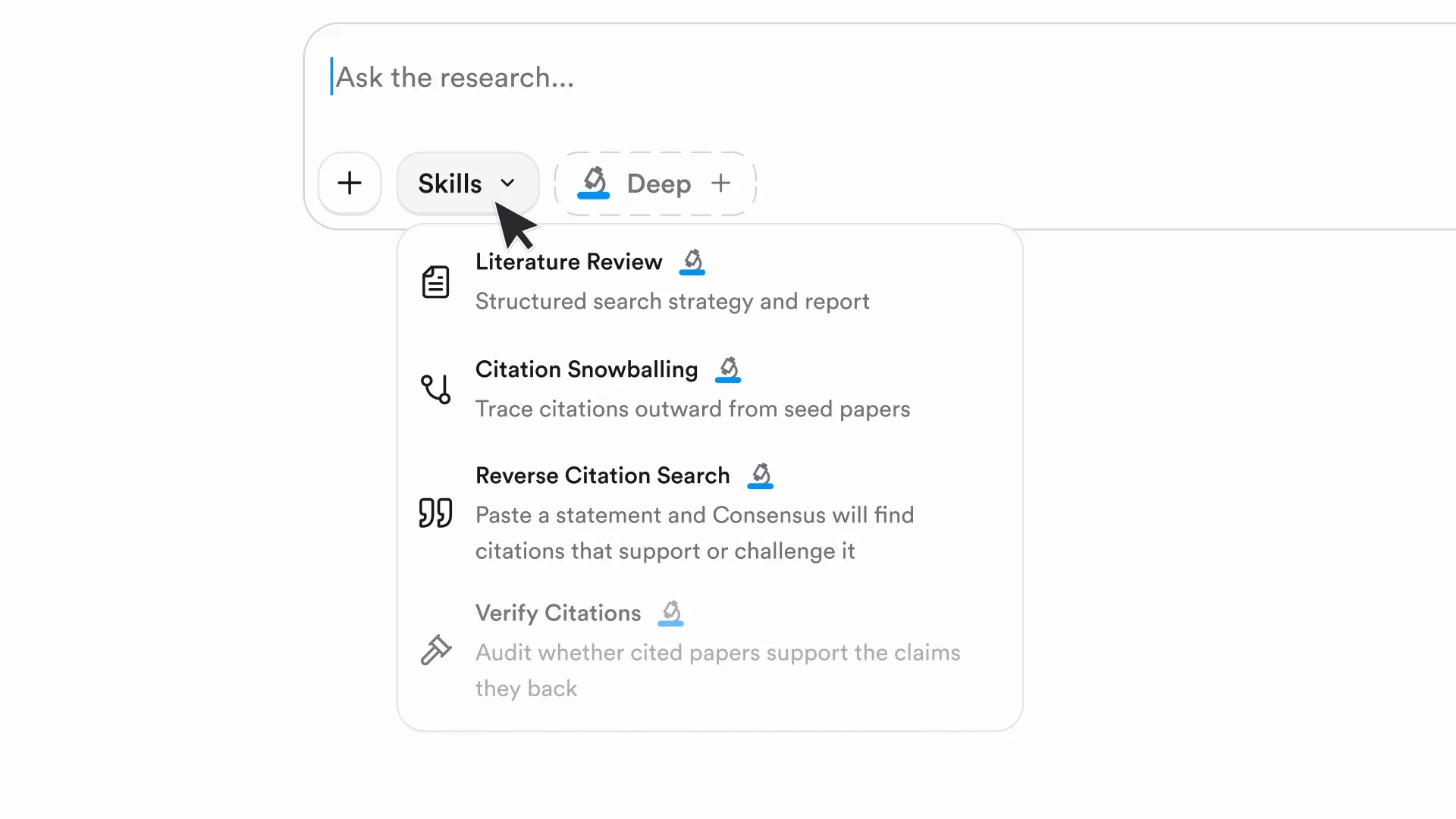
Verify one atomic claim against one identified paper at a time. Use Consensus Reverse Citation Search when a claim needs a source and Verify Citations when a draft already has citations. Then open the returned passage and paper, check bibliographic identity and publication status, compare the study's population, method, outcome, direction, magnitude, and uncertainty, and record a disposition. An AI “supports” label is triage, not evidence by itself.
This is a desk-researched workflow. We did not test Consensus's verdict accuracy or compare its recall with a bibliographic database.
Start with the right verification job
| Input | Job | Useful starting surface |
|---|---|---|
| Claim with no citation | Find candidate primary evidence and counterevidence | Reverse Citation Search, then database search |
| Claim with one citation | Test whether that exact paper supports the attached sentence | Verify Citations, then full-paper inspection |
| Paragraph with several citations | Split compound sentences and map each citation to each claim | Verify a focused section in batches |
| Paper cited through a review | Locate and read the original study | Citation graph, reference list, DOI lookup |
| Claim about the state of a field | Evaluate a body of evidence, not one convenient paper | Managed literature-review workflow |
A real paper can be the wrong citation. A relevant passage can describe prior work rather than the paper's own result. A statistically significant result can still support a much narrower claim than the sentence makes.
1. Atomize the sentence
Split conjunctions, causal language, populations, outcomes, and time windows into separately testable rows.
Draft: Remote work improves productivity and reduces burnout for software teams.

C1: Remote work improves productivity for software teams.
C2: Remote work reduces burnout for software teams.
For each row, capture:
claim_id, exact_claim, subject_or_population, intervention_or_exposure,
comparator, outcome, time_window, direction, magnitude, certainty,
attached_citation, verification_owner, status
Terms such as causes, reduces, effective, safe, significant, no difference, and consensus need their own checks. They encode design, direction, threshold, or strength that a topically related paper may not support.
2. Verify citation identity and current status
Before reading for support, confirm that the title, authors, journal, year, DOI or PMID, and cited version refer to the same work. Follow the DOI to the publisher record. Check whether the item is a preprint, conference abstract, protocol, correction, or version of record.
Then inspect updates. Crossmark can expose corrections, retractions, and other publisher-deposited changes. Crossref also distributes Retraction Watch retraction metadata through its REST records. Neither source is a quality score, and correction or expression-of-concern coverage is less complete than retraction coverage. Record the source and date of the status check.
Use explicit states:
identity: matched | ambiguous | mismatch | not-found
publication_status: current | corrected | expression-of-concern | retracted | unknown
Stop treating a citation as support when identity is ambiguous. Resolve the record first.
3. Give the tool the smallest useful input
For a missing source, send one claim to Reverse Citation Search. For an attached citation, send a focused section to Verify Citations with stable citation markers and the reference entries. Consensus says the latter classifies whether each source supports, contradicts, or does not address its claim and returns the passage behind that assessment.
Use a prompt that forbids claim repair inside the verdict:
Check each numbered claim only against its attached citation.
Do not infer support from topic similarity.
Return: supports exactly, supports a narrower claim, mixed/contradicts,
does not address, or insufficient access.
For each result, provide the source passage, section, paper version,
full-text-or-abstract status, and the smallest wording change needed.
Consensus Skills consume one Deep credit per run. Small sections improve traceability and prevent one ambiguous citation map from consuming a large batch.
4. Open the passage and classify support yourself
Consensus citation cards expose the quote used for an answer. A checkmark means the analysis used full text; no checkmark means it relied on the abstract and available metadata. Treat that marker as source-access metadata, not a confidence score. Full-text use by Consensus does not give you download or reading rights to a paywalled paper; obtain the original through a permitted route when needed.
Use five dispositions:
| Disposition | Meaning | Draft action |
|---|---|---|
| Supports exactly | Same population, relationship, outcome, direction, and warranted certainty | Keep; record passage + location |
| Supports a narrower claim | Some dimension is weaker or smaller | Rewrite to the supported boundary |
| Mixed or contradicts | Results, subgroups, or later evidence conflict | State uncertainty or replace synthesis |
| Does not address | Paper is merely adjacent or cites the actual source | Remove citation; trace original evidence |
| Insufficient access | Abstract/metadata cannot resolve the claim | Obtain full text or mark unresolved |
Do not accept a quote from the introduction as proof of the paper's result. It may summarize another study. Trace its citation to the original source, then repeat the identity and status check.
5. Match the claim across seven dimensions
| Dimension | Question that catches overstatement |
|---|---|
| Population | Is this the same species, age, condition, geography, and setting? |
| Exposure or intervention | Same dose, duration, implementation, and co-interventions? |
| Comparator | Placebo, usual care, active control, baseline, or no comparator? |
| Outcome | Measured endpoint or a proxy? Prespecified or exploratory? |
| Time | Immediate, end-of-treatment, or durable follow-up? |
| Direction + magnitude | Increase, decrease, null, subgroup-only, and how large? |
| Certainty | Causal, associated, suggestive, statistically non-significant, or explicitly uncertain? |
If any dimension differs, rewrite the claim until a skeptical reader could infer the same sentence from the cited results. Preserve effect sizes and uncertainty when the magnitude drives the decision. “Improved outcomes” is usually too vague to verify.
6. Separate claim fit from study weight
A paper may support a sentence accurately and still deserve little weight. Record study design, sample and attrition, allocation and blinding where relevant, preregistration, outcome switching, confounding, multiplicity, funding, conflicts, and the applicable risk-of-bias appraisal.
Keep two fields:
claim_fit: exact | narrower | mixed | none | unresolved
evidence_weight: high | moderate | low | not-appraised
Do not let a perfect sentence-to-passage match turn an observational association into causation or one small study into scientific consensus. For a field-level conclusion, move the accepted papers into the managed AI literature-review workflow.
7. Search for disconfirmation and citation drift
For every decision-driving claim, run a second search designed to fail it:
- same outcome plus no effect, null, adverse, or replication;
- later systematic reviews, corrections, and retractions;
- narrower population or longer follow-up;
- papers citing the candidate source for criticism or non-replication;
- the original source when the candidate only reports a secondary citation.
Consensus Citation Snowballing can follow references backward and citing papers forward. Following a citation graph does not replace reading the methods and results that determine claim fit.
8. Maintain a claim ledger
claim_id | draft_sentence | citation_id | identity | publication_status |
tool_verdict | reviewer_verdict | source_passage | section_or_page |
source_level | claim_fit | evidence_weight | disposition | replacement_text |
reviewer | checked_at
Allowed dispositions should be operational: keep, qualify, replace citation, add counterevidence, remove, or unresolved. After editing, rerun the exact revised sentence. A citation that supported the old wording may not support the new one.
The release gate for a report, article, policy memo, or product claim:
- every decision-driving sentence has a claim row;
- every citation identity and current status was checked;
- every kept claim has a methods/results passage, not only topical similarity;
- abstract-only checks are named and routed for full text when decisive;
- contradictory evidence is represented rather than averaged away;
- causal and consensus language matches the study design and evidence body;
- another reviewer can reproduce the disposition.
Current Consensus prices, credits, and documentation conflicts
Checked October 24, 2026:
| Plan | Published price | Monthly allowance relevant here |
|---|---|---|
| Free | $0 | 10 Pro messages, 3 Deep reviews; each Skill uses one Deep credit |
| Pro | $20/month or $144/year | Unlimited Pro messages, 15 Deep reviews |
| Deep | $65/month or $540/year | Unlimited Pro messages, 200 Deep reviews |
Consensus says Deep runs up to 20 targeted searches, reviews more than 1,000 candidates, and usually analyzes up to 50 papers, sometimes 100. A Verify Citations batch should still be a focused section because the task is traceable claim matching, not maximum paper count.
Two current documentation conflicts matter. The Deep FAQ says free users receive 15 Pro messages, while the dedicated subscription page says 10; this guide uses 10 and recommends checking the in-app allowance. The research database, Deep, and Skills pages describe 220M+ peer-reviewed papers, while Search Best Practices says a 400M+ research-paper corpus. Those may use different definitions, but the pages do not reconcile them, so corpus size is excluded as a decision fact here.
Community evidence shows why the workflow exists, not how often errors occur. In an r/PhD thread, u/nynanneis found that another paper cited their study for a finding that came from a different paper in its literature review. In the same thread, u/mf279801 said they rarely check whether references support claims when peer reviewing. These are anecdotes. They expose two practical failure paths: secondary-source drift and a final review stage that may not catch it.
Compare the research surfaces in Best AI Research Tools and the workflow differences in Elicit vs Consensus. For open-web business claims rather than scientific papers, use the source-grounded market research workflow.
Sources & further reading
- Consensus Skills workflow
- Consensus Skills launch and examples
- Consensus citation grounding and full-text marker
- Consensus Deep workflow and limits
- Consensus subscription plans
- Consensus research database
- Consensus search modes and corpus options
- Crossmark current-status checks
- Crossref Retraction Watch metadata
- Community discussion of incorrect citation use

Ordered for comparison, not as a universal ranking. Inclusion requires a direct fit with this page's stated workflow.