
Tool
SciSpace
Evaluate SciSpace for PDF comprehension, literature search, data extraction, citations, Agent credits, privacy, and evidence-quality controls.
Verdict
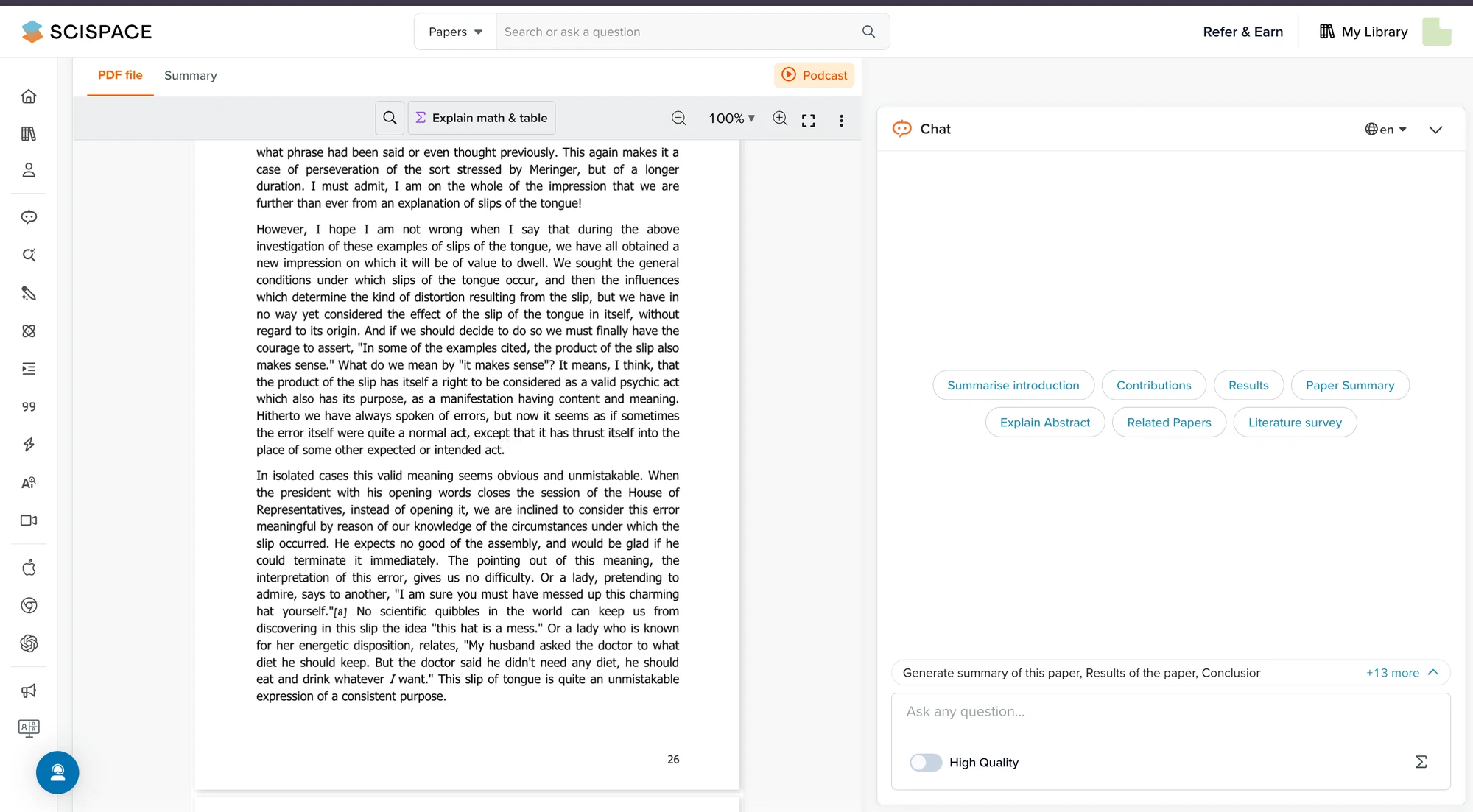
Choose SciSpace when the daily job is understanding dense papers, questioning an uploaded PDF, comparing the same fields across papers, and moving selected notes into a writing workspace. Chat with PDF is the clearest reason to buy: the document, generated answer, source markers, suggested questions, and saved notes live together instead of being split across a PDF reader and a general chatbot.
Do not treat its literature search or generated report as a complete evidence review. SciSpace's own systematic-review guidance says database choice must follow the field and names PubMed, IEEE Xplore, and Scopus as examples. Use SciSpace as a reading and extraction layer inside a documented search protocol, not as proof that every eligible paper was found.
For broader product selection, see Best AI Research Tools. Use Semantic Scholar for broad scholarly discovery, and ResearchRabbit or Litmaps when following citation networks is the main job.
Decision snapshot
| Criterion | What to test | Why it changes the decision |
|---|---|---|
| PDF comprehension | Methods, tables, equations, scanned pages, and page-level source jumps | Fluent summaries can still miss qualifiers or attach a claim to the wrong passage |
| Extraction | Your exact fields, missing-value rules, units, arms, and time points | A comparison table is useful only when every decisive cell is traceable |
| Search coverage | Known eligible papers, discipline databases, date coverage, and duplicates | A large corpus does not establish recall for your protocol |
| Evidence status | Corrections, expressions of concern, and retractions | Citation presence does not prove current validity |
| Usage model | Standalone tools versus Agent tasks, credits, and parallel chats | One Agent request can launch many subtasks and consume an unpredictable amount |
| Privacy | Upload access, retention, deletion, region, and institutional terms | “Not used for training” does not define the full data lifecycle |
PDF reading and extraction are the strongest fit
SciSpace's current Chat with PDF page describes citation-linked answers, section summaries, highlighted-text explanations, related-paper discovery, notes, and support for more than 75 languages. Its July 2026 help guide documents a 100 MB upload ceiling and a split workflow for asking questions, saving answers to Notebook, and revisiting chat history.
The Data Extractor turns multiple papers into a comparison table, allows up to 50 columns, and exports RIS, CSV, BIB, Excel, or XML. That makes it a practical first-pass tool for collecting sample size, design, intervention, outcome, effect estimate, limitations, and funding across a known paper set.
Treat extracted values as proposed data. Pilot heterogeneous papers, define whether a blank means unreported or not applicable, and verify every value that changes eligibility, effect direction, magnitude, or risk-of-bias judgment against the original PDF. Tables, footnotes, subgroup labels, and time points are exactly where a tidy row can become a wrong row.
Search breadth is not evidence completeness
SciSpace's current search documentation names OpenAlex, Semantic Scholar, Google Scholar, and other repositories, and says its curated corpus contains more than 200 million papers. Other current product pages advertise larger counts. Corpus-size copy is therefore directional, not a stable audit metric.
For a narrative review, natural-language discovery can quickly expose terminology and candidate papers. For a systematic or scoping review, preserve the database, exact query, filters, search date, result count, raw export, deduplication decisions, and exclusion reasons. Search discipline-specific databases separately, then use SciSpace to read or extract from the selected set. The managed literature-review workflow covers that control path.
Evidence status needs a separate check. A 2026 peer-reviewed evaluation tested free versions of nine AI tools against 15 retracted biomedical articles. SciSpace version 1.5.1 did not produce a fully correct five-task response set for any article. The study is narrow, biomedical, and does not test the current paid “Verified Report” feature, so it is not a general accuracy score. It does show why DOI identity, Crossmark or publisher status, and the underlying paper still need manual review. Use the scientific claim and citation verification workflow for decision-driving claims.
Pricing: credits are for Agent, not every workflow
Checked October 26, 2026. The live pricing selector, read with both billing tabs, plus SciSpace's current credit documentation showed:
| Plan | Monthly billing | Annual billing shown monthly | Live-selector Agent allowance | Parallel Agent chats |
|---|---|---|---|---|
| Basic | Free | Free | 100 credits per billing cycle | Verify in account |
| Premium | $20 | $12/month | 1,200 monthly credits | 4 |
| Advanced | $90 | $70/month | Unlimited monthly usage | 8 |
| Max | $200 | $160/month | Unlimited monthly usage | 16 |
Premium also lists unlimited Literature Reviews and Chat with PDF. SciSpace's credit troubleshooting guide says credits apply to Agent tasks; standalone tools outside Agent do not consume them. A task can involve search, reading, comparison, and drafting, so “one request” is not a fixed credit unit. Monthly credits expire at the next billing cycle.
The billing-cadence documentation contradicts the selector. The current credit guide says Advanced includes 10,000 credits on monthly billing and unlimited use on annual billing, while the live monthly selector says “Unlimited monthly usage.” A separate help page lists 10,000 Advanced and 40,000 Max credits without that cadence distinction. The live page also separates SciSpace Premium from legacy Typeset Researcher and Team editor plans. Confirm the allowance in signed-in checkout, plus concurrency, add-on credit terms, and Editor entitlement, before purchase; the published sources do not resolve this conflict.
Privacy claims leave a retention question
SciSpace's March 2025 uploaded-PDF statement says Library PDFs are private, accessible only to the uploader, and not used to train its AI models for free or paid accounts. Its broader privacy policy, effective April 10, 2024, says personal data may be retained as long as needed to provide services or meet business and legal purposes, and that services are hosted in the United States with possible processing in other countries.
Those statements answer different questions. “No training” does not specify an uploaded paper's deletion deadline, backups, subprocessors, support access, or institution-specific controls. Before uploading unpublished manuscripts, patient-linked material, or licensed documents, obtain the applicable DPA and written retention/deletion terms.
What researchers report
In a 2026 literature-review workflow discussion, u/lukus88 said they used SciSpace and Consensus for literature discovery and questions, but still had trouble producing the author-year-page citations required by their university. In a separate SciSpace discussion, u/secretsarebest preferred the older Deep Review workflow for search and summarization and criticized Agent credit burn. SciSpace Support later replied that Advanced and Max had moved to unlimited Agent usage, matching the current pricing page.
These are attributed experiences, not benchmarks, and the product changed after the complaints. They point to the right pilot: upload representative PDFs, verify source jumps and exact-page attribution, run one narrow Agent task and one broad task, record actual usage, and compare search recall against a known paper set. This profile is source-based desk research reviewed October 26, 2026; no independent PDF-accuracy, search-recall, or extraction benchmark was run.
Sources & further reading
- SciSpace current product home and branding
- SciSpace Premium pricing and plan selector
- SciSpace Agent credit pricing and usage guide
- SciSpace credit troubleshooting and standalone-tool boundary
- SciSpace Chat with PDF product page
- SciSpace Chat with PDF workflow and vendor interface examples
- SciSpace Data Extractor capabilities and limits
- SciSpace search sources and corpus
- SciSpace systematic-review search guidance
- SciSpace uploaded-PDF privacy statement
- Chat with PDF upload ceiling and workflow
- SciSpace privacy policy
- 2026 evaluation of AI tools handling retracted literature
- 2026 community literature-review workflow discussion
- Community discussion of SciSpace Agent credits and Deep Review


