
Tool
Relay.app
Relay.app shut down in September 2026. Review final dates, deleted data, historical pricing, export limits, recovery risks, and migration criteria.
Verdict
Do not evaluate Relay.app as a product to buy or recover from. Relay.app shut down in September 2026, and its current homepage says all accounts, workflows, and run history were permanently deleted. The free-user export window ended August 15 and the paid-user window ended September 14. Former users must rebuild from surviving files, screenshots, documentation, and records in downstream systems. Choose a replacement by proving the hardest workflow end to end; a Relay JSON file is a specification aid, not a portable executable.
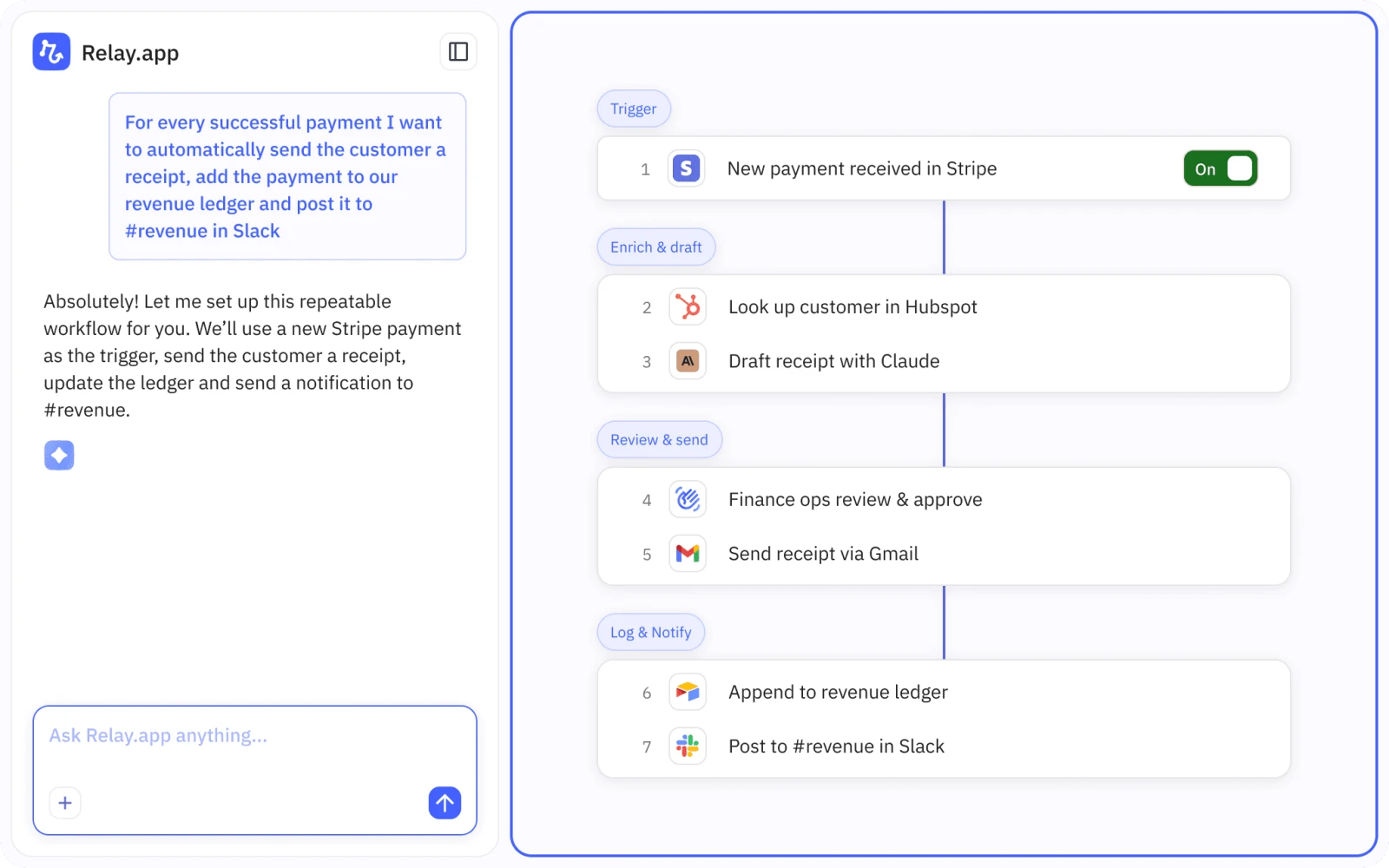
Relay.app was a managed visual automation service combining SaaS connectors, AI steps, human approvals, waits, branches, reusable sequences, tables, MCP servers, webhooks, HTTP requests, and JavaScript. That historical shape is useful for migration planning. It does not establish current availability.
Use the AI workflow automation guide to reopen the category decision. Compare Make for managed visual routing and mapping, n8n for HTTP, code, and self-hosting control, or Microsoft Power Automate when Microsoft 365, identity, and enterprise administration drive the choice.
Relay.app is closed, not merely unavailable to new users
The current Relay.app homepage was checked October 18, 2026. It says the product shut down in September and that all accounts, workflows, and run history have been permanently deleted. There is no active signup, login, pricing, export, or recovery offer.
The archived official shutdown announcement gives the exact wind-down sequence:
| Date | Official action | Consequence now |
|---|---|---|
| July 16, 2026 | New signups and free-to-paid upgrades stopped; paid subscriptions were canceled | No current plan can be purchased or renewed |
| August 15, 2026 at 11:59 p.m. PT | Free accounts and associated data were scheduled for permanent deletion | Free-user in-product exports are no longer available |
| September 14, 2026 at 11:59 p.m. PT | Paid access ended and associated data were scheduled for permanent deletion | Paid-user in-product exports and workflow execution are no longer available |
| September 2026 | Shutdown completed | Current first-party page says accounts, workflows, and run history are deleted |
The July notice said annual customers would receive prorated refunds and that paying workspaces would temporarily receive another 25,000 steps and 10,000 AI credits per month during the 60-day wind-down. Those were transition terms, not continuing entitlements. Reconcile old invoices or refunds from retained Paddle receipts; the public service provides no account view now.
Historical pricing explains old capacity, not a current offer
The prices below come from Relay.app's archived June 29, 2026 pricing page. They cannot be purchased in October 2026.
| Former plan | Archived annual-billing display | Included usage and operating limits |
|---|---|---|
| Free | $0 | 1 user, 200 steps/month, 500 AI credits/month, 5 workflows, 2 active workflows, 2 concurrent runs, 2 sequences, 2 tables, 2 custom MCP servers, 1 connection per app, 30-day run history |
| Professional | $19/month, billed annually | 1 user, 750 steps/month, 2,000 AI credits/month, unlimited workflows and active workflows, 10 concurrent runs, unlimited sequences/tables/MCP servers and app connections; run history configurable to 30, 90, or 365 days |
| Team | $59/month, billed annually | 10 users, 1,500 steps/month, 2,000 AI credits/month, shared workflows and connections, otherwise the same published workflow and concurrency limits as Professional |
| Enterprise | Custom | Custom usage limits and integrations, priority support, training, and claimed SOC 2/GDPR support |
Relay counted most actions and AI operations as steps, while its pricing FAQ excluded triggers, data transformations, path and loop evaluations, and some other operations. AI credits covered Relay-managed model usage; customers could also bring an API key. Old invoices therefore need separate reconciliation for plan fees, step top-ups, AI-credit top-ups, and external model or application charges.
Recovery now starts with surviving offline artifacts
During the wind-down, Relay offered a workspace ZIP containing a folder for each workflow, sequence, MCP server, and table. The official notice says those folders could include prompt.md, workflow.json, run-history CSV, one JSON file per run, and table CSV data. It also said stored credentials and authentication tokens would be deleted with the account.
That export window has passed. Check local downloads, managed-device folders, backups, shared drives, ticket attachments, and the machines of former workspace administrators. Keep an untouched copy of every ZIP and hash it before using third-party migration tools. Exports may contain customer content, prompts, step inputs and outputs, error details, AI chat history, and table data.
The pre-shutdown run-export documentation exposes important gaps:
- a workflow run-list CSV contained metadata, not full step payloads, and was capped at 100,000 rows per export;
- detailed execution history required a separate JSON export for each run;
- old runs could already have aged out after 30 days on Free or after the configured 30-, 90-, or 365-day retention on Professional and Team;
- waiting runs were exempt from ordinary age-based deletion, but the final platform shutdown superseded that historical behavior;
- credentials were not a portable dependency bundle. Every target connection must be created again with least-privilege scopes.
If no export survives, reconstruct from downstream audit logs, webhook producers, CRM history, email and Slack messages, source-system change history, screenshots, internal SOPs, and invoices. Recovery cannot restore Relay execution. It can only produce a new specification and evidence set for a replacement.
Preserve behavior, not just the visible list of steps
| Migration criterion | Relay behavior to reconstruct | Acceptance test on the replacement |
|---|---|---|
| Trigger semantics | Schedules, native app events, forms, mailhooks, webhooks, RSS, table events, and batches | Replay representative events; verify filters, timestamps, pagination, ordering, and duplicate handling |
| Flow control | Conditions, sequential or parallel loops, branch merging, fixed or event-driven waits, and reusable sequences | Test empty lists, large batches, both sides of every branch, timeout, resume, and partial failure |
| Human review | Email or Slack approval/input, due dates, reminders, reassignment, skip, or terminate-on-overdue | Verify reviewer identity, displayed context, edits, denial, timeout, duplicate response, stale state, and idempotent continuation |
| Integration depth | Multiple app accounts, shared connections, nested records, custom HTTP, webhooks, JavaScript, and secret references | Use the real scopes and hardest API path; verify rate limits, refresh tokens, file handling, and provider errors |
| State | Relay tables, workflow variables, run state, and long waits | Define system of record, locking, schema changes, backup, restore, and orphaned-run handling |
| AI behavior | Model, prompt, structured output, tool access, context fields, and review step | Run a fixed evaluation set; compare schema validity, refusals, cost, latency, and unsafe actions |
| Operations | Historical plans allowed up to 10 concurrent runs and retained run data by plan | Load-test expected bursts; prove queues, retry policy, deduplication, alerting, replay, and evidence retention |
| Governance | Workspace owners, shared connections, logs, and app credentials | Map roles, service accounts, offboarding, audit access, secret rotation, deletion, and incident ownership |
Historical Relay documentation says an approval or data-input step paused a run and could notify a workspace user, any email address, or a Slack channel. A Slack-channel action could be completed by any channel member. Do not reduce this to a generic “approval” box: decide who may act, bind the response to an authenticated identity, record the exact payload reviewed, and revalidate mutable data before the write.
Replacement fit depends on the hardest workflow
Make is the closest starting point when the team wants a hosted visual builder with routers, mapping, broad connectors, and low-code ownership. n8n is the stronger candidate when custom HTTP, JavaScript, self-hosting, or infrastructure control outweighs ease for nontechnical operators. Microsoft Power Automate deserves priority when Outlook, Teams, SharePoint, Dataverse, Entra ID, and tenant governance dominate the estate.
Do not select from feature checklists alone. In a July 2026 r/AiAutomations post, u/Rude-Ad4132 described a roughly 100,000-execution-per-month Relay estate using Airtable, Twilio, Fillout, Mailchimp, branches, API calls, AI, and communications. They reported that an early n8n test hit a wall on their most critical Cloudflare-protected HTTP workflow, later got that flow working in Pipedream, chose Make, and then remained dissatisfied with parts of the Make experience. This is one user's evolving migration, not comparative reliability evidence. The historical Pipedream result is not a current adoption recommendation: Pipedream Workflows now has its own March 31, 2027 shutdown deadline. Its useful lesson is the test order: prove the difficult API, volume, mapping, retry, and exception paths before rebuilding easy workflows or buying an annual plan.
Privacy and deletion claims have different scopes
Relay's archived privacy policy, effective July 29, 2024, said the service collected data from authorized productivity tools, including emails, messages, calendar information, and metadata, and shared data with service providers and authorized integrations. It said customer data obtained through APIs was not used to train generalized AI or machine-learning models. The policy also allowed retention while an account was open and longer where required for legal obligations, disputes, or fees, plus retention of anonymous or aggregated information.
The later shutdown notice specifically said unexported customer content and product data, stored app credentials, and authentication tokens would be permanently deleted at the end of each wind-down window. The current homepage specifically confirms deletion of accounts, workflows, and run history. Those statements do not prove deletion inside every connected app, model provider, email inbox, Slack workspace, downloaded export, backup, statutory record, or de-identified aggregate. Former customers should revoke old OAuth grants in each provider, rotate secrets referenced in workflow files, document downstream copies, and retain contractual or support evidence for deletion-sensitive audits.
We did not authenticate to Relay.app, download a real workspace export, execute a workflow, reproduce a community report, inspect backend deletion, or test a migration. Current status comes from the live official homepage; dates, features, prices, limits, exports, and privacy terms come from dated first-party archives. Relay.app is no longer a candidate. The decision is which maintained system can reproduce the necessary behavior from the evidence that survived.
Sources & further reading
- Current official Relay.app shutdown status
- Archived official shutdown announcement and export contents
- Archived June 2026 pricing and plan limits
- Archived run retention and export limits
- Archived human-in-the-loop documentation
- Archived Relay.app privacy policy
- Relay.app official shutdown post
- Attributed Relay migration experience


