
Tool
Gemini CLI
Decide whether Gemini CLI still fits after consumer access ended. Compare its enterprise and API routes, policies, sandboxing, IDE diffs, costs, and privacy.
Verdict
Gemini CLI is now a specialist choice for organizations and API-key users, not the free consumer coding agent its older launch copy suggests. Google ended Gemini CLI access for free individual, Google AI Pro, and Google AI Ultra accounts on June 18, 2026. Keep or adopt it when you have a Code Assist Standard or Enterprise license, Gemini API key, or Vertex AI route and specifically value an Apache-licensed terminal harness with granular policies, MCP, headless output, and editor diffs. If you expected Google-account subscription access, migrate to Antigravity CLI or choose another active terminal agent.
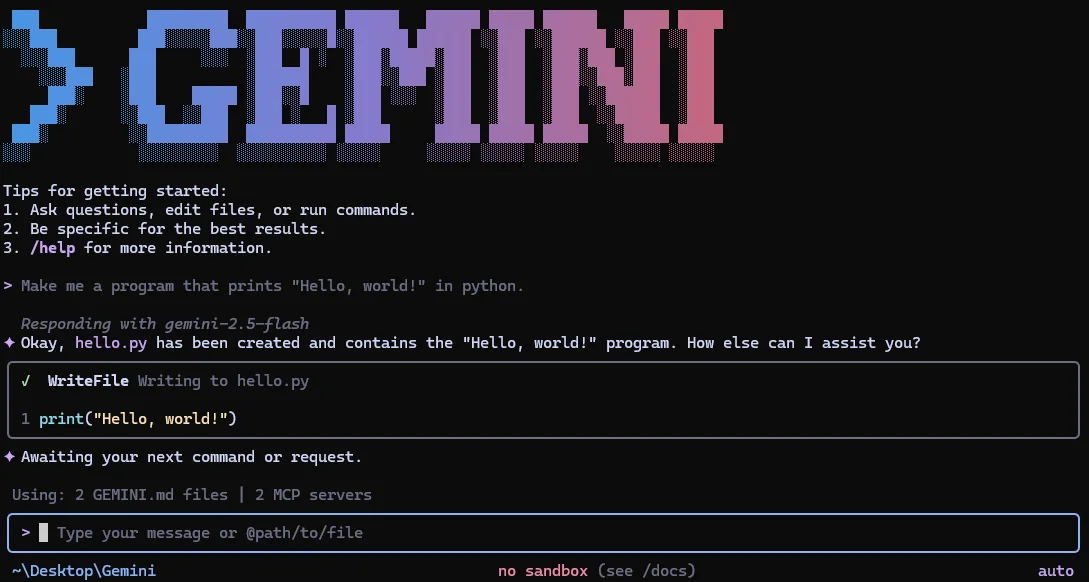
Gemini CLI reads repositories, edits files, runs shell commands, fetches web content, calls MCP tools, delegates to subagents, and runs interactively or headlessly. Its current decision is unusually narrow because access depends on authentication route.
Start with the best AI coding agents guide. Compare active terminal alternatives in Aider, OpenCode, Claude Code, and OpenAI Codex.
Choose by access route
| Your situation | Decision | Why |
|---|---|---|
| Free individual, Google AI Pro, or Google AI Ultra account | Migrate | Google disabled Login with Google for these tiers and directs users to Antigravity |
| Gemini API key for development | Conditional fit | Unpaid quota is limited to Flash; paid use is metered by model and tokens; data terms change when billing is active |
| Vertex AI workload | Stronger fit | Uses Google Cloud credentials, project controls, regional configuration, and usage-based billing |
| Code Assist Standard or Enterprise team | Keep or evaluate | Organizational access remains supported; licenses add fixed daily request allowances and admin controls |
| Multi-model or local-model workflow | Skip | Gemini CLI is open source, but its supported inference routes remain Google services and require internet access |
| Large unattended MCP automation | Pilot first | Headless modes and policies are useful, but tool-catalog scale and sandbox configuration need version-specific validation |
An unpaid Gemini API key is a developer-service route with its own quota and data terms.
Current status overrides older product copy
The September 2 deprecation notice and June 18 repository announcement agree on the access transition. Antigravity CLI is a different product and binary.
Several first-party pages still conflict with that status. The repository README advertises 1,000 free daily requests through personal Google login, while the authentication and quota pages still recommend consumer Google accounts and list Pro and Ultra allowances. Do not use those rows to make a purchase decision. The dated deprecation notice governs current consumer eligibility; only the API-key, Vertex AI, and organizational-license sections remain useful here.
What the active product offers
Terminal control with an editor review path
Default mode asks before most file writes and shell commands. Auto-Edit approves some editing operations, Plan mode restricts work to research and plan artifacts, and YOLO auto-approves tools. The policy engine can allow, deny, or ask for confirmation by tool, arguments, approval mode, interactive state, MCP server, or subagent. Administrators can install system policies that outrank user rules. Current docs warn that workspace policies in .gemini/policies are non-functional; use user or administrator policy locations.
The VS Code companion passes open-file and selection context to the CLI and opens proposed changes in a native diff. Gemini CLI is also listed in the ACP registry for compatible editors such as JetBrains IDEs and Zed. This is useful if you prefer terminal steering but still want an editor-native review step.
Plan mode is not an absolute security boundary. User or administrator policies can change its behavior, and a rule without a mode applies everywhere. Review policies with the same care as shell allowlists.
Extensibility and automation
Gemini CLI supports GEMINI.md project instructions, Agent Skills, hooks, MCP servers, extensions, subagents, structured JSON or streaming output, and non-interactive prompts. That makes the surviving product most credible as an inspectable Google-model harness inside an existing engineering platform.
For issue-to-change automation, define acceptance criteria and preserve an independent review step with the issue-to-PR coding-agent workflow. Generated diffs still need tests, security review, and human ownership.
Pricing and quota boundaries
The current quota page lists an unpaid Gemini API key allowance of 250 model requests per user per day, limited to Flash. Paid Gemini API and Vertex AI usage varies by model, tokens, quota tier, and enabled tools. Request-per-minute limits and service availability can still interrupt work. /stats model shows the active session’s usage and applicable limits.
For organizations, Code Assist Standard lists 1,500 maximum requests per user per day and Enterprise lists 2,000. Google Cloud prices the licenses by hour with monthly or 12-month commitments; the published rates are equivalent to about $22.80 or $19 per user per month for Standard and $54 or $45 for Enterprise, using 730 billing hours. Currency conversion and Cloud SKUs can differ.
Do not price a long agent loop by prompt count alone. Repository context, model routing, tool calls, retries, and generated output determine API cost. Measure representative tasks before standardizing a paid route.
Sandbox, permissions, and recovery
Full-process sandboxing is configurable with Docker, Podman, macOS Seatbelt, gVisor, or other supported providers, but it is disabled unless enabled by a flag, environment variable, or setting. The default macOS Seatbelt profile confines writes while allowing broad reads and network access; stricter profiles exist. Sandbox expansion can request extra directories or network access for one command.
Use default or Plan mode for unfamiliar repositories, enable a sandbox explicitly, and keep the workspace on a recoverable branch. YOLO removes approval stops; it does not make tools or dependencies trustworthy. Checkpoint and rewind features help with file state, but they do not reverse remote API calls, published artifacts, or leaked credentials.
Privacy depends on the inference route
The client’s optional usage statistics cover tool names, success or failure, timing, model, request status, enabled tools, and approval mode. Google says this telemetry excludes tool arguments, tool results, prompt and response content, file content, personally identifiable information, and API keys. It can be disabled in settings.
Model traffic has a separate boundary. Under the Gemini API terms, unpaid-service prompts and responses may be used to improve Google products and may be reviewed by humans; Google tells users not to submit sensitive or confidential information. The EEA, Switzerland, and UK receive the paid-services data treatment even for unpaid usage. For paid API services, Google says prompts and responses are not used to improve products, though limited abuse-monitoring retention and other service telemetry remain. Organizational Code Assist and Vertex AI deployments should be checked against their own contract, region, retention, and administrator settings.
Open-source client code therefore does not make repository context local. The selected Google service still receives the model request.
Current trade-offs and community signals
Record the exact authentication method and entitlement during a pilot. Conflicting documentation makes generic subscription labels unreliable.
Two open GitHub reports show configuration edges worth testing. gundermanc reports API 400 errors when a very large tool catalog is exposed; the issue is tagged as needing information and does not provide a client version, so it does not establish a universal threshold. 21vedansh reports file-permission failures with rootless Podman bind mounts and proposes --userns=keep-id; the report uses a nightly build and remains an anecdote, not proof that every Podman setup fails.
We did not run a comparative coding benchmark or hands-on acceptance test for this profile. These reports help define pilot cases: load your real MCP catalog, run your actual sandbox provider, test headless completion, and inspect the resulting diff.
Who should choose Gemini CLI
Choose Gemini CLI when your organization already pays for Code Assist or Google Cloud, or when a Gemini API key is an acceptable billing and privacy boundary. Its strongest case is a team that wants an open-source, terminal-first client with enforceable policies, headless interfaces, MCP, and IDE diffs while remaining inside Google’s model and cloud stack.
Individual developers looking for a bundled subscription should follow Google’s Antigravity migration path or compare Aider and OpenCode for provider flexibility. For a broader local-plus-cloud workflow, compare OpenAI Codex. Then validate any finalist with the CLI coding-agent shortlist and the same repository, task, tests, and review rubric.
Sources & further reading
- Consumer-account deprecation
- Gemini CLI transition announcement
- Gemini CLI repository
- Installation and system requirements
- Authentication setup
- Quotas and pricing
- Gemini Code Assist pricing
- Policy engine
- Plan mode
- Sandboxing
- IDE integration
- Configuration and usage statistics
- Gemini API data terms
- Large tool-catalog issue report
- Rootless Podman sandbox issue report


