Comparison
Gong vs People.ai (Backstory) (2026)
Choose Gong for native conversation capture and call-led deal inspection; choose Backstory for activity capture, account relationships, and revenue answers.
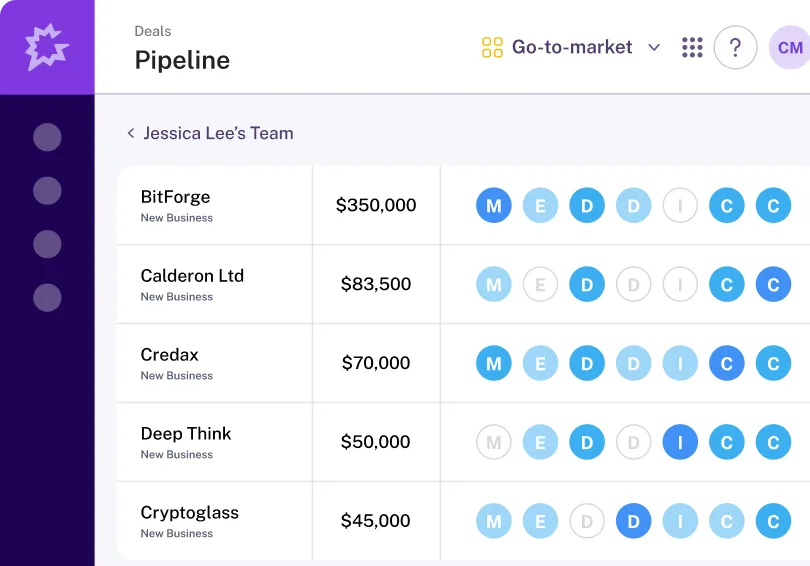
Verdict: Choose Gong when managers and reps need native meeting recording, searchable transcripts, call coaching, and conversation evidence connected to deals. Choose People.ai, now Backstory when RevOps and revenue leaders need broad activity capture, CRM matching, stakeholder coverage, account history, and answers across complex selling motions. Both inspect deals, accounts, engagement, and forecasts. The useful distinction is which evidence layer you need to establish first.
Gong starts with the conversation: replay it, inspect the transcript, coach the rep, then connect it to pipeline. Backstory starts with an account or opportunity assembled from email, calendar, CRM, meeting transcripts, and connected calls.
We did not run a controlled accuracy, forecast, or revenue-impact test. This comparison uses first-party product documentation checked October 7, 2026 and attributed user reports. Vendor outcome claims do not decide the verdict.
Gong vs People.ai decision matrix
| Decision | Gong | People.ai / Backstory |
|---|---|---|
| Evidence center | Recorded calls, meetings, transcripts, emails, and CRM context | Matched activity across email, calendar, CRM, meeting transcripts, and third-party call systems |
| Best inspection view | Exact conversation moments, trackers, summaries, coaching, deal boards | Account and opportunity backstories, engagement, stakeholder coverage, relationship maps, pipeline answers |
| Native conversation workflow | Records and transcribes calls; supports call libraries, collaboration, scorecards, and Ask Anything | Ingests meeting transcripts and calls logged in Salesforce or connected sources; traces answers back to activity |
| Account workflow | Account console combines activity, AI briefs, CRM data, deals, and contacts | Activity matching, Account/Opportunity pages, engagement scoring, parent rollups, and Salesforce relationship maps |
| Forecast and deal risk | Deal boards plus Forecast and Enable applications; risk can be tied directly to conversation evidence | Forecasting, pipeline movement, qualification, and risk based on complete matched activity and account structure |
| Rollout owner | Sales enablement, revenue leadership, and RevOps | RevOps, CRM admins, IT, and revenue leadership |
| Public price | No dollar price; per-user licenses plus a platform fee | No dollar price; connected customer-facing people plus prepaid answer consumption |
| Main risk | Paying for a broad suite while managers use it mainly as a recorder; AI and credits still need governance | Weak CRM hierarchy or activity matching undermines account answers; deployment is data and permissions work |
Choose Gong for conversation-led inspection and coaching
Gong's advantage starts before analysis: it can join, record, transcribe, and organize customer calls. A manager can jump to a tracked objection, review talk patterns, score a call, share a clip, or ask a question about a transcript. Deal boards then combine those interactions with CRM fields, warnings, playbooks, contacts, and forecast context.
Gong is broader than call recording. Its Foundation account console includes calls, emails, CRM updates, digital engagement, AI briefs, deals, and stakeholders. Its AI Activity Mapper associates calls and emails with CRM entities; Forecast and Enable extend that dataset into pipeline inspection and coaching.
If a forecast review ends with “show me where the buyer said that,” Gong is built around the recording and transcript. The advantage goes unused when managers do not review calls, configure trackers, or coach from them.
Choose Backstory for activity and relationship evidence
People.ai officially renamed the product Backstory in 2026; the company says it is the same platform and data infrastructure. Backstory automatically captures email and calendar activity, matches it to CRM accounts and opportunities, creates engagement history, and layers summaries, risk signals, forecasting, qualification, and natural-language answers over that record.
Its distinct strength is relationship context across a complex account. Backstories show engagement, people, risks, and next steps at account or opportunity level. ClosePlan, a separately scoped add-on, provides maps of reporting lines, decision authority, influence, conflict, and coverage in Salesforce. Confirm its entitlement and Salesforce package during procurement.
Backstory still uses conversation content. Its current documentation covers meeting transcripts, calls logged in Salesforce, and calls from systems such as Gong. Its homepage says answers can trace to a meeting, stakeholder, and deal. Choose it for the broader activity graph, not because it excludes conversations.
Pricing and packaging changed in 2026
Gong publishes no self-serve dollar amount. Licenses are per user, a platform fee depends on supported user count, and existing integrations are free. Foundation is the core platform; Forecast Essentials and Enable Essentials are application seats. A narrower Call Intelligence seat includes recording, transcription, collaboration, CRM mapping, and per-call Ask Anything, but excludes broader activity analysis, account pages, starter deal boards, and Gong applications.
Gong also introduced a shared AI-credit pool: each paid core seat contributes 2,000 credits annually. Question-based AI Trackers, AI APIs, MCP, and deep mode consume credits; normal call, coaching, deal, forecast, and individual-agent capabilities remain seat-included. For the applicable credit-metered processing, ten emails or a call longer than ten minutes consume one credit; that is not a charge for every ordinary recording.
Backstory also withholds the dollar quote but explains its meter. Buyers pay for connected customer-facing people plus prepaid consumption for risks, summaries, coaching flags, and answers. Viewers do not require paid seats. Backstory says excess use neither shuts service off nor causes mid-term back-billing; renewal is sized forward from actual use.
Security, retention, and rollout
Both platforms ingest sensitive revenue communications. Gong documents TLS 1.2 or better in transit, AES-256 at rest, permissions, consent profiles, redaction, deletion controls, and optional customer-managed keys. Standard retention is the shorter of three years or the customer term; company-library calls are an exception unless admins apply retention there.
Backstory says filtered sensitive content is discarded before CRM sync. Email bodies, meeting descriptions, and transcripts are retained for 15 days for processing; metadata remains for the contract term. Admins can configure exclusions. Backstory says customer data is not used to train or fine-tune base models, PII is stripped before model-provider requests, and AI can be disabled tenant-wide.
Backstory says most teams go live in two to four weeks; G2 reports a three-month average implementation time from reviews. Treat those as vendor target and planning counterweight. Pilot Backstory's activity matching, hierarchy, and exclusions. For Gong, pilot capture coverage, transcript quality, tracker precision, CRM mapping, permissions, and manager adoption.
What current users report
G2 reviewer Marissa W., an enterprise account executive posting October 1, 2026, reported useful recordings, summaries, and coaching signals while still checking AI analysis and using other models for some risk interpretation. G2 labels the review validated and sourced through an invite.
For Backstory, Jonathan B., an enterprise SVP posting January 24, 2026, described activity, engagement, stakeholder, and relationship visibility while noting dependence on account hierarchy, CRM hygiene, and adoption. G2 labels it current-user validated and organic. A verified biotechnology reviewer on April 7, 2026 praised Salesforce auto-logging but reported interpretation errors and limited transparency; G2 labels that review G2-invited and incentivized. Use these reports to design a pilot, not predict an outcome.
Practical verdict
- Pick Gong when native capture, searchable call evidence, rep coaching, and conversation-led deal review are the buying center.
- Pick Backstory when automatic activity capture, CRM completeness, stakeholder mapping, and account-level revenue answers are the buying center.
- Consider both when Gong owns conversation capture and Backstory needs those calls inside a broader account and relationship model. Backstory explicitly lists Gong as a call source; price and govern the integration as two systems.
Compare the wider category in the best AI sales tools guide. For adjacent execution layers, review Salesloft, Outreach, and the Clay vs Apollo comparison. For an evaluation dataset, use a small set of known accounts from the target-account research workflow and reconcile every surfaced risk against source activity.
Sources & further reading
- Gong pricing
- Gong plans and seats
- Gong credits
- Gong Call Intelligence seat
- Gong Account console
- Gong security controls
- Gong retention policy
- Backstory homepage and rebrand
- Backstory platform introduction
- Backstory pricing
- Backstory activity capture and filtering
- Backstory relationship maps
- Backstory trust and security
- Gong user reviews on G2
- Backstory user reviews on G2
Ordered for comparison, not as a universal ranking. Inclusion requires a direct fit with this page's stated workflow.