Use case
How to Build Account Plans with AI
Build an AI-assisted account plan with sourced priorities, stakeholder gaps, owners, and review dates. Compare Backstory and Gong limits before rollout.
Verdict
Build an AI account plan around one agreed objective, evidence-backed stakeholder gaps, and owned next actions. Choose Backstory, formerly People.ai, when Salesforce account strategy and cross-team activity capture justify a dedicated platform; confirm the ClosePlan add-on for structured plans and relationship maps. Use Gong to recover conversation evidence when it already contains your account history, then maintain the approved plan in your CRM. A convincing generated strategy is still a draft until the account owner checks the evidence and accepts the actions.
This guide owns ongoing strategy for a named account: land, expand, defend, or renew. It begins after target-account research has established fit. It does not replace a lead-priority queue, a single-call risk review, or a buyer-facing recap. Compare the wider AI sales stack, the Backstory profile, Gong profile, and Gong versus Backstory if the evidence system is still undecided.
Decide what the account plan must change
Start with the decision the team will make this period. “Learn more about Acme” cannot be accepted or rejected. “Confirm whether the existing deployment can expand into the European business unit before renewal” can.
| Plan field | Acceptance criterion | Common failure to reject |
|---|---|---|
| Account boundary | CRM ID, parent/subsidiaries, covered business units, plan owner and period | Mixing a parent company's public strategy with a subsidiary's budget |
| Customer objective | Buyer-confirmed objective, evidence and measurable success condition | Turning a vendor sales target into a customer commitment |
| Current position | Existing deployment, open deals, competitors and known constraints | Treating an empty CRM field as proof of unused opportunity |
| Stakeholder coverage | Known people, observed relationships, missing roles and next verification | Declaring the most responsive contact the economic buyer |
| Strategic plays | At most a few prioritized hypotheses with supporting and opposing evidence | Filling a generic SWOT matrix without changing any action |
| Action register | Owner, due date, dependency, completion evidence and state | Generating tasks that no person has agreed to own |
| Review policy | Freshness window, update triggers and approval owner | Replacing the plan after every call and losing previous decisions |
The table is an editorial operating template, not a claim that any vendor implements every field automatically. For an early account with little private history, a manually reviewed CRM template may be enough. More software does not repair missing notes or unclear ownership.
Choose the evidence and planning surfaces
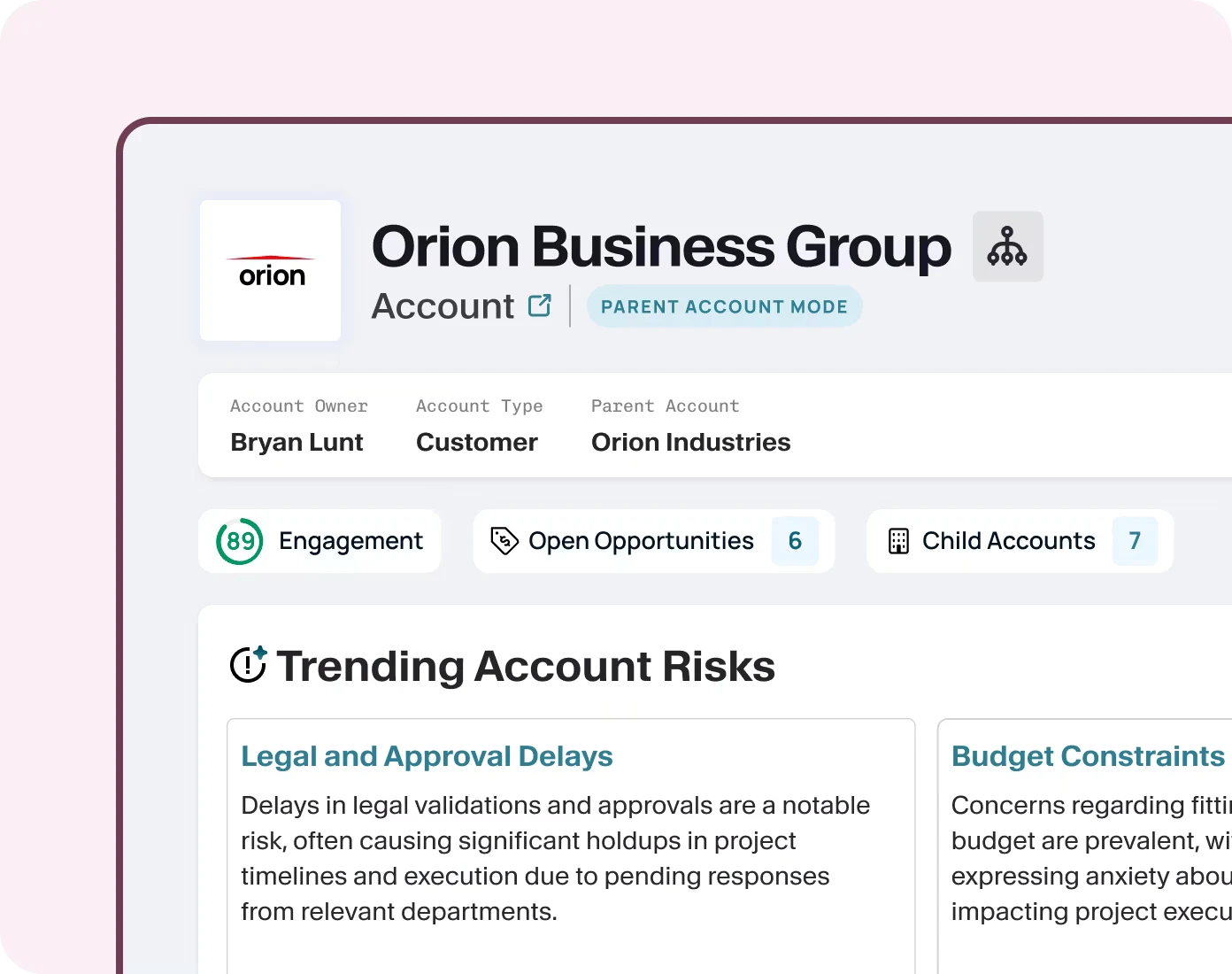
Backstory's account-strategy page describes combining public company material with CRM and captured interactions. That scope fits account-wide planning, but an inferred buying role remains a hypothesis. Its ClosePlan documentation separately describes the structured planning add-on. Do not assume every marketed planning capability is enabled in a base contract.
Gong's Ask Anything is useful for evidence questions such as “what did the buyer say about renewal conditions?” Its documented account/deal scope is up to 60 calls and 500 emails in the selected period; contact questions use up to 10 calls and 80 emails. CRM fields, unrecorded meetings and automatic replies are excluded from account/deal answers. The same page's generic tips repeat the smaller limits without scope, so confirm behavior in your tenant. This is not proof that a single answer covers the complete account record.
Build the plan in six steps
1. Assemble a bounded evidence packet
Collect the account hierarchy, approved CRM facts, active opportunities, relevant call excerpts, permitted email context, support or adoption signals, and current primary-source company announcements. Store source IDs or URLs, event dates and retrieval dates. Define who may read each source before combining it into a plan.
Keep commercial commitments separate from background research. A press release about expansion does not establish procurement budget. A rep's note that someone “seems supportive” does not establish a champion. Missing or inaccessible evidence should remain visible as a gap.
2. Extract facts before asking for strategy
Have the model produce individual claims with supporting references, contradictions and unknowns. Review the decisive claims before generating recommended plays. Preserve the original wording when it changes the meaning: “exploring next year” must not become “buying this quarter.”
A useful instruction is: “Separate observed facts, customer-confirmed commitments, and proposed hypotheses. Give each claim its source and date. If evidence conflicts, list both versions. Do not infer budget, authority, sentiment or a deadline from a title or silence.”
3. Map influence and missing access
Represent people and roles separately. An unnamed procurement owner is an actionable gap; an invented name is not. Record the last verified role, actual interactions, reported influence, and who on your team can validate the relationship.
Backstory's Relationship Maps support unknown-contact placeholders and engagement-based contact recommendations. Account maps cover the organization; opportunity maps cover a deal. AI hierarchy generation is documented as beta, requires the current ClosePlan release plus API connection, and has a review step before changes apply. Review suggested reporting lines rather than treating title-based inference as an authoritative org chart.
4. Draft a small number of strategic plays
Ask for the strongest play, a credible alternative and a reason to wait. Each should connect a customer objective to evidence, identify what would disprove it, and name the next information-gathering action. Require evidence against the proposed expansion as well as evidence for it.
For example, in a hypothetical account, a buyer asks about a second-region rollout while support reports an unresolved deployment issue. The plan should record both. A sensible proposed next step may be a joint technical review before an expansion proposal; it should not silently interpret interest as purchase intent.
5. Approve actions and publish one current version
The account owner accepts, rejects or edits each proposed action. Assign a real owner and due date only after agreement; preserve unassigned or date needed otherwise. Publish a versioned plan with links back to the evidence, plus a short decision log explaining changed priorities.
ClosePlan Account Plans can hold initiatives, Salesforce tasks, supporting files and product whitespace. Multiple plans can exist for an account, but only one is primary. A Follow-up Plan preserves continuity across periods; a Clone is independent and does not copy Actions. Check task continuity when rolling a plan forward instead of assuming a duplicated document duplicates the work.
6. Refresh by change, not by full rewrite
Trigger review when a stakeholder leaves, an opportunity changes stage, a material customer commitment changes, a renewal approaches, or evidence expires. Ask AI for the difference from the approved version: new facts, invalidated assumptions and affected actions. Keep unchanged decisions intact.
For external communication, pass approved commitments to the post-meeting follow-up workflow. Internal theories about influence, commercial risk or competitors do not belong automatically in a buyer-facing message.
Pricing, access and operating limits
Checked October 9, 2026. Neither vendor publishes a universal dollar price for this workflow; obtain the actual package and limits in writing.
| Product | Verified commercial model | Account-planning checks |
|---|---|---|
| Backstory / ClosePlan | Custom quote: connected customer-facing people plus pooled, pre-packaged answer consumption. Dashboard viewing is free; generated answers draw from the allowance. The vendor describes forward adjustment at renewal rather than mid-term overage back-billing. | Price ClosePlan explicitly. The pricing page says full-product access without feature tiers, while documentation calls ClosePlan an add-on. Confirm entitlement, consumption quantity, connectors and services rather than resolving that ambiguity yourself. |
| Gong | Per-user licenses plus a platform fee, with a custom proposal. | Ask Anything requires a paid seat and access permissions. The narrower Call Intelligence seat excludes account page views and starter deal boards; call-level AI does not establish account-planning access. |
Budget the work needed to reconcile CRM IDs, capture missing activity, configure exclusions and review suggestions. Track cost per approved and maintained plan, including operator time, rather than cost per generated page.
Backstory's security page describes domain, email and CRM-object controls, tenant-level AI disabling and role-based visibility. Those are vendor commitments, not an independent audit performed for this guide. Test that excluded interactions remain inaccessible in both generated output and shared exports before rollout.
What community evidence adds
In a Customer Success discussion, Reddit user u/treousa described pressure to maintain account plans while other teams' customer conversations and notes remained scattered. Their use of AI for writing did not solve the missing-context problem. This is one anonymous practitioner's account, not evidence for either vendor's performance or a measured industry rate.
The practical implication is to test capture coverage before prose quality. If Sales, CS and Product each hold different parts of the story, a polished plan can still miss the decisive interaction.
Validate before rolling out to the whole book
Use a small representative set: a new account, a renewal, a parent with subsidiaries, a stalled expansion, and one with contradictory history. Have account owners grade factual correctness, evidence access, missing stakeholder roles and whether the proposed action is justified. Include a revoked-source test and a known wrong account match.
A plan passes only when the team can identify its current version, open the decisive evidence, explain why the chosen play outranks alternatives, and name the next owner-approved action. Recheck after the next material account event. Faster drafting is useful only if the maintained plan stays trustworthy.
Sources & further reading

Ordered for comparison, not as a universal ranking. Inclusion requires a direct fit with this page's stated workflow.