Use case
How to Draft Post-Meeting Sales Follow-Ups with AI
Turn reviewed sales-call notes into a buyer-confirmed recap email with explicit commitments, owners, dates, attachments, unknowns, and human approval.
Verdict
Start with notes a seller has already reviewed, convert only confirmed statements into a commitment ledger, then let AI draft the buyer-facing recap. Choose Gong when calls already live in a revenue-intelligence system and the wider team uses deal and account context. Choose Fathom when an individual or small team needs a lighter recorder with built-in action items and follow-up drafts. Neither product should decide what the buyer promised, fill an unstated date, or send without a person checking recipients, commitments, links, and attachments.
A post-meeting sales follow-up is an agreement check. Its job is to let the buyer correct the record while the conversation is fresh and make the next move unambiguous. It is not a miniature call summary and it is not cold outreach dressed up with a first name.
This workflow begins after the call notes have been reviewed. Use AI sales-call analysis for objections, talk patterns, coaching, and deal-risk interpretation. Use the separate meeting-note-to-CRM workflow for record association and writeback, or the meeting action-item workflow when the desired output is an internal task. Here, the end state is one send-ready email draft for the buyer.
Judge the workflow on the email it produces
| Criterion | What good looks like | Hold the draft when |
|---|---|---|
| Source boundary | Draft uses reviewed notes and approved attachments only | It reaches into raw call analysis or unrelated account history for new claims |
| Commitment fidelity | Each action preserves who agreed to do what and by which exact date | Owner, date, scope, or dependency is inferred |
| Buyer confirmation | Wording invites a factual correction without reopening settled points | Generated prose overstates agreement or consensus |
| Unknown handling | Open questions stay visibly open or are omitted by policy | A blank becomes a plausible-sounding answer |
| Attachment control | Every promised file has an approved version, filename, and audience | The draft says “attached” before the file is selected and checked |
| Review surface | Reviewer sees the email beside the commitment ledger and file manifest | Approval requires trusting a generated summary |
| Send boundary | Output is a draft in the correct thread with recipients populated for review | The automation can send on generation alone |
Speed is useful only after these checks. “Email generated in 20 seconds” is a poor success metric if the buyer has to untangle who owns the security questionnaire.
1. Build a reviewed input packet
Give the model a compact packet that a seller has already checked against the call. The following packet uses fictional people, companies, and files to illustrate the format:
meeting:
  account: Northstar Health
  seller_company: Acme
  occurred_at: 2026-10-08T11:00:00-04:00
  buyer_attendees:
    - name: Priya Shah
      role: Director of Security
      email: priya@example.com
  seller_attendees:
    - name: Alex Moreno
      role: Account Executive
      email: alex@vendor.example
agreed_outcome: Security review starts after buyer receives the DPA and architecture diagram.
commitments:
  - party: seller
    owner: Alex Moreno
    action: Send current DPA and architecture diagram
    due_date: 2026-10-09
    status: confirmed
  - party: buyer
    owner: Priya Shah
    action: Return security questionnaire
    due_date: null
    status: confirmed_action_date_unknown
attachments:
  - filename: Acme-DPA-2026-09.pdf
    purpose: Current DPA requested on call
    approved: true
  - filename: Acme-Architecture-v4.pdf
    purpose: Current architecture diagram requested on call
    approved: true
unknowns:
  - Owner and date for procurement review were not established.
next_meeting: null
Keep buyer and seller commitments separate. A sentence such as “we should review security next week” does not establish an owner or deadline. Use unknown, not a best guess. Relative dates such as “Friday” should be resolved against the meeting date and timezone during note review, then shown as an exact date in the draft.
If several stakeholders share a first name, bind every commitment to the attendee record and email. If a promised owner was absent, mark the owner for confirmation rather than assigning the task on their behalf.
2. Control attachments before writing “attached”
Build a file manifest before generation. For every promised asset, record the approved filename, version or revision date, owner, external-sharing permission, and whether it contains customer-specific or confidential material.
The drafting rule is simple:
approved: trueand file present: name it under Attachments;- file pending: say who will send it and by what confirmed date;
- unclear version or external permission: hold the draft;
- no file promised: do not add collateral because it looks helpful.
Links need the same treatment. Check access in an incognito session or with an external test identity. A valid internal URL can still be useless to the buyer.
3. Generate from the ledger, not from sales instinct
Use an output contract that makes invention visible:
Write a concise reply-thread recap for the buyer.
Use only the reviewed packet.
Include: agreed outcome, commitments grouped by party, exact confirmed dates,
approved attachments, and open questions that require buyer confirmation.
Do not infer urgency, authority, budget, enthusiasm, agreement, owner, or date.
Do not add product claims, new collateral, or a new next step.
If a required field is unknown, preserve it as an explicit question.
Return: subject, recipients, body, attachment_filenames[], unresolved_fields[].
The generated subject should preserve the existing email thread when there is one. Recipient suggestions are not authoritative: Gong notes that its generated draft only includes invitees whose email addresses appear in meeting metadata. A participant who joined without an associated address can be missing, while a calendar invitee who never attended may still require removal.
Apply the same control in Gong or Fathom
Gong's built-in generator starts from the recorded-call transcript. Open the call, generate the follow-up, choose the summary style, then treat the result as a candidate draft. Compare every commitment against the reviewed packet before copying it to email or opening it in Gong Engage. The ledger is the approval surface even when Gong's generator cannot be limited to that packet.
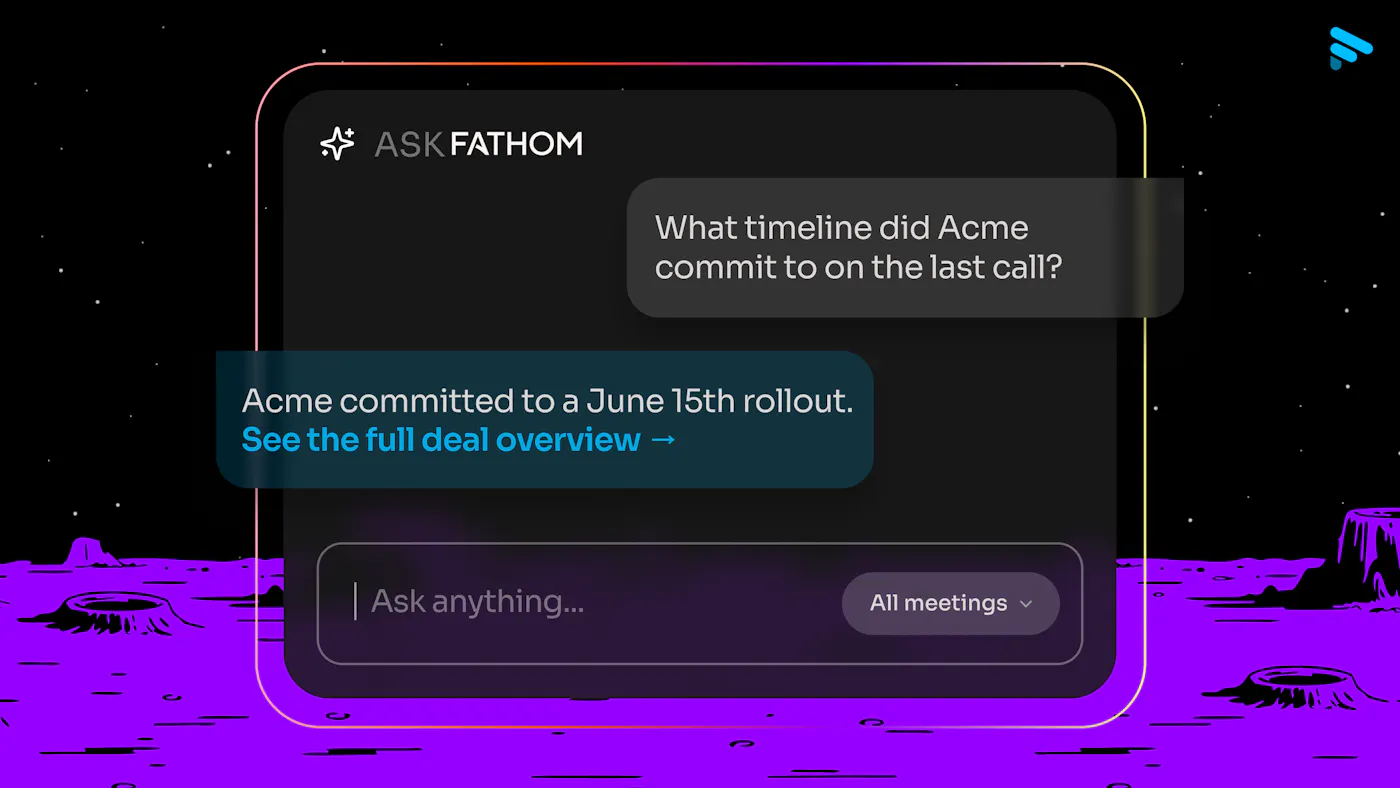
Fathom says its follow-up draft is generated from extracted action items. Review and correct those action items first, then generate and copy the draft to the email client. If the notes do not support an owner or date, remove the generated certainty and preserve the question.
4. Review for meaning, not polish
Put the draft beside the reviewed packet. The seller should check:
- Every recipient attended or is intentionally included.
- The agreed outcome matches what the buyer confirmed.
- Each commitment has the correct party, named owner, action, and exact date.
- Unknowns remain questions; none became facts.
- “We,” “you,” and company names point to the right party.
- Every named attachment is present, current, externally shareable, and opens.
- Links work for the buyer.
- No pricing, legal, security, implementation, or product claim was added from memory.
- The email asks for corrections without implying that silence is approval.
Regenerate only after correcting the structured packet. Repeatedly asking the model to “make it accurate” while keeping bad inputs hides the actual error.
Illustrative send-ready draft
The names, company, dates, commitments, and files below are fictional. They demonstrate structure, not a tested template or claimed outcome.
Subject: Re: Northstar security review — agreed next steps
Priya — thanks for today's discussion. My understanding is that Northstar can begin its security review after receiving our current DPA and architecture diagram.
Our next step
- Alex has attached the current DPA and architecture diagram, meeting the agreed October 9 deadline.
Your next step
- Priya will return Northstar's security questionnaire. We did not set a date on the call; what date should we plan around?
Still open
- We did not confirm who owns the procurement review or when it starts.
Please correct anything I captured incorrectly. Once we have the questionnaire timing, I'll reflect it in our plan.
Alex
This draft is useful because the buyer can accept, correct, or complete the record quickly. It does not repeat the full conversation, assign procurement to an unnamed stakeholder, or manufacture a next meeting.
Gong or Fathom for this workflow?
Prices and entitlements were checked October 8, 2026. Verify the live pricing page and contract before buying.
| Product | Choose it when | Follow-up behavior | Current price and access | Main check |
|---|---|---|---|---|
| Gong | Calls already feed coaching, deal review, account context, or forecasting across a revenue team | Any team member with permission can generate a draft from a recorded call on any Gong plan, choose a summary style, review it, and copy it to an email client. Sending through Gong requires Engage and a connected mailbox. | Custom quote. Gong publishes per-user license pricing plus a platform fee based on supported users; Foundation is the core license and applications such as Engage are added separately. | Confirm recipients, sharing permissions, and whether the contract includes Engage. A recording link appears only when external sharing allows it. |
| Fathom | An individual or small team mainly needs recording, reviewed notes, action items, and a draft to paste into email | Fathom documents AI follow-up drafts generated from meeting action items and copied into the user's email client. | Individual Premium: $20 monthly or $16/month billed annually. Team: $19/user monthly or $15/user/month billed annually, two-user minimum. Free has unlimited recording and transcription but Fathom's plan guide places AI follow-up emails in Premium. | Verify every action item before generation; Fathom's follow-up draft inherits any wrong owner or missed commitment. |
Gong is the stronger fit when follow-up is one step in a governed revenue workflow. Fathom has the clearer self-serve cost and is easier to trial for a seller whose real requirement is a good record plus a draft. If the category is still open, compare the AI sales tools guide and AI meeting note-taker shortlist.
What practitioners add
In a September 2024 r/salesengineers discussion, u/AmeriKiwi2019 said Gong summaries were imperfect but useful after quick edits for follow-up email. In the same thread, u/Aggiejue reported that their organization used Gong to generate a follow-up template from listed action items. These are individual, anonymous reports without a shared call set or controlled comparison.
The more transferable warning comes from workflow, not brand. In r/salesdevelopment, u/Makasene3 described a generated follow-up as poor but still useful as an editable starting point. u/Asleepystudent described manually including the next steps, owner, and deadline. Another seller, u/JohnQPublicc, recommended sending the buyer a recap and asking what was missed.
Those reports do not establish accuracy or time savings. They support the operating design: structured facts first, editable draft second, buyer correction invited, human send decision last.
Pilot without pretending the tool was tested here
Test 20 reviewed calls across discovery, technical validation, procurement, and commercial negotiation. Seed ambiguous first names, one missing attendee email, a changed deadline, a buyer action with no date, an unavailable file, a stale attachment, a restricted link, and a commitment that was later withdrawn.
Measure commitment precision by field, recipient corrections, unknowns preserved, attachment defects caught, unsupported claims, reviewer edit rate, and time from reviewed notes to approved draft. Do not count an email as correct because it reads smoothly.
We did not run Gong or Fathom accounts, generate drafts, send emails, or measure outcomes for this guide. Capabilities and prices come from first-party documentation; the media is existing vendor imagery; practitioner evidence is attributed anecdote. The recommended workflow is an editorial control design to validate on your own calls, policies, and contracts.
Sources & further reading


Ordered for comparison, not as a universal ranking. Inclusion requires a direct fit with this page's stated workflow.