
Tool
Zapier Agents
An AI agent builder that uses Zapier app connections, live business data, and web browsing to complete multi-step work.
TL;DR
- Best for teams that already trust Zapier connections with business data.
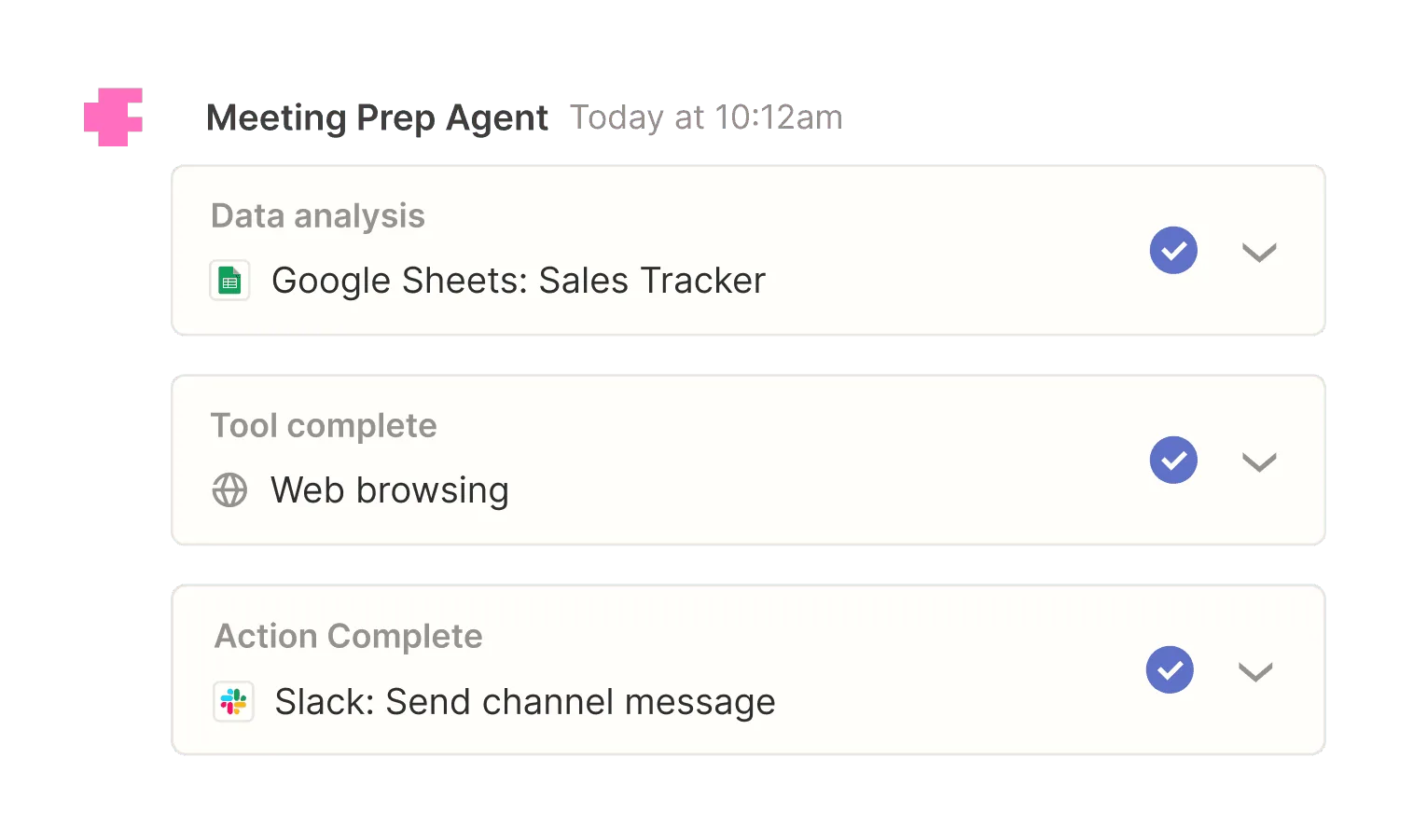
- Agents can browse the web, consult connected knowledge, and take actions in configured apps.
- The free plan includes 400 activities per month; Agents Pro starts at $33.33 per month billed annually.
- An activity can be an app action, web-browsing action, or knowledge lookup, so multi-step jobs consume quota quickly.
- It is an agent product built on Zapier's integration layer, not a replacement for every deterministic Zap.
Zapier Agents lets you describe a role, connect data sources and apps, and give an agent specific actions it may perform. The useful distinction from a normal Zap is that the agent can decide which configured action to use and in what order. It is still bounded by the connections, instructions, and permissions you provide.
Decision snapshot
| Question | Answer |
|---|---|
| Primary interface | Web-based agent builder plus Chrome extension |
| Best use | Cross-app research, follow-up, triage, and routine operations |
| Free allowance | 400 agent activities per month |
| Starting paid price | $33.33 per month billed annually for Agents Pro |
| Main trade-off | Activity metering makes complex or browse-heavy runs hard to estimate |
What Zapier Agents does well
The strongest reason to choose it is access to Zapier's established app-connection layer. An agent can work with live business data and take permitted actions without a team building and maintaining each API connection itself. That is useful for jobs whose path varies, such as researching an account before updating a CRM or deciding how to route an incoming request.
The builder also keeps permissions concrete. You choose the apps and actions an agent can use. Pro raises the per-run ceiling from 10 to 40 activities and stops counting testing against the monthly allowance, which matters while refining instructions.
Where it falls short
The activity unit is broader than a completed task. Browsing, knowledge lookups, and individual app actions all count, so a single outcome may spend several activities. The 400-activity free tier is enough to prototype but not enough to judge a busy production workload.
Reasoning does not remove the need for explicit boundaries. High-impact actions still need narrow permissions, test data, and review points. Deterministic, high-volume data movement may remain simpler and cheaper as a conventional workflow.
What users report
Zapier reviews on Product Hunt consistently pair ease of setup with concern about scaling cost. Scott Q writes that Zapier is “like having an extra operations manager,” while noting that pricing rose as his team automated more processes. That feedback applies directly to Agents: integration breadth lowers setup work, but activity consumption needs monitoring.
Bottom line
Choose Zapier Agents when your team already uses Zapier and needs bounded agents that can decide among connected actions. Use conventional Zaps or a developer-oriented orchestrator when the flow is fixed, high volume, or sensitive to per-action economics.
Sources & further reading



Appears in