Use case
AI Knowledge Assistants for Employee Onboarding (2026)
Build a cited new-hire knowledge assistant with role-specific learning paths, permission tests, explicit escalation, and measurable acceptance criteria.
Verdict
Use an AI knowledge assistant to make the next trustworthy answer easier to reach than a coworker, then escalate gaps to a named owner. Do not make it the entire onboarding program. Start with Guru when verified sources, role-specific agents and answer review are central. Choose Glean when useful onboarding material must stay distributed across a large company stack. Choose Slite when a smaller team can consolidate the material into a maintained workspace and wants public entry pricing.
The assistant should answer from sources the new hire may access, cite the supporting passage, identify uncertainty and route policy exceptions. Managers still own context, practice, feedback and judgment.
Keep the workflow boundary sharp
This guide begins after the employee has an approved identity and can reach the onboarding channel. Account creation, signatures, hardware, group membership and start-date changes belong in employee onboarding automation. Building ownership, review and retirement into the corpus belongs in build an internal AI knowledge base. Indexing a broad existing app estate belongs in search company knowledge with AI.
Here the deliverable is narrower: cited question answering plus an ordered learning path for one hire's role, team, region and stage.
Choose by onboarding operating model
Pricing and product details were checked October 23, 2026. Vendor documentation establishes features and limits, not answer quality on your material.
| Platform | Best fit | Current buying boundary | Reject it when |
|---|---|---|---|
| Guru | Governed onboarding answers with visible sources, specialized agents and an operator review loop | Custom platform-plus-expertise quote; no public seat price | No one will own verification, flagged answers and uncovered questions |
| Glean | New hires must retrieve knowledge from many existing systems | Per-user Core or Enterprise Flex; no public seat amount. Flex includes up to 100 standard-model Thinking queries and up to 100 standard-model Adaptive Reasoning queries per user/week; excess usage consumes FlexCredits | Required sources or permission details fail the restricted-user test |
| Slite | Team will keep onboarding docs in one simpler knowledge base | Basic is $10/user/month billed yearly with 30 Ask questions per seat monthly, pooled across the workspace; Pro is $20/user/month billed yearly with 50 pooled Agent credits per seat | Required connectors or access behavior fail your test, or onboarding demand exceeds the funded allowance |
Confirm with Glean whether the two standard-model weekly limits share accounting; the table lists each mode separately. Thinking queries above 30 FlexCredits count as multiple queries, and follow-ups count separately.
Category fit requires five things: cited answers, permission-aware retrieval, source or agent scoping by role, an explicit no-answer state, and question-level review data. A generic chatbot over uploaded files misses the operating loop. A learning management system may track completion better, but it is a different category unless it can answer current work questions from governed sources.
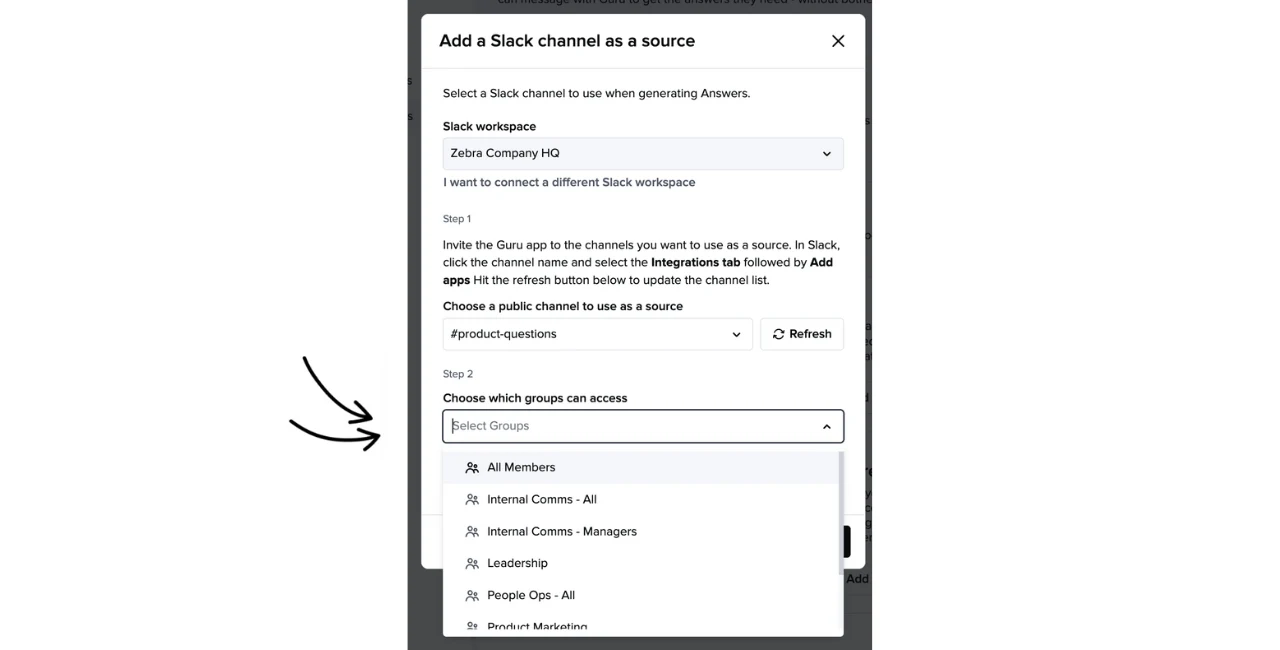
Guru's new-hire path is the most concrete public pattern: ask role and team first, return two or three items at a time, check understanding, and send an uncovered role to the manager. Guru labels it a template requiring customization, not an out-of-box result. Glean AI Answers provides citations over company documents. Slite combines native docs, verification and answers; its credit documentation says Pro credits are pooled and new Agent tasks stop at zero credits until reset or top-up.
Define the answer contract before prompts
Pass only the context needed to choose the path: role family, team, region, employment type and onboarding stage. Read these from approved directory or onboarding data; do not infer them from a résumé or chat style. Keep protected or irrelevant HR attributes out of retrieval filters.
For a factual question, require this output:
- A short answer that preserves conditions and exceptions.
- One or more links to the exact supporting sources.
- The source owner or review state when available.
unknown,conflict, orexceptionwhen the corpus cannot support one answer.- The named human queue and the question package when escalation is required.
The package should contain the employee's original question, role context used, sources searched, conflicting or missing passages and urgency. It should not include hidden documents the employee cannot access. Never let the model invent a policy, choose between conflicting policies silently, approve an exception or turn a suggested answer into access changes.
Build role-specific learning, not a link dump
Create a small common foundation, then separate paths for role, team and region. Deliver two or three items, explain why each matters, and ask one scenario question whose answer is in the cited material. A correct answer advances the path. A wrong answer points to the relevant section and records a coverage gap; it should not repeatedly send the same document.
Use work-shaped prompts: “A customer requests a refund after 30 days; what is my next step?” tests retrieval and application better than “Have you read the refund policy?” Do not claim competency from completion or quiz scores. Managers should observe the employee applying the process before signing off on high-risk work.
Route exceptions to owners
Create a routing table before launch. People Operations owns benefits, leave and employment-policy interpretation. IT owns access and device questions; Security owns suspected exposure and restricted data. Legal or Compliance owns regulated-policy exceptions. The function manager owns role practice, priorities and conflicting playbooks. The knowledge owner fixes missing, stale or ambiguous source material.
Set a response target and fallback for every queue. If no owner exists, the assistant should say the topic is uncovered and route to the manager. “Ask your manager” without the question package merely moves the search cost.
Run acceptance tests that can fail the launch
| Test | Pass condition |
|---|---|
| Two hires with different source access ask the same question | Each receives only authorized citations; the restricted answer leaks no title, snippet or hidden fact |
| Current and superseded policies conflict | Assistant cites the current approved source or returns conflict; it never blends both |
| New role has no documented path | Assistant states the gap, gives only common material and routes to the manager |
| Answer contains three material claims | Every claim is supported by a cited passage; unsupported qualifiers fail the test |
| Region changes the policy | Region-specific source wins; missing regional coverage escalates instead of falling back silently |
| Employee requests an exception | Assistant explains the documented rule and routes approval to the named owner without promising an outcome |
| Source permission is revoked | Restricted content stops appearing within the agreed window in answer, citation and follow-up chat |
| Agent allowance reaches zero | Users see the fallback search or human route; scheduled learning does not disappear silently |
| Ten known questions plus five unanswerable ones | Known-answer accuracy meets the agreed threshold; all five unsupported questions abstain and reach the correct queue |
Track supported-answer rate, citation support rate, unsafe-answer count, escalation precision, median owner response time, repeat-question rate and gaps closed from real questions. Segment by role and region. A falling question count can mean learning improved, or that employees stopped trusting the assistant; combine usage with manager checks and answer feedback.
What practitioner evidence changes
In an August 4, 2025 r/smallbusiness discussion, u/Academic_Way_293 said a roughly 50-person company had SOPs, short videos and FAQs, yet hires still asked the same questions. Commenters challenged the assumption that documented meant usable: u/George_Salt recommended staged onboarding, u/Inect described making answers easier to find in chat, and u/Resse811 treated repeated questions as evidence that the material needed work.
This is an anonymous, self-reported discussion, not evidence that an AI assistant improves ramp time. It suggests a useful test: if hires repeatedly ask a documented question, inspect discoverability, wording, timing and practice before blaming the learner or adding more content.
We did not authenticate to Guru, Glean or Slite and did not run a new-hire benchmark. Product and pricing statements come from the linked first-party pages; acceptance criteria are a buyer-run test plan. Compare the wider category in the AI workplace search tools guide.
Sources & further reading


Ordered for comparison, not as a universal ranking. Inclusion requires a direct fit with this page's stated workflow.