Use case
How to Build an Internal AI Knowledge Base That Stays Current
Build an AI knowledge base with canonical records, named owners, version history, risk-based reviews, and a safe retirement process for stale content.
Verdict
Build the governance loop before adding AI answers. Give every canonical process, policy, or decision one record, one accountable owner, a visible state, a review rule, revision history, and a retirement path. Let AI find conflicts and draft changes; require a human owner to approve high-impact knowledge. Guru fits designated verifiers and configurable automated verification, Slite for a simpler maintained wiki, and Tettra for a lightweight Slack-centered knowledge base.
This workflow is about owning company knowledge after it is written. It is separate from choosing a workplace-search vendor, searching company knowledge with AI, and configuring answers across Slack, Drive, and Notion. Those jobs retrieve distributed material. A governed knowledge base decides which answer is canonical and what happens when it changes.
Define what can become canonical
Do not ingest every chat, meeting note, and project file as equal truth. Start with recurring knowledge that has a decision-maker: policies, standard operating procedures, product facts, escalation paths, approved messaging, system runbooks, and durable decisions. Slack threads and meeting notes can supply evidence or reveal gaps, but they should not silently become policy.
Use one canonical record per process or decision. Each record needs enough metadata to govern it:
| Field | Rule |
|---|---|
| Status | Draft, active, under review, superseded, or archived |
| Owner | One accountable person; a team may be the fallback, not the owner |
| Approver | Required for legal, security, HR, finance, or safety-sensitive content |
| Effective date | When the record starts governing work |
| Last and next review | Visible to readers and reportable to admins |
| Supersedes | Link to the prior record or decision |
| Evidence | Source system, ticket, release, contract, or decision note |
| Sensitivity | Access and handling classification |
If two active records answer the same question differently, the system has a governance failure. Do not ask the model to average them.
Make every change recoverable
Use a draft → review → publish lifecycle. A published revision should retain its author, approver, timestamp, change summary, and previous version. Product launches, policy changes, migrations, incident follow-ups, and organizational changes should include a documentation check in their definition of done. This event-driven trigger catches drift earlier than a quarterly cleanup.
Guru's Card history can compare revisions and revert a draft. Slite's document history records a version after five minutes of inactivity and can restore an older document, although restoring an earlier collection version is not supported. These are recovery controls, not editorial review: a reversible wrong answer is still wrong until an owner checks it.
Review by risk and change rate
A single annual reminder is too slow for access procedures and too noisy for stable principles. The following intervals are suggested starting points, not vendor defaults or compliance requirements. Set the interval from consequence and volatility:
| Knowledge | Review rule |
|---|---|
| Security, legal, HR, finance | Named human approval on every change plus a 30–90 day check |
| Customer-facing policy or live runbook | Review on each release or incident plus a quarterly check |
| Team process | Review after workflow changes or every six months |
| Stable background | Annual review or event-driven review |
Guru verification exposes the verifier, last verification, and intervals from 30 days to one year or “Does not expire.” Its Knowledge Agents can run daily quality checks, with auto-verify enabled by default for Knowledge Agents created after January 2026 and auto-unverify off by default. A verified state alone does not prove a human reviewed that revision. Slite verification gives verified docs more weight in Ask and Search and distinguishes expired verification from content marked Outdated: Outdated docs are ranked lower in Ask and excluded from Slite Agent. Treat these states as routing signals. For high-impact records, “verified” must mean a named expert reviewed the current revision.
Retire knowledge without erasing history
Retirement needs its own workflow. Trigger it when a system is replaced, a policy expires, a team dissolves, an owner leaves, or a newer record supersedes the old one. Before archiving:
- Link the successor from the old URL and update incoming links.
- Record the retirement reason, owner, date, and retention requirement.
- Remove the record from default AI-answer sources and active search.
- Preserve the last approved revision for audit or rollback.
- Delete only when the retention policy permits irreversible removal.
Guru supports scheduled Card archival, warns authors to check incoming links first, and restores only the last published version. Synced Cards must be removed at their source. Slite archives retain original access controls and can be restored; permanent deletion cannot be undone. Slite can also search archived docs when that source type is deliberately selected, so test default answer scope instead of assuming “archived” means unreachable everywhere.
Pick the operating model, then the product
Pricing and product behavior checked October 23, 2026.
| Tool | Best fit | Current commercial boundary |
|---|---|---|
| Guru | Governed answers with designated verifiers, automated verification controls, revision history, and scheduled retirement | Quote-only package based on scale, knowledge complexity, and AI maturity |
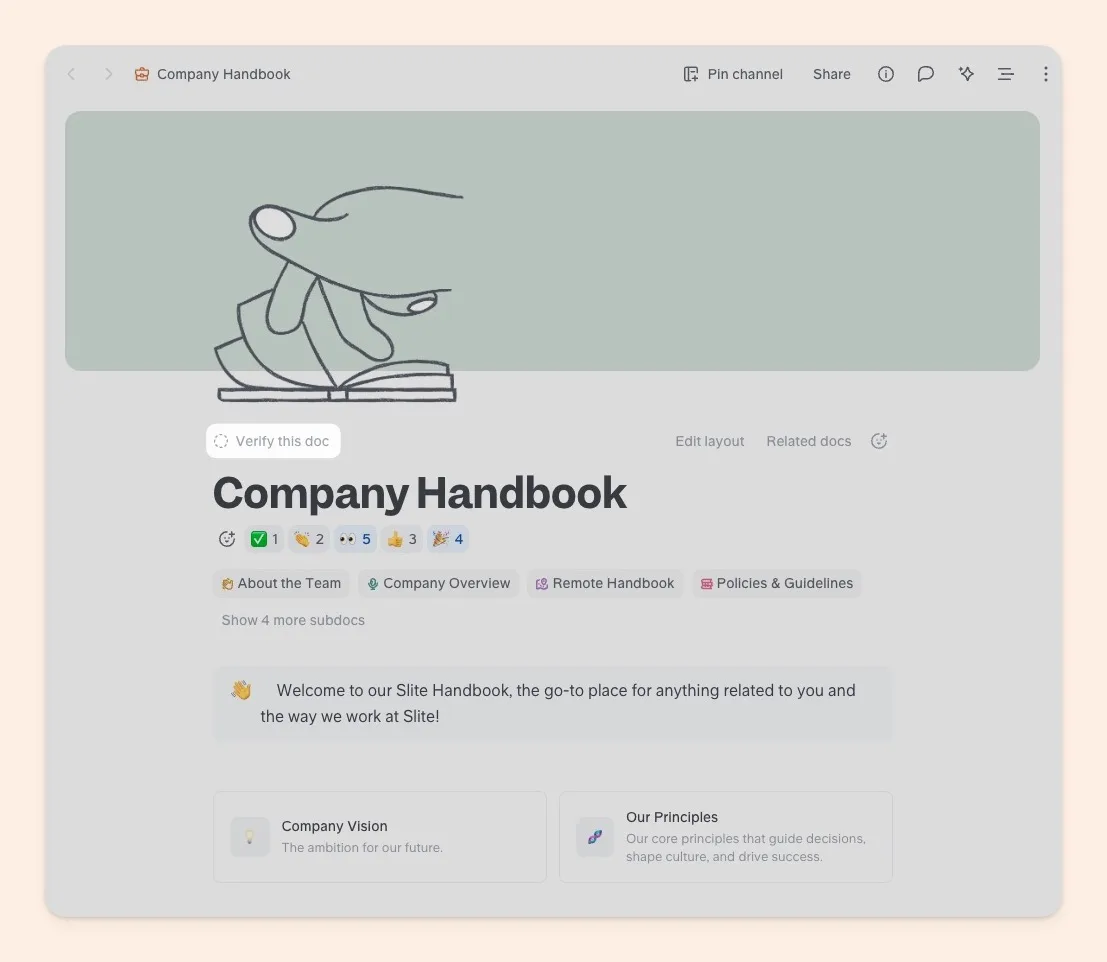
| Slite | Maintained wiki with ownership, verification, and a lower public entry price | Basic is $10/user/month billed yearly and contributes 30 Ask questions per member to a shared monthly workspace pool; Pro is $20 and contributes 50 Agent credits per paid seat to a shared monthly workspace pool |
| Tettra | Lean internal wiki with Slack delivery, verification, stale-page, and unowned-page queues | Scaling is $8/user/month billed yearly with a 10-user minimum; Enterprise is custom |
Choose Guru when designated ownership and configurable verification controls are operating requirements and the implementation package is useful. Choose Slite when the team will consolidate durable knowledge in a clean wiki and wants public pricing. Tettra is the lighter third option. For retrieval across a large existing app estate, compare Glean vs Guru before forcing distributed material into a new authoring system.
Run a pilot that can fail
Use 30–50 real records from one function, including a superseded policy, an orphaned page, a future-dated change, two contradictory answers, and a record that must be archived. Require these acceptance criteria:
- Every active record has exactly one owner, status, effective date, evidence link, and review rule.
- A departure test reassigns every owned record before account removal.
- Ten representative questions cite active canonical records; conflicts or missing evidence produce an abstention, not a blended answer.
- A changed record creates a reviewable revision, and an operator can restore a known prior version.
- A superseded URL points to its successor; archived content disappears from default AI answers within the measured product-specific refresh window.
- At least 90% of due high-impact reviews finish inside the agreed SLA; overdue items are visibly downgraded or removed from answer sources.
- The owner can export active records plus lifecycle metadata and explain the recovery path after cancellation.
This site has not run that pilot. Permission leakage and revocation belong in the separate cross-source permissions test, but they remain go-live blockers.
What practitioners add
In a February 8, 2025 r/sysadmin thread, u/spacesheep10 described a small team whose wiki went stale while repeat questions returned to Slack. In the discussion, u/0w1Knight described rotating wiki duty, converting service-desk discoveries into update tasks, and feeding organizational and software-purchase changes into the same queue. That is one anonymous practitioner report, not measured evidence. Its useful lesson is operational: scheduled review catches age, while work-system events catch change.
For role-specific delivery of that maintained knowledge, use the new-hire knowledge-assistant guide.
Sources & further reading


Ordered for comparison, not as a universal ranking. Inclusion requires a direct fit with this page's stated workflow.