Tool
Tettra
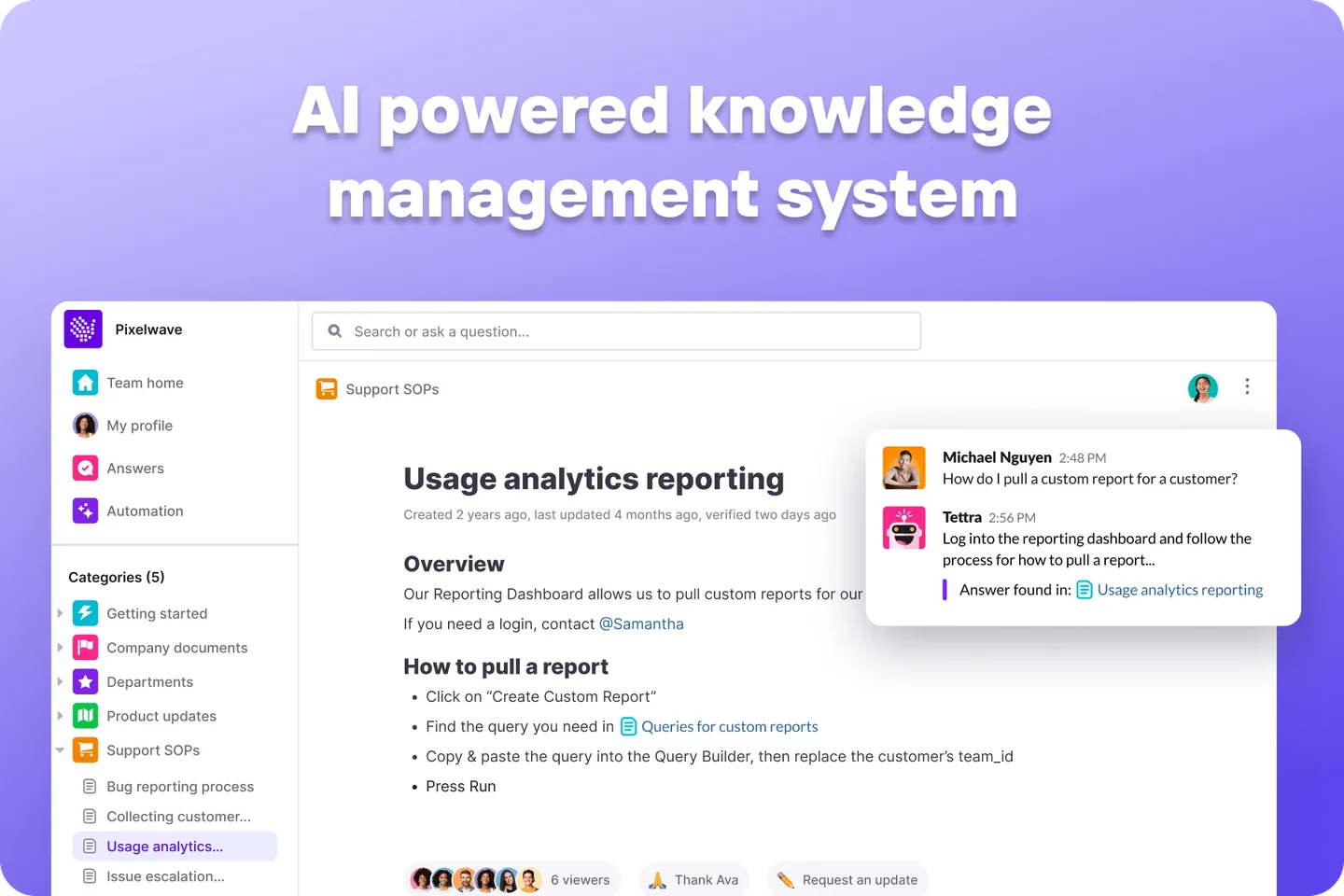
Internal knowledge base with AI answers, Slack and Teams workflows, subject-matter experts, and content verification.
TL;DR
- Best for team knowledge with named owners and review workflows.
- Slack and Teams integrations reduce context switching.
- AI cannot compensate for sparse or abandoned documentation.
- Better fit for a focused knowledge base than universal enterprise search.
Tettra is an internal wiki built around a practical problem: employees ask repeat questions in chat while the answer, if it exists, grows stale somewhere else. Teams document the answer, name subject-matter experts, and use AI to retrieve it in Slack, Teams, or the web app.
Decision snapshot
| Best fit | Main tradeoff |
|---|---|
| Operations-heavy small and mid-sized teams | Requires disciplined content ownership |
| Repeated policy and process questions | Narrower retrieval surface than Glean |
| Slack-first internal support | Not a full document suite |
What works
Tettra makes knowledge maintenance visible. Verification and analytics surface pages that need attention; question workflows reveal gaps. That creates a better feedback loop than assuming an AI bot will infer a trustworthy policy from years of chat.
Pilot one domain such as HR or customer support. Track repeat-question deflection, unanswered questions, and how long owners spend verifying pages. If those numbers do not improve, adding more departments will not rescue the rollout.
What users report
G2 reviewer Jacob E. wrote, “I like how easy it is to update documentation and keep it current.” The same review notes that search can improve and value depends on what the team puts in. That is the honest Tettra bargain.
Bottom line
Choose Tettra for a manageable, owner-led knowledge base. Choose Slite for a broader collaborative-doc experience, or Glean when the information must remain spread across many systems.


