
Tool
Sana
Enterprise AI agents that search company knowledge, create deliverables, analyze data, and act across connected work systems.
TL;DR
- Best for enterprise teams wanting agents beyond question answering.
- Searches connected knowledge, creates files, analyzes data, and can take actions.
- Governance and source selection matter more as permissions expand.
- Pricing is custom.
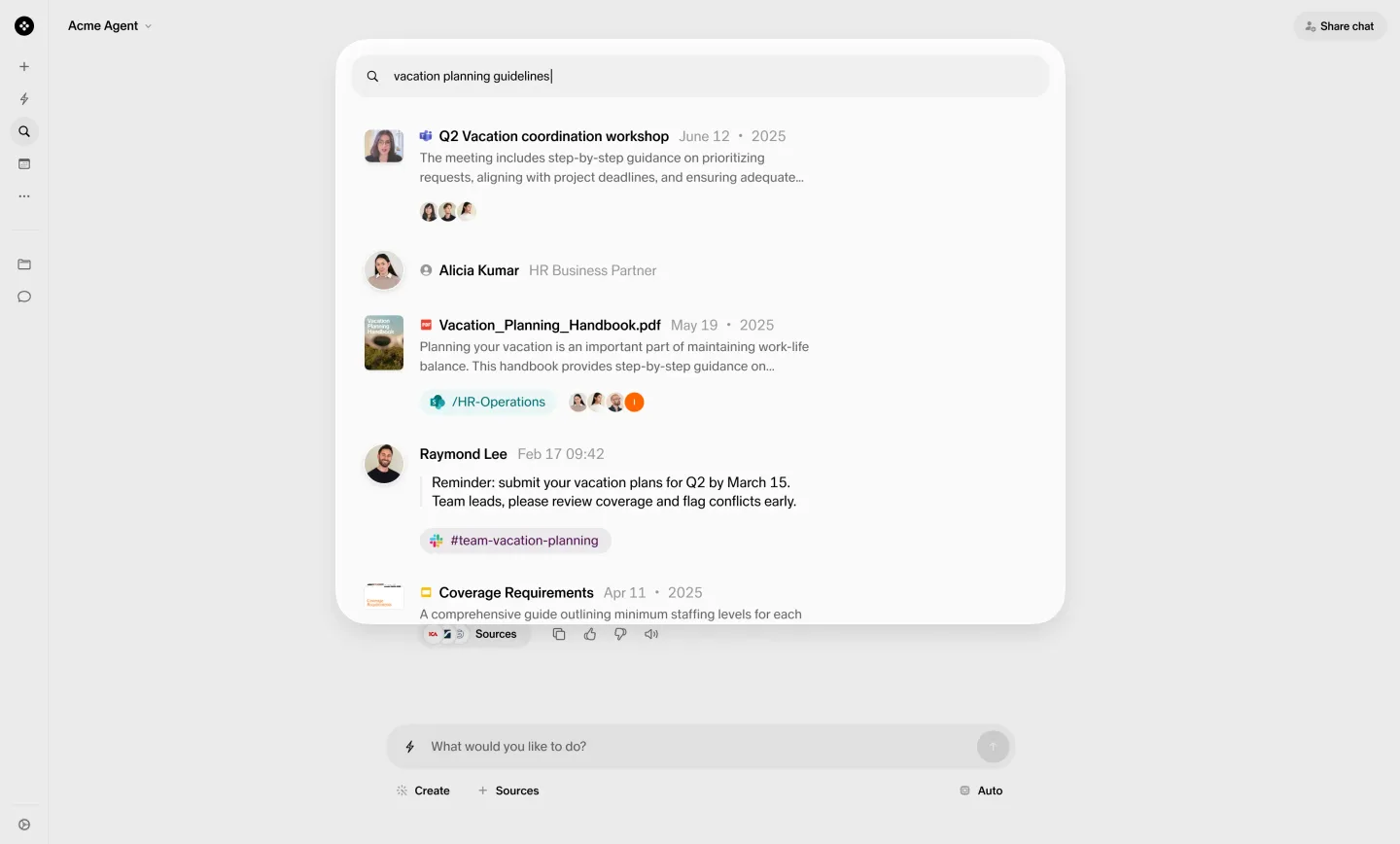
Sana sits between enterprise search and an agent workspace. It can retrieve company knowledge, synthesize it, create reports or slides, analyze data, and act through connected systems. That makes it more ambitious than a conventional internal wiki.
Decision snapshot
| Strongest use | Main risk |
|---|---|
| Cross-functional work grounded in private company context | Over-broad agent permissions |
| Teams that want deliverables, not only answers | Harder evaluation than simple search |
| Governed model and data-source choices | Enterprise rollout effort |
How to evaluate it
Separate retrieval from action. First test whether Sana finds the correct source and cites it. Then allow low-risk creation tasks. Only after those pass should an agent update records or trigger external workflows. Keep approval gates around consequential actions.
Its product materials emphasize permissions, model choice, connected apps, deep research, and generated documents. The relevant question is not whether it can make a slide; it is whether the slide uses the right internal evidence and remains auditable.
What users report
Anders Ivarsson, CTO at Voi, described asking Sana in Slack for meeting actions or an internal metric definition as “a game-changer.” That vendor-hosted customer quote is useful context, not independent proof. Recreate those exact retrieval tasks during a pilot.
Bottom line
Choose Sana when you want company search to become controlled, multi-step work. Choose Glean if retrieval quality across many systems is the narrower priority, or Dust when teams want to build more customized internal agents.


