Tool
Dust
Enterprise workspace for building governed AI agents connected to company knowledge, tools, models, and reusable skills.
TL;DR
- Best for teams building specialized agents over private company context.
- Supports multiple models, connectors, reusable skills, and governance.
- Requires someone to design, evaluate, and maintain agent behavior.
- More flexible than a ready-made company search box.
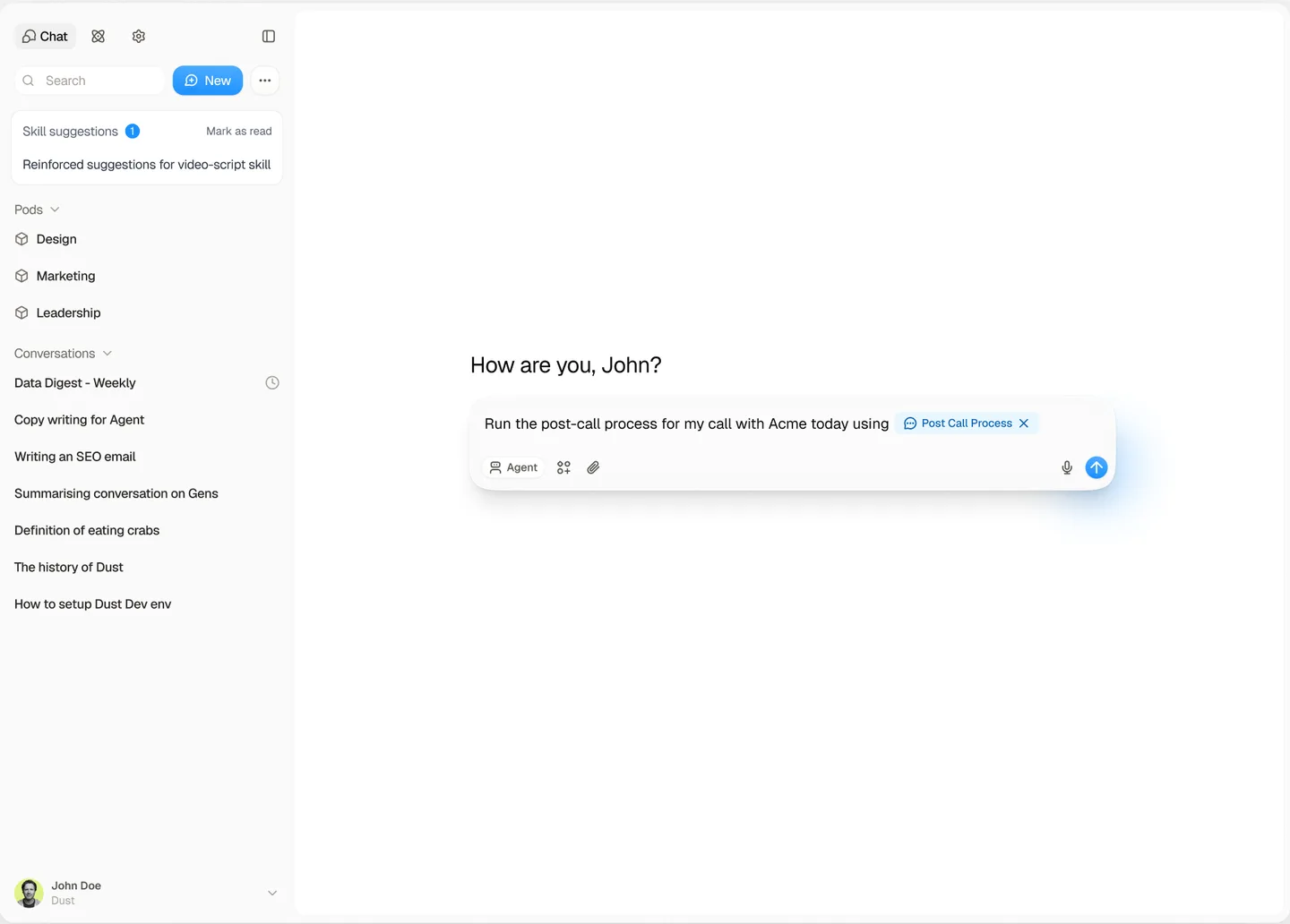
Dust provides the middle layer between a generic chatbot and a fully custom agent platform. Teams connect company knowledge and tools, choose models, define skills, and publish agents for recurring work.
Decision snapshot
| Strongest for | Main tradeoff |
|---|---|
| Technical ops and enablement teams | Needs internal builders and evaluators |
| Specialized research and content workflows | More setup than turnkey search |
| Governed access to several AI models | Agent sprawl without ownership |
What works
The flexibility matters when different teams need different behavior. A competitive-intelligence agent can use approved notes and web research; a support agent can stay inside product documentation; a writing agent can apply a house style. Shared skills and permissions provide more control than pasting context into public chat tools.
Start with one expensive, repeatable workflow. Define an evaluation set, log failures, and name an owner. An agent catalog with no maintenance plan becomes a second knowledge graveyard.
What users report
One six-month user described building custom agents over internal data, including a workflow that combines company notes with web and social signals for competitor comparisons. That concrete use is more informative than a generic “chat with your data” claim.
Bottom line
Choose Dust when your team wants to compose internal agents and has the operational maturity to maintain them. Choose Sana for a more packaged enterprise workspace or Glean when search relevance is the primary job.


