
Tool
Relevance AI
A no-code platform for building AI agents, tools, and multi-agent workforces that act across business systems.
TL;DR
- Best for teams composing specialized agents and tools into multi-agent workforces.
- The free plan includes 200 actions per month and $2 in model vendor credits.
- Pro starts at $29 monthly, or $19 per month when billed annually, with 2,500 monthly actions on the monthly plan.
- Platform actions and model vendor credits are separate usage dimensions.
- Failed tool runs can still count as actions, so fragile chains waste quota as well as time.
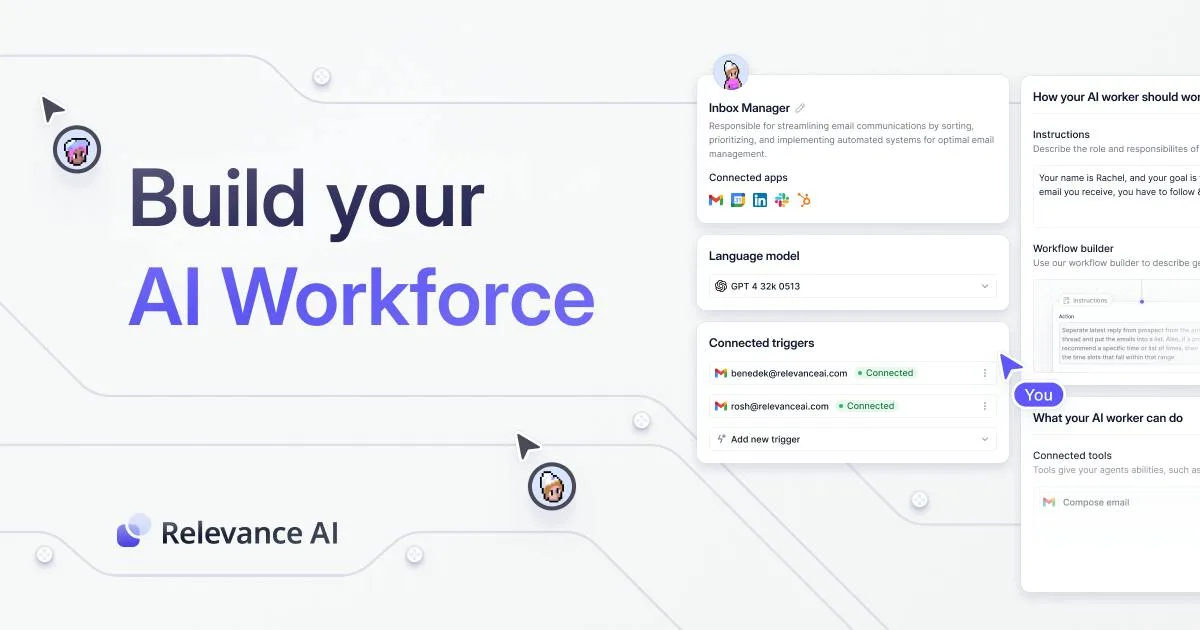
Relevance AI is a no-code agent platform. Builders create tools, connect them to specialized agents, and combine agents into workforces that coordinate on a larger process. Its Invent interface can generate an initial agent from a plain-language description, while the main platform exposes the tools and instructions for further editing.
Decision snapshot
| Question | Answer |
|---|---|
| Primary interface | Web-based agent, tool, and workforce builder |
| Best use | Role-specific agents coordinated across sales, support, research, and operations |
| Free allowance | 200 actions per month plus $2 in vendor credits |
| Starting paid price | $29 per month for Pro, or $19 per month billed annually |
| Main trade-off | Separate action and model-credit meters complicate forecasting |
What Relevance AI does well
The platform makes the agent hierarchy explicit. A tool performs a defined operation, an agent chooses and uses tools, and a workforce coordinates multiple agents. That structure is more maintainable than hiding an entire department-sized workflow in one long prompt.
Free and Pro plans allow unlimited agents and tools, while paid plans support bringing model keys. Integrations, marketplace templates, knowledge sources, and API access reduce the amount of connective code required for a first deployment.
Where it falls short
Actions and vendor credits are billed separately. A tool run is an action, while model usage draws from vendor credits; failed tool runs can still count. Multi-step agent chains therefore need load testing with real inputs before their cost is predictable.
Integration coverage also varies in depth. An integration may exist without supporting the exact object or action a workflow needs. API bridges are possible, but they shift the burden back toward technical builders.
What users report
Product Hunt reviewer Nolan Vu says the “build tools, chain them into agents” model clicked quickly and that semantic search worked with clean data. He also reports limited native integrations and surprising credit burn at scale. That is a credible summary of the product: strong agent composition, with operational details still requiring engineering discipline.
Bottom line
Choose Relevance AI when multi-agent coordination is the product requirement, not a marketing label. Choose a conventional workflow tool for predictable data movement, or a code framework when every tool call and runtime behavior must be controlled directly.
Sources & further reading



Appears in