
Tool
Qodo
Choose Qodo for governed AI code review across pull requests and repos. Compare its $30 credit plan, platform coverage, data terms, and limits.
Verdict
Choose Qodo when your real problem is governing code review across teams and repositories: automatic pull-request findings, shared review standards, cross-repository context, and one control plane for Git, IDE, CLI, and coding-agent workflows. Skip it when you want a general coding agent, a predictable per-seat allowance, or a permanent free plan. The strongest fit is an engineering organization willing to tune review policy and measure accepted findings rather than treat every bot comment as truth.
Qodo is now an AI code-review and governance platform. The current site calls the release Qodo 3.0, while the documentation index identifies Qodo Review v2 as current and Qodo Merge v1 as legacy. Older Qodo Gen and PR-Agent reviews may describe a different product and pricing model.
Compare the category in the best AI coding agents guide. For adjacent approaches, see GitHub Copilot cloud agent, Sourcegraph Cody, and Cline.
Decision table
| Decision factor | Qodo answer | What to verify |
|---|---|---|
| Primary job | Review pull requests, enforce standards, and govern findings across repositories | Whether the team needs review infrastructure more than code generation |
| Review context | Repository structure, PR and commit history, dependencies, rules, tickets, and connected repositories | Indexing scope, excluded content, and whether cross-repo relationships are correct |
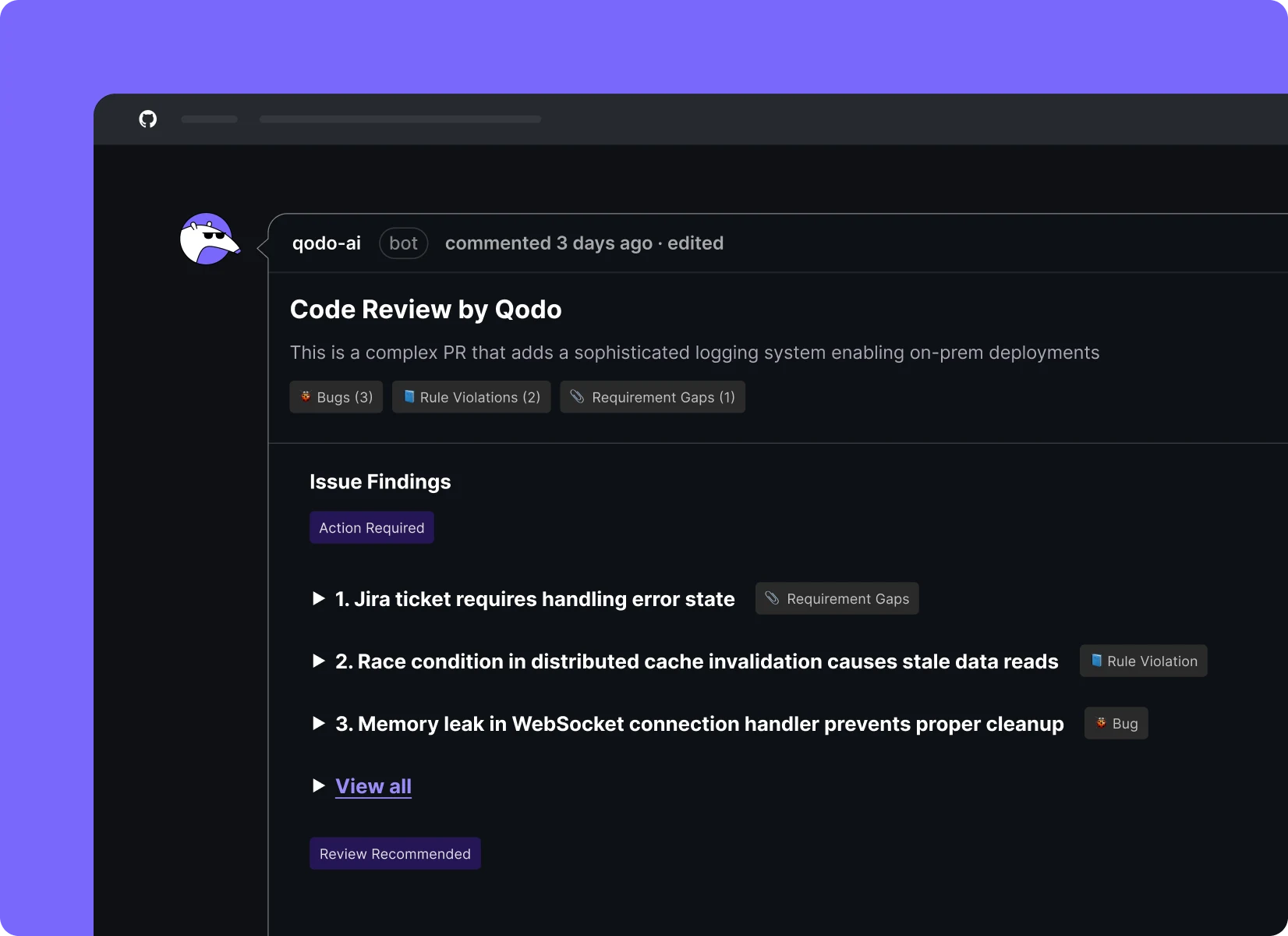
| Feedback | Severity-ranked bugs, rule violations, requirement gaps, summaries, chat, and suggested remediation | False-positive rate on representative PRs and which findings should block merge |
| Shift-left path | IDE review plus Agentic Toolbox through CLI, MCP, Codex, Claude Code, and Kiro | Which local workflows are included in the selected plan and allowed by policy |
| Git coverage | GitHub, GitLab, Bitbucket, Azure DevOps; Gerrit is Enterprise | Provider-specific feature gaps before standardizing configuration |
| Team controls | Central rules, analytics, audit-oriented governance, deployment choices | Several advanced controls remain Enterprise-only; some current features are Beta or Research Preview |
| Cost model | Shared workspace credits; $30/month buys 2,500 credits, estimated by Qodo at about 18 reviews | Actual burn on large or complex PRs, overage cap, and unused-credit expiry |
| Data boundary | Multi-tenant by default; Enterprise adds BYOK, single-tenant, on-premises, and air-gapped options | Governing terms, derived repository data, enabled third parties, and retention in the signed order |
Review and governance are the differentiator
Qodo runs specialized review agents for critical issues, breaking changes, ticket compliance, duplicated logic, and organizational rules. Findings can appear automatically when a pull request opens or updates. Teams can tune where findings appear, severity thresholds, verbosity, ignored paths, draft behavior, and supported comment commands.
The product goes beyond a diff-only bot by building a persistent representation of repository structure, dependencies, embeddings, PR history, and generated summaries. Cross-repository review can trace an API, schema, shared library, or pipeline change into a connected repository and post a tagged finding in the pull request. That feature is currently Beta, so validate its dependency map before making it a merge gate.
Qodo 3.0 also introduced PR Triage as a Research Preview and an analytics dashboard as Beta. These can help a larger organization prioritize review work and inspect finding acceptance, but preview labels matter: evaluate stability and contractual support before treating either as an operational control.
Credit pricing needs a workload test
Pro Team starts at $30 per month for 2,500 pooled credits at $0.012 per credit. Qodo estimates that pack at roughly 18 reviews per month, but smaller reviews consume fewer credits and larger or more complex reviews consume more. The 5,000- and 20,000-credit examples correspond to about 36 and 144 reviews. Credits expire each monthly cycle; overage continues at the same per-credit rate until the customer-set spending cap is reached.
The 14-day trial includes unlimited reviews and credits without a card. There is no permanent general free tier, although qualified open-source projects can apply for free access. Public Qodo pages currently disagree on the Pro Team user limit: the pricing page says the plan is designed for up to 30 users, while the pricing documentation says unlimited users per workspace. Confirm the contract boundary before a rollout.
Platform coverage is broad, feature parity is not
Qodo lists GitHub Cloud and Enterprise Server, GitLab Cloud and self-managed, Bitbucket Cloud and Data Center, Azure DevOps, and Enterprise Gerrit support. It also lists VS Code, JetBrains IDEs, Visual Studio, CLI, and MCP-based agent workflows.
The Git provider matrix shows material differences. GitHub and GitLab expose more rich-comment controls; Bitbucket and Gerrit lack collapsible sections; chat on code suggestions is limited to GitHub and GitLab; CI failure feedback is GitHub-only. Select on the weakest required provider, not the broad platform logo row.
The Agentic Toolbox adds pre-PR review, rule retrieval, repository questions, and resolution of existing Qodo findings inside Codex, Claude Code, Kiro, CLI, or an MCP client. It complements a coding agent; it does not replace the agent that edits code. Apply the AI pull-request review workflow to keep evidence, tests, and human approval separate.
Privacy claims need contract-level review
Qodo’s current marketing says code is analyzed and discarded, is not logged, and is not used to train models. Its pricing page repeats that code is not used for model training. Enterprise adds BYOK and isolated deployment choices.
Those statements do not describe the whole data model. Qodo’s architecture documentation says it persistently stores a graph of relationships, vector embeddings, PR and commit history, and auto-generated module summaries. The reasonable reading is that “zero data retention” refers to raw code or request content rather than the absence of derived repository knowledge, but Qodo should confirm that interpretation for your deployment.
The public legal documents also differ by buyer. General Terms for Developer or Team subscriptions grant Qodo rights to use Customer Data to train and improve the platform and models. Business Terms say Customer Data is not used to train AI models with exceptions for improvement of the customer’s specific instance and customer-specific fine-tuning requested in writing, while allowing retention needed for memory and indexing. Review the applicable terms, DPA, subprocessors, retention schedule, and selected deployment model before connecting private repositories.
Community evidence is mixed
Public reports do not establish a reliable accuracy rate. Reddit user yairEO said Qodo produced substantial noise and incorrect findings. In another thread, Lumpy_Ad_1296 reported fewer nitpicks and more relevant repository-aware feedback after switching from CodeRabbit. Terrible-Lab-7428 said their team uses Qodo but a careful human reviewer still catches details the AI pipeline misses.
These are attributable anecdotes with unverified environments and affiliations, not controlled tests of Qodo 3.0. Use the trial on a representative set of small, large, cross-repository, and domain-heavy pull requests. Track actionable findings, false positives, missed seeded defects, review latency, credit burn, and whether developers still inspect the underlying diff. Keep humans responsible for architecture, business rules, security decisions, and merge approval.
Sources & further reading
- Qodo documentation index and current-versus-legacy status
- Qodo 3.0 release notes
- Qodo platform overview
- Qodo platform architecture
- Qodo code review documentation
- Qodo code governance documentation
- Qodo cross-repository code review
- Qodo Agentic Toolbox
- Qodo pricing
- Qodo pricing and usage documentation
- Qodo Git provider feature support
- Qodo deployment models
- Qodo product and security overview
- Qodo general terms
- Qodo business terms
- Qodo privacy policy
- Reddit report that Qodo produced noisy or wrong findings
- Reddit report comparing Qodo review focus with CodeRabbit
- Reddit report that human review still found details Qodo missed