
Tool
Artisan
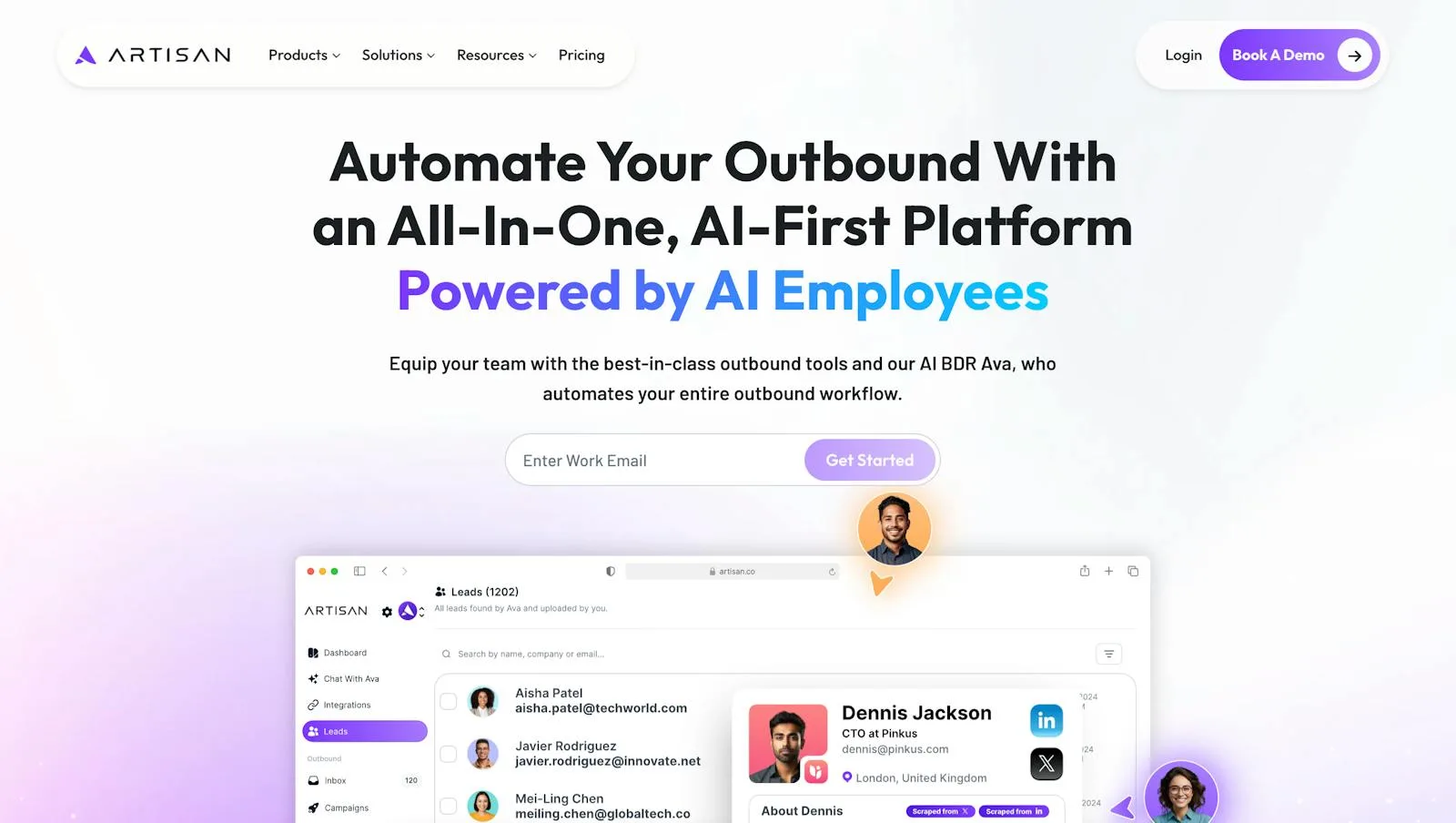
AI BDR platform centered on Ava for prospect sourcing, research, personalized outbound, reply handling, and meeting booking.
TL;DR
- Best for teams considering autonomous outbound across prospecting, research, messaging, replies, and booking.
- Ava combines contact data, intent signals, enrichment, sequencing, and deliverability tooling.
- Paid pricing is custom and credit-based; the public product page offers a free starting path.
- Approval and escalation controls matter because Ava can act directly with prospects.
- Human oversight remains necessary for nuanced targeting, objections, brand risk, and compliance.
Artisan is an outbound sales platform centered on Ava, its AI BDR. Ava sources and researches prospects, builds personalized multi-channel campaigns, handles replies within configured knowledge and escalation rules, and books meetings. The product combines these agent actions with data, sequencing, and deliverability infrastructure.
Decision snapshot
| Question | Answer |
|---|---|
| Primary interface | Web platform for configuring, reviewing, and monitoring Ava's outbound work |
| Best use | Automating a defined B2B outbound motion with clear qualification and escalation rules |
| AI role | Prospect research, qualification, personalization, sequence optimization, replies, and booking |
| Starting paid price | Custom quote |
| Main trade-off | Autonomous customer contact creates quality, compliance, and brand-control risk |
What Artisan does well
Artisan reduces handoffs between data, research, copy, and execution tools. Ava can watch signals such as funding and leadership changes, enrich leads, generate outreach, and respond using a company knowledge base. Approval controls let teams review work rather than forcing full autonomy from day one.
The current Ava 2.0 product also emphasizes continuous testing and optimization. That can be useful for teams with enough volume and a stable ICP to learn from outcomes. Salesforce and HubSpot integrations connect activity back to the system of record.
Where it falls short
Artisan does not publish a fixed paid price. Its public material describes custom, credit-based pricing based on team, motion, and volume. Buyers should request a quote that separates platform access, data, mailboxes, sending volume, onboarding, and overages.
Autonomous copy can still be superficially personalized or wrong. Objection handling is especially sensitive because the agent may make a claim, answer a pricing question, or continue a conversation under the company's name. Start with narrow qualification rules, visible evidence for personalization, human approval, and conservative sending limits.
What users report
On Product Hunt, Jim Jeffers identified the core evaluation question:
“The hard part with an autonomous BDR is not ‘can it send more?’ It is whether the system knows when not to send.”
Artisan replied that Ava checks qualification criteria and hard disqualifiers, and escalates uncertainty based on configured rules. Buyers should verify those controls with bad-fit accounts and ambiguous replies, not only ideal demo inputs.
Bottom line
Choose Artisan when the team wants a unified autonomous outbound system and is prepared to govern it like a customer-facing operator. Choose a co-pilot or traditional sequencer when reps need to retain direct control over research, messaging, and replies.
Sources & further reading



Appears in