Comparison
AlphaSense vs Tegus (2026)
AlphaSense owns Tegus. Compare current platform plans, Expert Insights access, transcript permissions, expert-call pricing, add-ons, and legacy accounts.
Verdict: AlphaSense vs Tegus is no longer a choice between independent vendors. AlphaSense acquired Tegus in 2024, and current first-party pages place Tegus Expert Insights, its transcript library, and expert-call services inside AlphaSense. For a new purchase, evaluate the AlphaSense platform, then price the exact Tegus content and call-service entitlements your team needs. Existing Tegus customers should compare their legacy access and migration terms with a consolidated AlphaSense contract.
The distinction still matters commercially. “Tegus by AlphaSense” names a live expert-research layer, not a separate competitor. A broad market-intelligence subscription, full transcript access, bespoke calls, AI-led calls, internal-content search, and optional call add-ons can have different permissions and costs.
This comparison uses vendor documentation and attributed community reports checked October 24, 2026. We did not run a controlled search-recall, transcript-quality, expert-sourcing, or value test. Vendor corpus counts and performance claims are not independent measurements.
AlphaSense vs Tegus decision matrix
| Question | AlphaSense platform | Tegus by AlphaSense |
|---|---|---|
| What is it now? | Parent platform and contracting surface for market intelligence, search, AI workflows, financial data, and external or internal content | Current name attached to Expert Insights, the Expert Transcript Library, and Expert Call Services |
| Can a new buyer choose one vendor over the other? | AlphaSense is the current vendor to evaluate | No current first-party evidence supports Tegus as an independent rival subscription |
| Core content | Filings, company documents, news, regulatory sources, broker and independent research, expert transcripts, financial data, and plan-dependent internal content | 300,000+ vendor-reported expert transcripts across 32,000+ public and private companies, plus bespoke expert calls |
| Public platform price | Custom quote; annual subscriptions with per-seat through enterprise-wide options | No separate public subscription rate card |
| Public call price | Managed through the AlphaSense call portal | Expert's hourly rate, vendor-reported average about $450, plus a flat $75 transcription fee; usage rounded to 15 minutes |
| Contract choice | Market Intelligence vs Enterprise Intelligence, then content and product entitlements | Transcript-library access, human-led or AI-led calls, prepay or pay-as-you-go calls, and add-ons |
| Internal content | Enterprise Intelligence; permission and connector behavior matter | Not an alternative internal-content plan |
| Legacy-account issue | New AlphaSense compliance portal and account permissions | Some existing firms still use a Tegus compliance portal for Tegus-origin transcript requests |
The acquisition ended the old head-to-head comparison
AlphaSense closed its acquisition of Tegus in July 2024. Current product pages are more decisive than the deal announcement: the Expert Transcript Library article tells users to log into AlphaSense, the Call Projects portal lives in AlphaSense navigation, and the vendor describes Tegus Expert Insights as the proprietary transcript-and-call layer of AlphaSense Expert Insights.
That makes “which product is better?” the wrong procurement question. Ask which AlphaSense package exposes the sources, tools, and permissions your researchers need. Keep the Tegus name in the requirements because it identifies a meaningful content set and service. Do not let it become a second fictional vendor column in a quote comparison.
There is one real exception: transition state. AlphaSense's current Compliance Portal guide says firms using both environments may still route AlphaSense-origin transcript requests through the new AlphaSense portal and Tegus-origin requests through the Tegus portal; expert-call requests can be available in either. Existing customers should inventory saved searches, transcript permissions, compliance workflows, exports, API or Excel dependencies, and renewal dates before consolidating access.
Choose the AlphaSense platform for broad research coverage
AlphaSense is the broader purchase. Its pricing page describes Market Intelligence and Enterprise Intelligence plans across company documents, broker and independent research, expert transcripts, news, regulatory material, support, training, and hosting. The same page says subscriptions are annual and available from per-seat to enterprise-wide, but publishes no subscription price.
Market Intelligence is the relevant baseline when the research job centers on external market and financial sources. Enterprise Intelligence is the step up when teams need to add internal documents, obtain IT and professional-services support, use custom training, or evaluate private-cloud options. Exact content access still depends on the quote and entitlements; a plan-family name is not proof that every broker feed, transcript, connector, or export is enabled.
The permissions deserve a live test. AlphaSense says document actions vary by source, type, and account permission. A source may allow a link or in-platform share while download or print is unavailable. Internal uploads require Enterprise Intelligence, and annotations or added content can be shared organization-wide or with selected people and groups. Test these controls with a restricted document and a user who should not see it.
Also test the evidence boundary. AlphaSense's Smart Summaries documentation says users can see expert-call summary bullets without Expert Insights access, but full source context requires adding Expert Insights. A summary visible in a demo is therefore not proof that the contracted user can open and verify the transcript.
Add Tegus Expert Insights when primary research drives the decision
Tegus Expert Insights is the meaningful package choice when interviews with operators, customers, competitors, regulators, and other specialists materially change diligence. AlphaSense currently reports more than 300,000 transcripts covering over 32,000 public and private companies. Treat those as vendor counts, then measure coverage against your own company list, sectors, geographies, and date windows.
Full transcript access matters more than a large top-line count. During a trial, choose several known companies: one well-covered public company, one recent private target, one niche vertical, and one market outside the US. Record relevant transcripts found, publication dates, expert roles, duplicate or overlapping interviews, blocked documents, citation-to-passage matches, and how often the source resolves the question.
Two buyer discussions make the fit boundary concrete. In r/private_equity, u/Shirleyfunke483 found AlphaSense useful for searching filings and earnings transcripts but said the cost did not justify the product for their lower-middle-market PE role; they thought the fit could improve for an upper-middle-market public-to-private strategy. In another thread, u/gllliggll valued the combination of sell-side research, expert transcripts, filings, and AI-assisted filtering. These are individual reports from different periods, not pricing or performance evidence. They suggest trial criteria: corpus advantage and saved review time must clear the contract cost for the exact team using it.
Buy calls separately from the platform subscription model
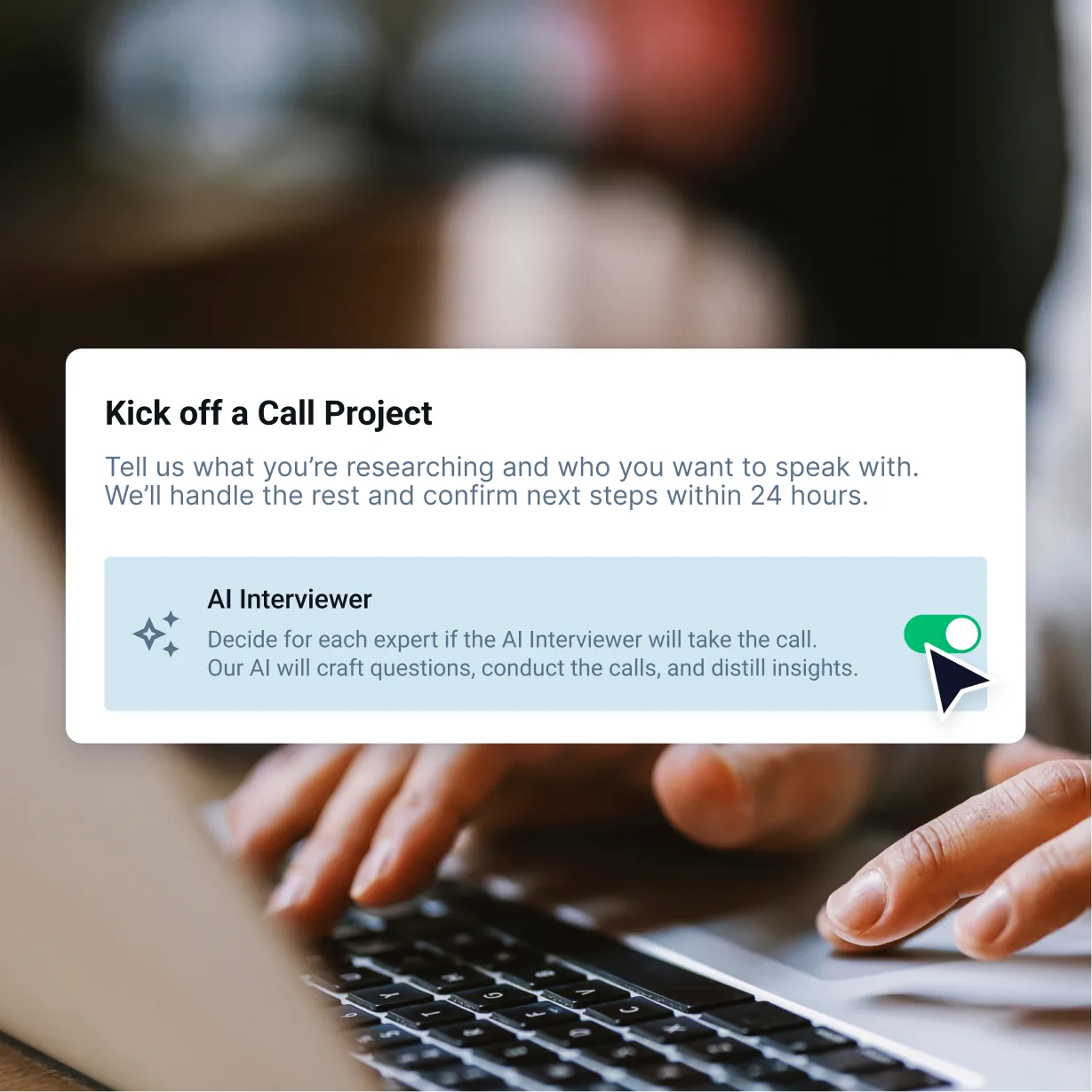
Tegus Expert Call Services publishes a transactional price. AlphaSense says calls can be human-led or conducted by its AI Interviewer, booked for 30, 45, or 60 minutes, and purchased pay as you go with no minimum commitment or through prepay packages that do not expire. The published price is the expert's rate—about $450 on average according to the vendor—plus a flat $75 transcription fee, billed for used time rounded up to the nearest 15 minutes.
That call price is not the AlphaSense subscription price. Ask whether platform access is required, which users can start projects, how prepaid balances are treated at renewal, what cancellations cost, and whether the transcript library, call portal, compliance tooling, or analysis features are separate entitlements.
The current portal exposes another permission edge: users without Call Projects in navigation must ask their AlphaSense account manager to confirm access. Users not approved for AI-led calls are routed to the human-led path. The AI-led FAQ requires compliance-officer confirmation before sourcing. It also says customers cannot join or live-prompt AI-led calls and scheduled duration can vary; confirm cost controls before commissioning one.
For AI-led and human-led calls, establish who owns the question guide, who selects the expert, and when the transcript becomes reusable. AlphaSense says AI-led call transcripts follow a standard library delay of 14 days for public-company targets and 90 days for private-company targets, with a paid delay option. Its published add-ons also include concierge service and translation. Those terms affect research exclusivity; capture them in the order form rather than assuming a private call remains private indefinitely.
An expert-side r/expertnetworks report from u/yourlicorceismine described substantial Tegus project volume but inconsistent screening requests and associate interactions after integration. That does not measure buyer results. It does justify sampling the operational lane: time to first qualified slate, screening-question quality, expert consent, reschedule rate, compliance turnaround, transcript delivery, and disputes.
What to put in the quote request
Ask sales to return one written matrix covering:
- Market Intelligence or Enterprise Intelligence, seat count, annual term, renewal uplift, and implementation fees.
- Exact broker, independent-research, news, financial-data, and Expert Transcript Library entitlements by user group.
- Internal-content connectors, permission mirroring, storage model, retention, download controls, and private-cloud or key-management options.
- Human-led and AI-led call access, average and maximum expected expert rates, the $75 transcription fee, rounding, cancellation terms, prepaid balance, and add-on prices.
- Transcript publication delays, pay-to-delay terms, audio access, sharing rights, and compliance approval workflow.
- Legacy Tegus migration: portal cutover, saved objects, transcripts, annotations, compliance records, integrations, and support owner.
Run the trial against one real research project and a frozen scorecard. Measure relevant-source recall, source access failures, citation correctness, reviewer time, export usability, and the number of bespoke calls still needed after searching the library. A polished generated answer is useful only when the decisive passage opens under the buyer's actual permissions.
Practical choice
- For a new buyer, contract with AlphaSense and specify the Tegus Expert Insights and call-service layers required. There is no honest independent-vendor winner.
- Choose Market Intelligence when external market content is the job; evaluate Enterprise Intelligence when internal content, connectors, enterprise support, or hosting controls are requirements.
- Add Expert Insights when full transcript inspection changes decisions, not merely when a demo can display expert-summary bullets.
- Add Tegus Expert Call Services when the library leaves a defined gap and the call economics beat another expert network or direct sourcing.
- For an existing Tegus customer, compare the legacy contract and portals with the consolidated AlphaSense offer before migrating.
Compare the wider category in the best AI research tools guide. See the AlphaSense profile for the parent platform and the Tegus profile for the expert-research layer.
For execution, use the source-grounded market research workflow to test citations and coverage, use the competitor-brief workflow for a dated rival decision, then use the competitor-monitoring guide when the job shifts from one-time diligence to recurring change detection.
Sources & further reading
- AlphaSense acquisition of Tegus closed
- AlphaSense current plans and pricing model
- Tegus Expert Insights inside AlphaSense
- Tegus Expert Transcript Library introduction
- Tegus Expert Call Services pricing and add-ons
- AlphaSense expert-call portal
- AlphaSense AI-led expert-call FAQ
- AlphaSense AI-led call publication delay
- AlphaSense document permissions
- AlphaSense sharing and privacy settings
- AlphaSense Smart Summaries entitlements
- AlphaSense and Tegus compliance portal transition
- Private-equity community discussion of AlphaSense value
- Private-equity community discussion of combined content
- Expert community discussion of Tegus sourcing


Ordered for comparison, not as a universal ranking. Inclusion requires a direct fit with this page's stated workflow.