Comparison
Aider vs OpenCode (2026)
Choose Aider for Git-first terminal pairing; choose OpenCode for configurable agents, granular permissions, and broader interface and provider options.
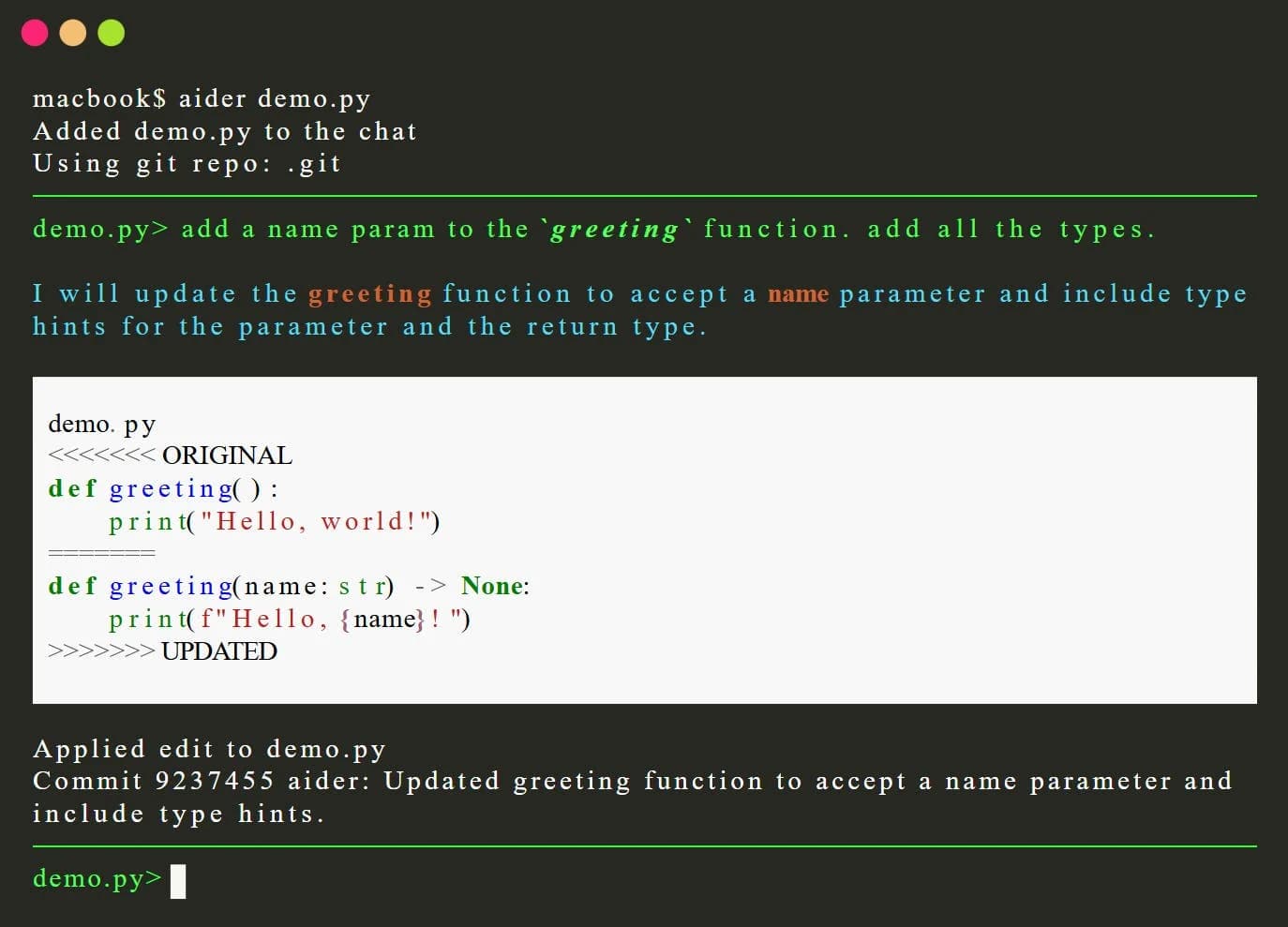
Choose Aider for an AI pair programmer inside an existing Git loop: select files, make one change, inspect the diff, keep a checkpoint. Choose OpenCode for an agent runtime with role-specific agents, subagents, tool policies, and several interfaces. Both are open source and model-flexible. OpenCode is the stronger configurable agent; Aider is the cleaner default for deliberate repository edits.
Aider vs OpenCode decision matrix
| Decision | Aider | OpenCode |
|---|---|---|
| Core workflow | Human-steered pair programming around files added to chat plus a repository map | Agent explores, edits, runs tools, and can delegate to configured subagents |
| Change recovery | Auto-commits AI edits by default; /diff and /undo make each turn easy to inspect or revert | Session snapshots power /undo and /redo; normal Git commits remain your workflow |
| Context control | Editable and read-only files, /drop, /clear, token reporting, and a repo map | Agent discovers context with search, reads, LSP, sessions, compaction, and references |
| Permissions | File selection and explicit commands shape the loop; no comparable path-and-tool policy engine | Ordered allow, ask, and deny rules for reads, edits, shell, web, MCP tools, subagents, and external directories |
| Automation | One-shot --message, --yes, lint/test commands, and an unofficial Python API | Custom agents, commands, skills, MCP tools, server API, and multiple clients |
| Interfaces | Terminal first; optional browser GUI and editor integrations | TUI, desktop app, IDE extension, and client/server API |
| Model access | Most hosted providers plus local and OpenAI-compatible models through LiteLLM | 75+ providers, local models, custom endpoints, OpenCode Zen, and OpenCode Go |
| Best fit | Focused edits, reviewable refactors, and developers who already live in Git | Longer exploratory tasks and teams willing to maintain agent and permission configuration |
The decisive difference is the control loop
Aider normally commits every AI edit, protects pre-existing dirty work with a separate commit, and lets you undo its last commit. Its repository map supplies symbols from the wider codebase while you keep the editable set narrow. Ask mode cannot edit; code mode can; architect mode separates design from edit generation.
That shape suits review-heavy maintenance. For a legacy refactor, add the target files, plan in ask mode, create characterization tests, then land bounded checkpoints. One sharp edge: Aider skips pre-commit hooks on automatic commits by default. Enable --git-commit-verify or run required checks before treating a commit as evidence.
OpenCode starts from a broader loop. Its Build agent can search, read, edit, run commands, ask questions, and call subagents. Plan and custom agents can use different models and permissions. That helps when work begins with “find the relevant implementation.” Model choice, roles, tools, compaction, and plugins can all change cost and behavior.
Permission boundaries are not equivalent
| Boundary | Aider | OpenCode |
|---|---|---|
| File writes | Files added as editable context are the clearest boundary; read-only context is separate | Match edit permissions by path, globally or per agent |
| Shell commands | /run, /test, and /lint are explicit workflow commands; --yes accepts confirmations for unattended scripts | Match shell commands with ordered allow, ask, or deny rules; block pushes while allowing status and diff |
| Outside project | File selection is not an operating-system sandbox | External-directory access needs a separate permission check |
| Network and extensions | /web fetches a supplied URL; model calls follow the selected provider | Web fetch/search, skills, subagents, and MCP tools each have policy actions |
| Default caution | Narrow workflow, but automatic commits skip hooks unless configured | V2 base policy allows most actions; external directories and .env reads ask. Shell still runs with host-user authority |
OpenCode wins policy expressiveness, not automatic safety. Its V2 docs warn that shell directory inference is best effort. Set shell to ask, allow read-only Git commands, and deny pushes and destructive commands. Treat Aider's --yes as automation, not a sandbox.
Model economics and limits
The clients themselves are free. The bill comes from the model route and context pattern.
Aider usually means bring your own API key or local model. It reports costs when metadata is known but does not enforce provider context limits. Architect mode makes at least two model calls; focused files and diff formats can reduce tokens. Quotas, retention, and overages come from the provider.
OpenCode can use provider keys or local models too. It also offers bundled routes. As checked September 30, 2026, OpenCode Go costs $10 monthly and Go Plus $40; included usage varies by model and is capped on rolling five-hour, weekly, and monthly meters. OpenCode Zen is pay as you go, offers workspace and member budgets, and may auto-reload credit unless disabled. Temporary free models are temporary, and Go can fall back to a Zen balance after limits only when that option is enabled.
Do not compare “requests” across models as equal. Price a representative week using accepted changes, cached input, retries, and review time. OpenCode can route exploration and reasoning separately; Aider can pair an architect with a cheaper editor.
What users report
Community evidence supports the workflow split, not a quality winner. Hacker News user gwd described OpenCode as more agentic while valuing Aider's explicit context control. That July 2025 report predates OpenCode's current permissions. In 2026, mihneadevries reported that Aider's --yes plus a Git loop worked well for headless changes followed by diff review. Neither report controls for repository, model, prompt, or version.
For a fair trial, give both tools the same bug, starting commit, model, acceptance tests, and spend ceiling. Use the unit-test workflow to reject agents that weaken assertions to make a patch pass.
Practical verdict
- Pick Aider for small-to-medium edits where explicit context, automatic Git checkpoints, and a tight human review loop matter most.
- Pick OpenCode for repository discovery, configurable roles, multiple surfaces, and permission rules that differ by agent or command.
- Pick neither by benchmark headline alone. The harness, edit format, provider, context, and policy configuration all affect the result.
Compare the wider market in the CLI coding-agent shortlist and AI coding-agent guide.
Sources & further reading
- Aider Git integration
- Aider repository map
- Aider chat modes
- Aider linting and testing
- Aider model connections
- Aider scripting
- OpenCode V2 permissions
- OpenCode agents
- OpenCode providers
- OpenCode TUI
- OpenCode Go pricing and limits
- OpenCode Zen pricing
- Hacker News Aider and OpenCode workflow comparison
- Hacker News Aider headless workflow report


Ordered for comparison, not as a universal ranking. Inclusion requires a direct fit with this page's stated workflow.