
Tool
Avoma
Revenue-focused meeting assistance combining transcription, structured notes, scheduling, coaching, CRM updates, and pipeline intelligence.
TL;DR
- Best for sales, customer success, and revenue operations teams.
- Combines meeting notes with scheduling, coaching, forecasting, and CRM work.
- Supports live transcription in more than 75 languages.
- Starts at $19 per recorder seat per month billed annually.
- Overkill for someone who only needs personal meeting memory.
Avoma makes sense when meetings are revenue events. It records and transcribes calls, then applies sales and customer-success structure: custom note templates, coaching, methodology fields, CRM updates, scheduling, and deal intelligence.
Decision snapshot
| Question | Answer |
|---|---|
| Primary buyer | Sales, customer success, and revenue operations teams |
| Language coverage | More than 75 languages |
| Starting paid price | $19 per recorder seat per month billed annually |
| Non-recording seats | Viewers and collaborators are free |
| Main trade-off | Too much system for ordinary personal notes |
What Avoma does well
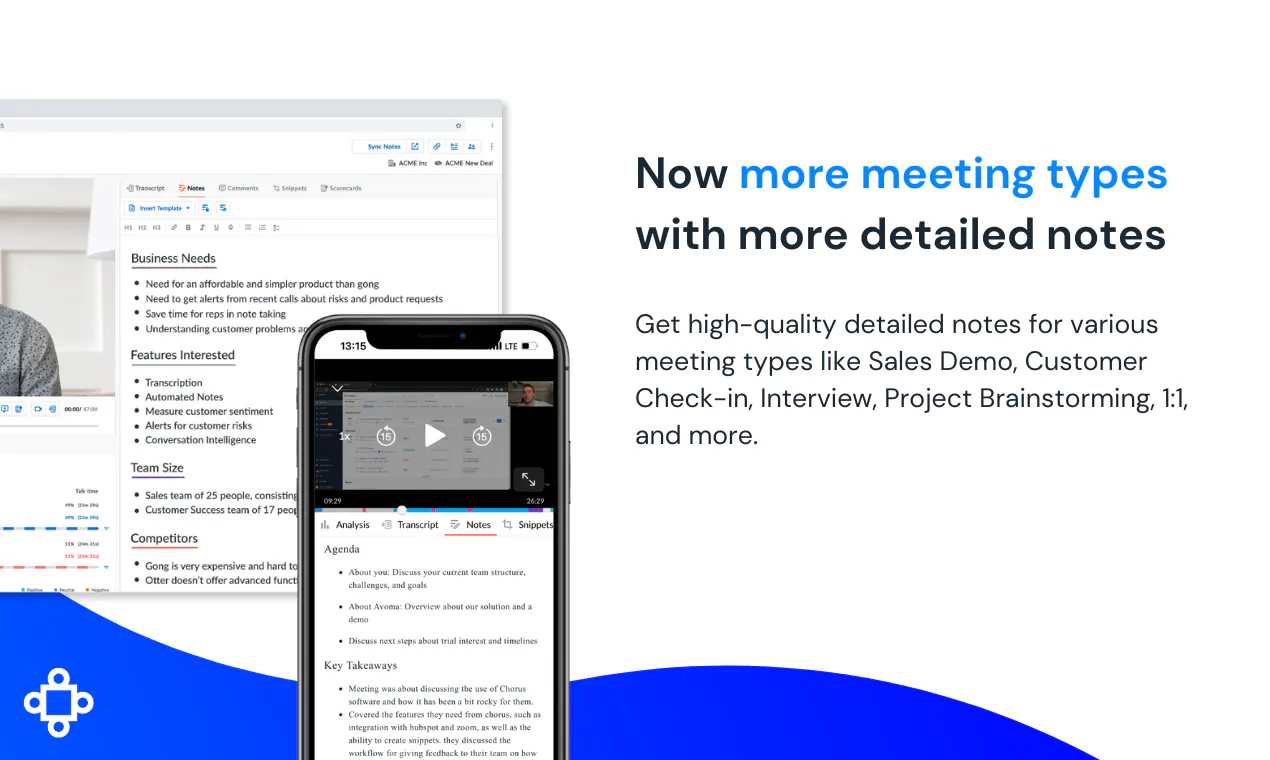
Generic summaries usually fail because a discovery call, customer escalation, interview, and product review do not need the same output. Avoma supports custom templates by meeting type, so the resulting note can match the team's workflow.
CRM automation is the second difference. Avoma can draft follow-up email, save notes to CRM records, and update structured fields for frameworks such as MEDDIC or SPICED. A verified field update saves more operational time than a polished paragraph nobody uses.
The recorder-seat model also limits rollout cost. Only people capturing meetings need paid seats; viewers and collaborators remain free.
Where it falls short
Avoma is not a lightweight consumer recorder. Scheduling, coaching, conversation intelligence, and revenue intelligence add configuration and administrative ownership. If no one owns CRM hygiene or coaching programs, much of the product will sit unused.
AI-generated methodology fields must remain suggestions until an accountable person confirms them. A model can misread hesitation, assign the wrong owner, or turn an inference into a fact.
What users report
Reddit user u/Pleasant-Photo-9933 highlighted the exact advantage: “Avoma lets you structure notes based on use case,” including sales, customer success, and product meetings. The same commenter argued that one fixed summary style creates reshaping work afterward.
That is a specific, testable claim. Build one template for your highest-volume call type and compare the cleanup time with a generic recorder.
Bottom line
Choose Avoma when notes must drive sales coaching, CRM data, and pipeline action. Choose Fathom, Granola, or Otter when the requirement ends at a reliable personal transcript and recap.
Sources & further reading


Appears in