
Tool
Kimi
General-purpose AI assistant for deep research, long-context analysis, documents, coding, and agentic knowledge work.
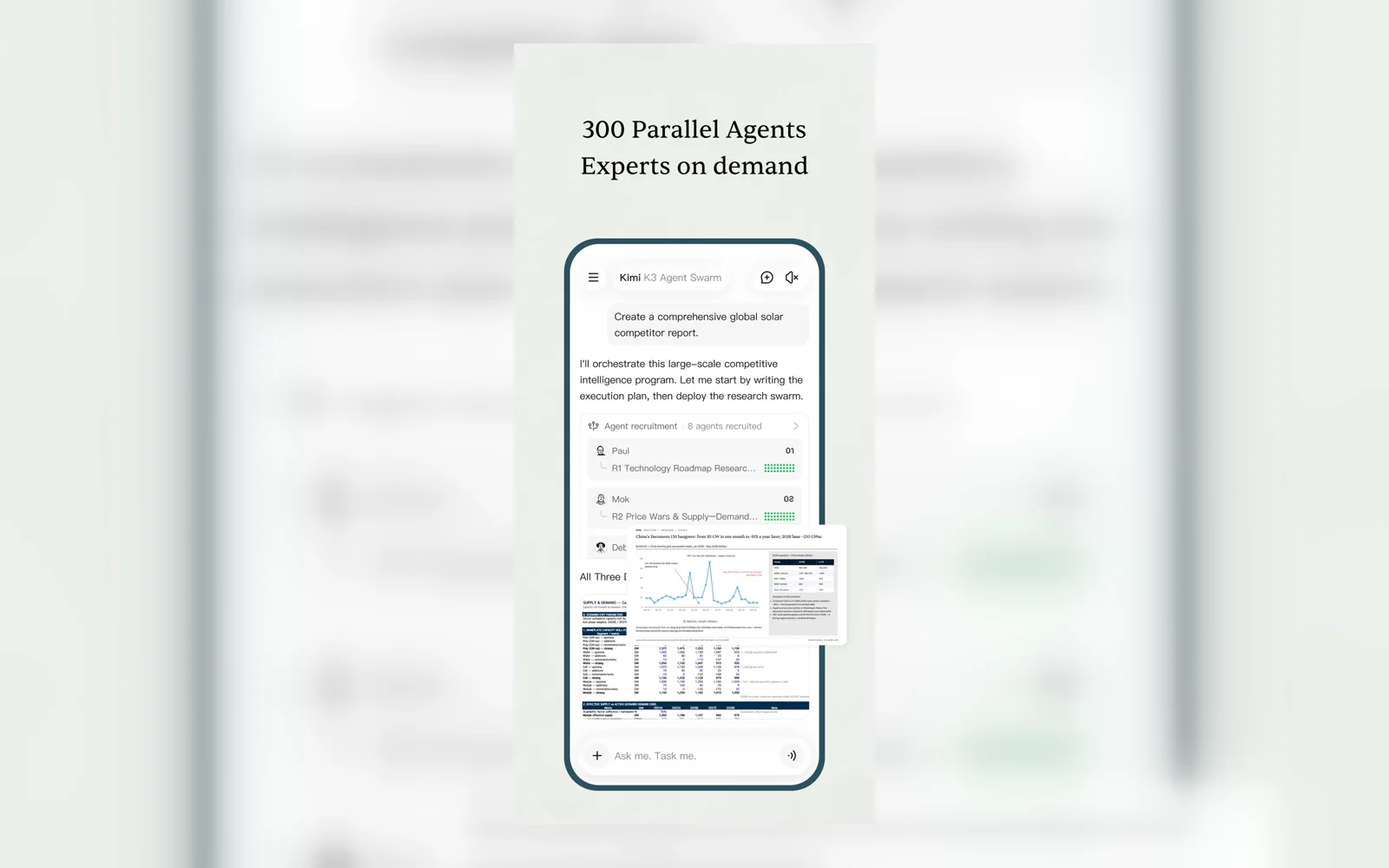
TL;DR
- Built for deep research, long documents, coding, and multi-step knowledge work.
- Supports web search, files, images, video, office documents, Python, memory, and agent tasks.
- Free credit-limited access; Andante starts at ¥49 per month.
- Kimi Work, Kimi Code, and the Kimi API are separate products and surfaces.
- Consumer conversations may be used for training unless the account opts out.
Kimi is Moonshot AI's general-purpose assistant for research and knowledge work. It can search and fetch the web, analyze long files and office documents, run Python, remember preferences, create presentations and spreadsheets, and carry multi-step tasks through its agent mode.
Decision snapshot
| Question | Answer |
|---|---|
| Primary interface | Web and mobile chat with agent workflows |
| Best use | Deep research, long-context analysis, documents, and structured project work |
| Starting paid price | ¥49 per month for Andante |
| Related products | Kimi Work desktop agent, Kimi Code, browser extension, and API |
| Main trade-off | Shared credit limits and mainland-China consumer data storage |
What Kimi does well
Kimi brings research and production work into the same conversation. Its built-in tools cover web and image search, direct URL fetching, Python analysis, memory, images, video, PDFs, and common office formats. Projects can retain instructions and reference files instead of forcing every chat to start from zero.
Long-context work is a clear focus. That is useful for comparing many sources, organizing large document sets, developing a specification, or maintaining continuity across a complex task. Paid plans add more shared credits and higher-capacity agent workflows.
Where it falls short
All membership features draw from one credit pool, so deep research, document generation, Kimi Code, and agent tasks compete for the same allowance. Free limits are not fully quantified publicly, and heavier work can make paid-plan capacity harder to predict from the headline price alone.
Kimi's own guidance says answer quality may decline in very long conversations and recommends periodic summaries or new sessions. Its consumer data policy also says de-identified conversations may be used for model training. Opt-out is account-wide, requires contacting support, and may take five to seven working days. Consumer data is stored in mainland China. The separate Kimi API states that API inputs and outputs are not used for training.
What users report
Product Hunt user @arlanrakh highlighted one of Kimi's recurring strengths:
“The long-context reasoning is genuinely impressive.”
The report came from using a Kimi model inside another product's routing layer, not from testing every feature in the consumer app. It supports the long-context claim but should not be treated as a complete Kimi product review. Read the Product Hunt report.
Bottom line
Choose Kimi when research depth, large working context, and document-heavy agent workflows matter more than simple chat. Check the shared-credit system and consumer data terms before moving sensitive or high-volume work into it.